So, what’s the deal with the honey scene in ‘Marty Supreme?’
A harrowing story of survival in Auschwitz has been misinterpreted by some viewers
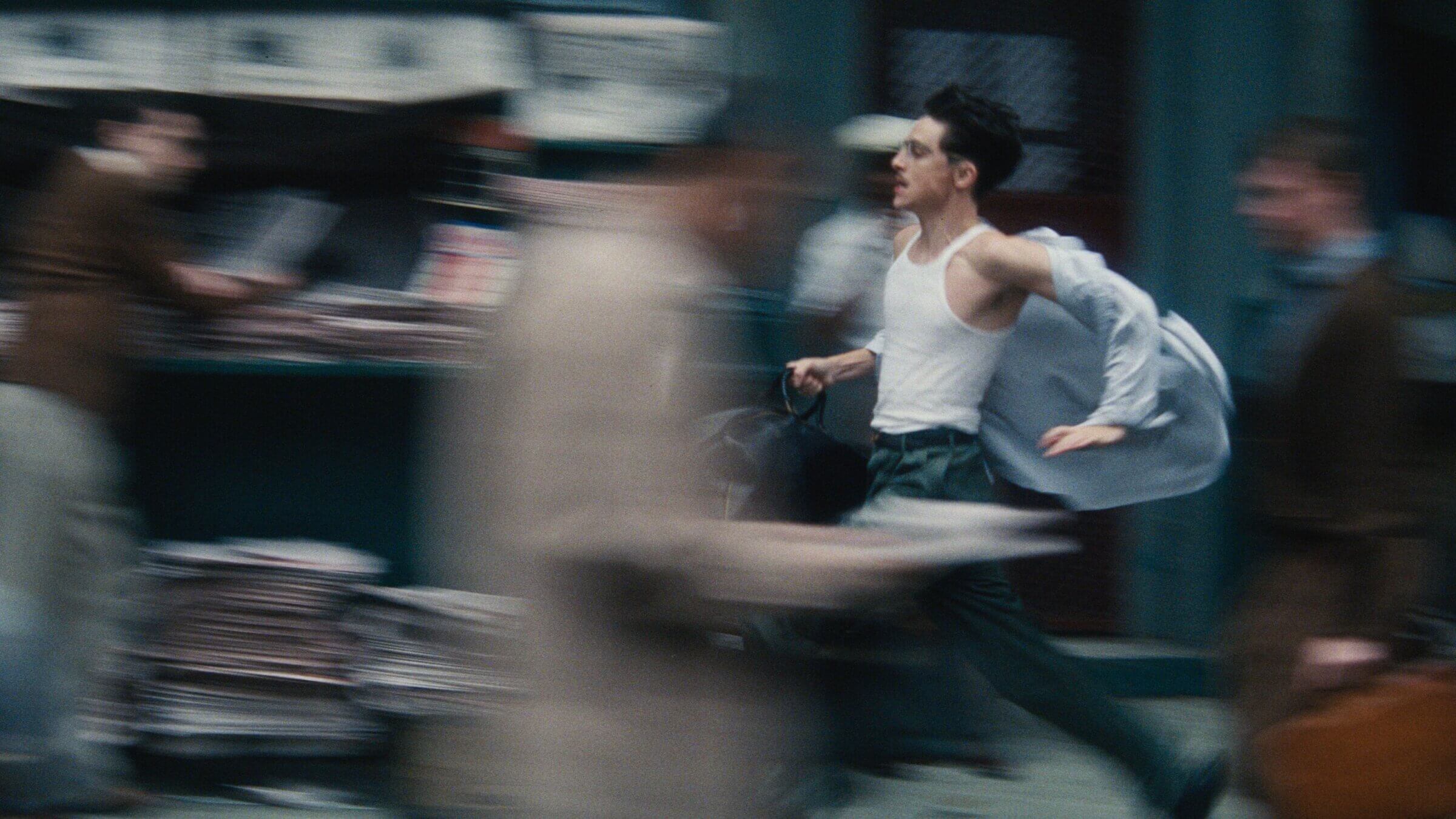
Timothée Chalamet plays Jewish ping-pong player Marty Mauser in Marty Supreme. Courtesy of A24

By Olivia Haynie December 29, 2025
There are a lot of jarring scenes in Marty Supreme, Josh Safdie’s movie about a young Jew in the 1950s willing to do anything to secure his spot in table tennis history. There’s the one where Marty (Timothée Chalamet) gets spanked with a ping-pong paddle; there’s the one where a gas station explodes. And the one where Marty, naked in a bathtub, falls through the floor of a cheap motel. But the one that everybody online seems to be talking about is a flashback of an Auschwitz story told by Marty’s friend and fellow ping-ponger Béla Kletzki (Géza Röhrig, best known for his role as a Sonderkommando in Son of Saul).
Kletzki tells the unsympathetic ink tycoon Milton Rockwell (Kevin O’Leary) about how the Nazis, impressed by his table tennis skills, spared his life and recruited him to disarm bombs. One day, while grappling with a bomb in the woods, Kletzki stumbled across a honeycomb. He smeared the honey across his body and returned to the camp, where he let his fellow prisoners lick it off his body. The scene is a sensory nightmare, primarily shot in close-ups of wet tongues licking sticky honey off Kletzki’s hairy body. For some, it was also … funny?
Many have reported that the scene has been triggering a lot of laughter in their theaters. My audience in Wilmington, North Carolina, certainly had a good chuckle — with the exception of my mother, who instantly started sobbing. I sat in stunned silence, unsure at first what to make of the sharp turn the film had suddenly taken. One post on X that got nearly 6,000 likes admonished Safdie for his “insane Holocaust joke.” Many users replied that the scene was in no way meant to be funny, with one even calling it “the most sincere scene in the whole movie.”
For me, the scene shows the sheer desperation of those in the concentration camps, as well as the self-sacrifice that was essential to survival. And yet many have interpreted it as merely shock humor.
Laughter could be understood as an inevitable reaction to discomfort and shock at a scene that feels so out of place in what has, up to that point, been a pretty comedic film. The story is sandwiched between Marty’s humorous attempts to embarrass Rockwell and seduce his wife. Viewers may have mistaken the scene as a joke since the film’s opening credits sequence of sperm swimming through fallopian tubes gives the impression you will be watching a comedy interspersed with some tense ping-pong playing.
The reaction could also be part of what some in the movie theater industry are calling the “laugh epidemic.” In The New York Times, Marie Solis explored the inappropriate laughter in movie theaters that seems to be increasingly common. The rise of meme culture and the dissolution of clear genres (Marty Supreme could be categorized as somewhere between drama and comedy), she writes, have primed audiences to laugh at moments that may not have been meant to be funny.
The audience’s inability to process the honey scene as sincere may also be a sign of a society that has become more disconnected from the traumas of the past. It would not be the first time that people, unable to comprehend the horrors of the Holocaust, have instead derided the tales of abuse as pure fiction. But Kletzki’s story is based on the real experiences of Alojzy Ehrlich, a ping-pong player imprisoned at Auschwitz. The scene is not supposed to be humorous trauma porn — Safdie has called it a “beautiful story” about the “camaraderie” found within the camps. It also serves as an important reminder of all that Marty is fighting for.
The events of the film take place only seven years after the Holocaust, and the macabre honey imagery encapsulates the dehumanization the Jews experienced. Marty is motivated not just by a desire to prove himself as an athlete and rise above what his uncle and mother expect of him, but above what the world expects of him as a Jew. His drive to reclaim Jewish pride is further underscored when he brings back a piece of an Egyptian pyramid to his mother, telling her, “We built this.”
Without understanding this background, the honey scene will come off as out of place and ridiculous. And the lengths Marty is willing to go to to make something of himself cannot be fully appreciated. The film’s description on the review-app Letterboxd says Marty Supreme is about one man who “goes to hell and back in pursuit of greatness.” But behind Marty is the story of a whole people who have gone through hell; they too are trying to find their way back.
This is a moment of great uncertainty. Here’s what you can do about it.
We hope you appreciated this article. Before you go, we’d like to ask you to please support the Forward’s independent Jewish news this Passover. All donations are being matched by the Forward Board - up to $100,000.
This is a moment of great uncertainty for the news media, for the Jewish people, and for our sacred democracy. It is a time of confusion and declining trust in public institutions. An era in which we need humans to report facts, conduct investigations that hold power to account, tell stories that matter and share honest discourse on all that divides us.
With no paywall or subscriptions, the Forward is entirely supported by readers like you. Every dollar you give this Passover is invested in the future of the Forward — and telling the American Jewish story fully and fairly.
The Forward doesn’t rely on funding from institutions like governments or your local Jewish federation. There are thousands of readers like you who give us $18 or $36 or $100 each month or year.
Support our mission to tell the Jewish story fully and fairly.