In a stylish mystery, Jodie Foster releases the dybbuk of French Jewish identity
‘A Private Life’ gets at the heart of a demon France has yet to fully exorcise
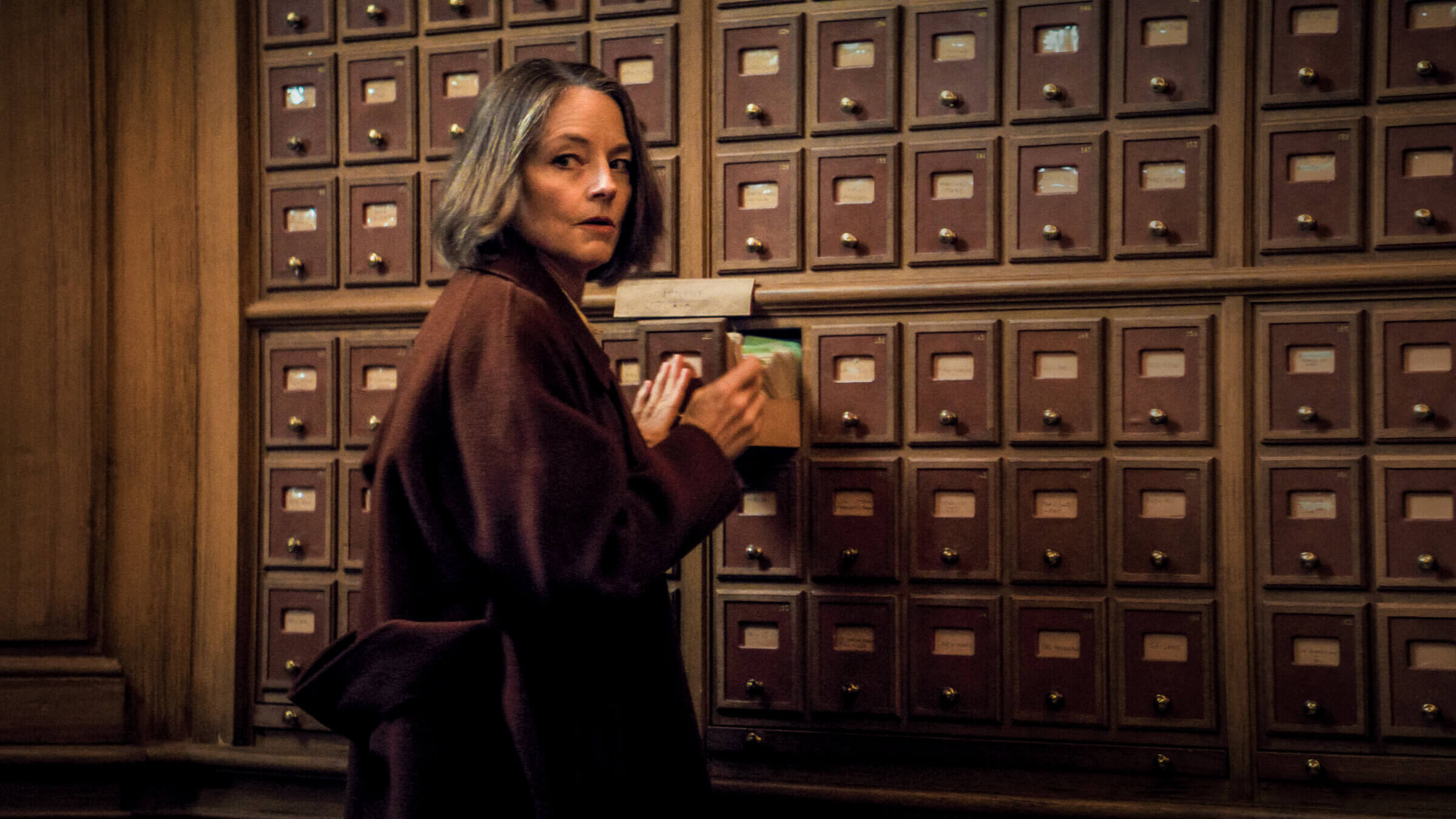
Jodie Foster in Rebecca Zlotowsky’s A Private Life. Photo by Sony Pictures

By PJ Grisar January 13, 2026
Dr. Lilian Steiner isn’t really listening.
Yes, she hears the thunderous strains of the Talking Heads’ “Psycho Killer” playing from an upstairs neighbor’s apartment above her psychiatry practice in a tony arrondissement of Paris. She is committed to recording the sessions on mini-discs for future reference, even if she has to bug her digital native son to buy replacements on Amazon. But when a patient dies from an apparent suicide, without any of the usual warning signs, she knows she’s missing something.
French director Rebecca Zlotowski’s A Private Life, a semi-dark comic mystery takes Lilian out of her routine. The film has the therapist, played by a captivating Jodie Foster, principalement en français, working to solve the case of her patient, a middle-aged German language teacher named Paula. When Paula’s daughter, Valérie (Luàna Bajrami), approaches Lilian with what she believes is a message, Lilian listens back to their sessions and begins to suspect foul play — i.e., murder. Soon she’s sleuthing around, and hooking up with her ex-husband Gaby (Daniel Auteuil).
Things take a turn for the sinister when Lilian shows up to pay her respects — later to be thrown out by Paula’s irate widower, Simon (Mathieu Amalric). Shortly after arriving, Lilian removes a sheet from a mirror, and a woman warns her that in doing so she will “awaken the dybbuk.”
The moment of cultural unawareness is telling if not entirely plausible. While Lilian is Jewish, and establishes her knowledge of the custom of burying a body quickly, she’s firmly secular. We see her slurping back an oyster and learn she didn’t circumcise her now-adult son, Julien (Vincent Lacoste). For whatever reason, she didn’t get the mirror memo. What she does detect, perhaps more acutely than most as an American expat, is antisemitism.
A hypnotist Lilian consults to fix her newly compulsive crying informs her that Freud stopped practicing hypnotism when he realized it was less “interesting” financially than the longer process of psychoanalysis. Lilian wastes no time dubbing this remark “borderline antisemitic.”
But their session produces a real breakthrough, linked to an infamous episode in the Holocaust. In a surreal sequence, Lilian sees herself in the body of a male cellist in 1942 Paris, witnessing a raid of a concert hall by the police in what can be assumed to be the Vel d’Hiv Roundup, the mass arrest and deportation of Paris’ Jews.
In the trance, Lilian sees Nazis in the house seats, a woman who looks exactly like Paula is playing next to her whispering something indistinct, Simon conducts, and her son Julien’s face is on the body of a militiaman — not a Nazi, she insists, but a French collaborator. Indeed, they were the ones who carried out the arrests. When Lilian returns to her tape of her hypnosis to reenter the scene, she finds more clues, including a postcard that takes her out of Paris for a stakeout. (Zlotowski co-wrote the film with author Anne Berest, whose autofictional book The Postcard uncovers her family’s story in the Holocaust.)
When Lilian brings this hypnotic vision up at Julien’s birthday dinner — noting his interest in German at school — he scoffs at the story and calls her paranoid. Gaby is shocked that Lilian, a woman of science, would suddenly buy into woo-woo notions of past lives. She really, truly, seems to believe her vision holds the key to Paula’s death, while her French-born family takes it all in stride.
Why, then, is history erupting in this modern story, a kind of continental arthouse spin on Netflix’s Murder Mystery franchise?
As motives are clarified and red herrings reveal themselves, the Pétain years Lilian glimpsed show themselves as very much alive in the present. A disgruntled patient draws a swastika by her office: “A very small one,” he says in his defense, “by the doorbell.”
Zlotowski took on the period just before Nazi occupation in her 2016 film Planetarium, a sort of roman à clef about persecuted Jewish French film producer Bernard Natan. In Private Life, as in her films Dear Prudence and Other People’s Children, Zlotowski masterfully sketches a French Jewish family and all its messy intersections in a society that privileges the principle of laïcité, the state religion of secularism. (I can’t account for her choice to have Paula’s family say kaddish over her dead body at their home before the funeral, but the rest feels right and an autopsy did delay burial.)
Long on style, with scarlet giftboxes and blood on white snow that reminded me of Resnais’ Stavisky and mirror shots that recalled Joseph Losey’s Monsieur Klein, the film has something elemental on its mind that seems inseparable from the Jewish question. It ponders how Jews may continue on in a culture that rejects them with some regularity, even as Lilian says at one point — and this holds mostly true of the cast of characters — “everyone here is Jewish.”
What Lilian picks up on is the “very small” swastika on the national fabric, a country still haunted by the Vichy regime. It’s a dybbuk that has yet to be exorcized, and like all dybbuks its business is unfinished.
This is a moment of great uncertainty. Here’s what you can do about it.
We hope you appreciated this article. Before you go, we’d like to ask you to please support the Forward’s independent Jewish news this Passover. All donations are being matched by the Forward Board - up to $100,000.
This is a moment of great uncertainty for the news media, for the Jewish people, and for our sacred democracy. It is a time of confusion and declining trust in public institutions. An era in which we need humans to report facts, conduct investigations that hold power to account, tell stories that matter and share honest discourse on all that divides us.
With no paywall or subscriptions, the Forward is entirely supported by readers like you. Every dollar you give this Passover is invested in the future of the Forward — and telling the American Jewish story fully and fairly.
The Forward doesn’t rely on funding from institutions like governments or your local Jewish federation. There are thousands of readers like you who give us $18 or $36 or $100 each month or year.
Support our mission to tell the Jewish story fully and fairly.