While sculpting Jesus, this Jewish artist wrestled with his demons
In ‘Jimmy & the Demons,’ James Grashow confronted mortality as he finished his last big project
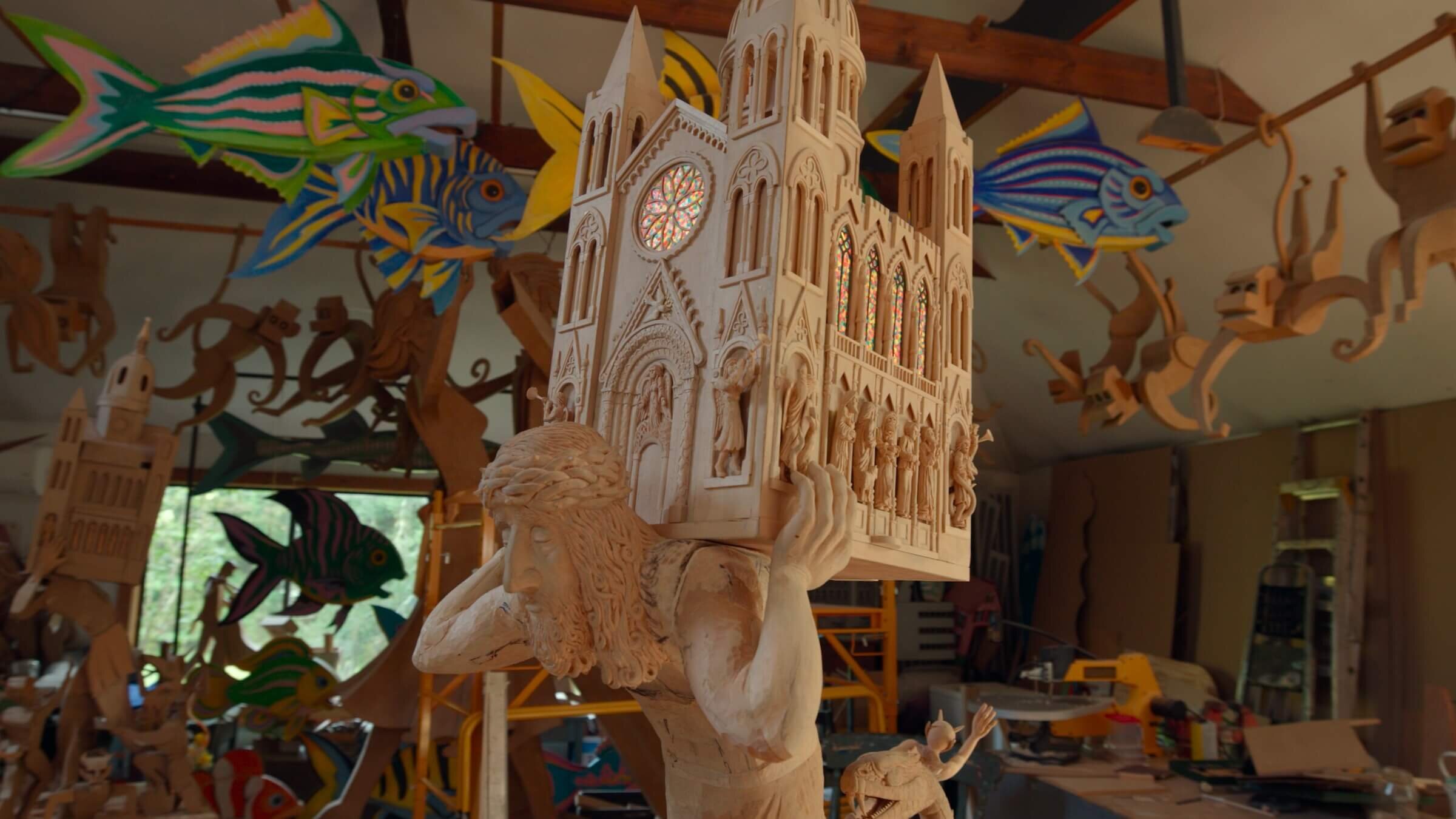
Grashow’s last big sculpture was a commissioned for Catholic art collector Michael Marocco. Photo by Scott Ruderman
By Olivia Haynie March 30, 2026
You may not know the name Jimmy Grashow, but it’s likely you’ve seen his work. His psychedelic drawings have been featured in The New York Times, Ms. and Playboy. He illustrated album covers for The Yardbirds and Jethro Tull. His cardboard sculptures of people, animals and buildings have been shown all over the country, including at MoMA, the Library of Congress, and the San Jose Museum of Art. Within the first 30 seconds of Jimmy & the Demons, a documentary about the artist directed by Cindy Meehl, I recognized his cardboard sculptures of a dancing couple; a version lives in the Cameron Art Museum in Wilmington in my home state of North Carolina.
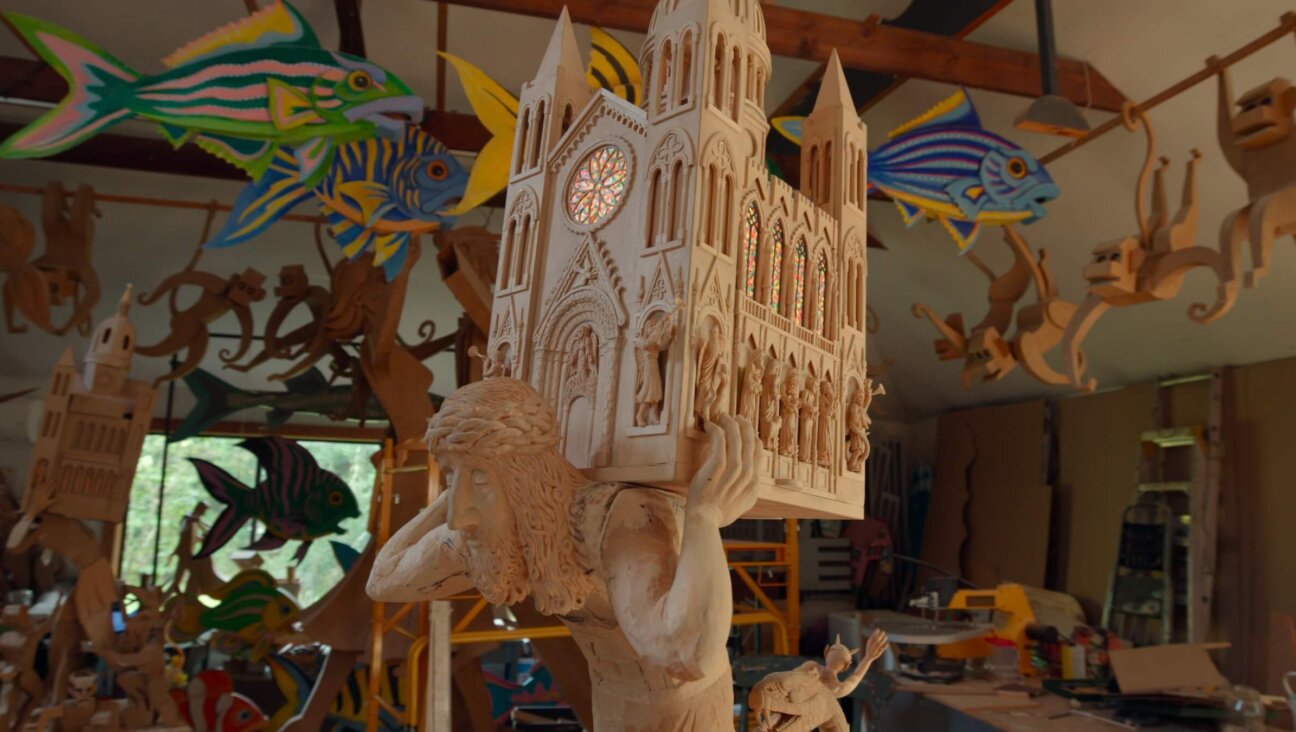
The documentary follows Grashow as he works on his latest commission: an eight-foot tall wooden sculpture of Jesus hoisting a cathedral on his back, while demons, each one completely different from the other, reach out of the flames around his feet. The cathedral’s intricate exterior is matched by an equally elaborate interior: A mural of Eden decorates the cathedral wall and a figure resembling the piece’s commissioner Michael Marocco, a Catholic art collector who has several Grashow pieces in his private sculpture garden, kneels in prayer. If you look closely at the mural, you can see God’s name written in Hebrew on a painted banner. The cathedral’s stained glass windows are illuminated by an electric bulb.
Grashow’s work is painstakingly detailed and took years to complete, as the slightest error in measurement or cut could have ruined the whole thing. While the documentary doesn’t last for years the way the project did, it follows a similarly leisurely pace, spending lots of moments in silence with Grashow in his home workshop in Redding, Connecticut. It’s a close look at the mostly solitary work of an artist, although viewers also get a few moments to meet Grashow’s family, including his daughter who is a rabbi.
-
-
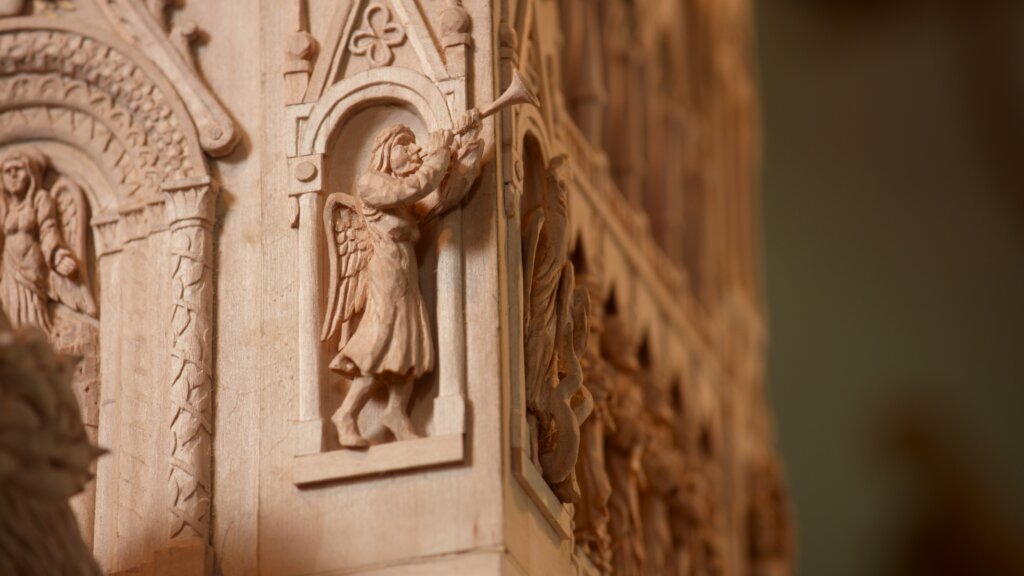
A trumpeting angel in one of the cathedral’s alcoves.
Photo by Scott Ruderman
-
-
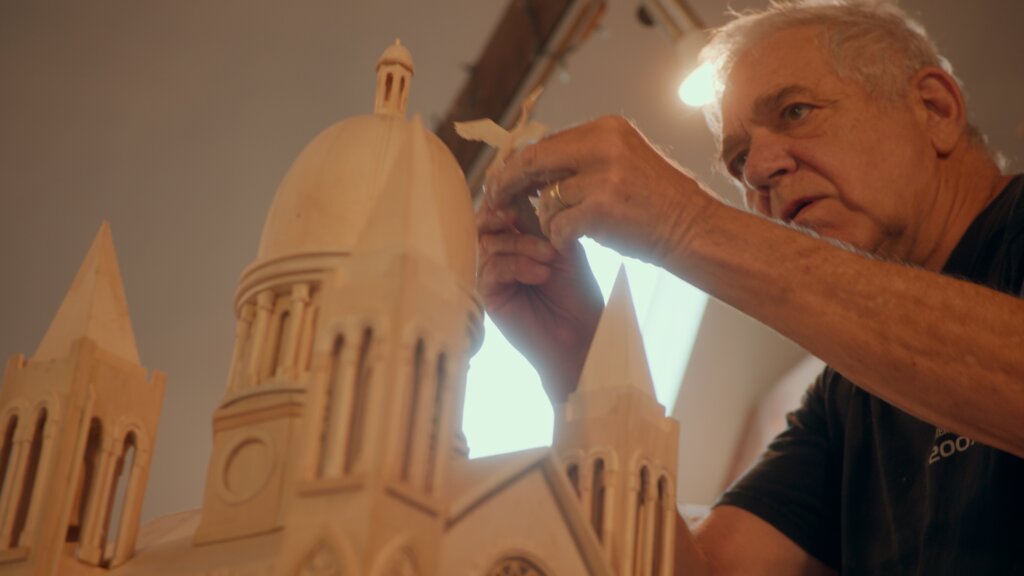
Grashow perched carved birds on the top of the cathedral.
Photo by Scott Ruderman
Meehl has profiled unconventional figures in her past documentaries, such as Buck, about horse whisperer Dan “Buck” Brannaman, and The Dog Doc, about holistic veterinarian Marty Goldstein. Grashow, who passed away in September 2025, three months after the film premiered at the Tribeca Film Festival, is no exception.
Despite his artistic talent, Grashow said that as a kid he “felt inadequate in every way.” Dyslexic and bad at math, Grashow struggled in his Brooklyn high school. At home, he felt overshadowed by his athletic brother and brilliant older sister. But he found a place to succeed at the Pratt Institute, where he studied woodworking, and received a Fulbright to study in Florence. There he fell in love with the cathedrals that would appear in many of his projects over the years.
Grashow did not view his sculpture of Christ as conflicting with his Jewish faith, noting the relationship between the word “Israel,” which means one who wrestles with God, and the meaning he saw in the piece.
“The world is full of peril and devils,” Grashow said. “And there you are trying to carry your faith and keep your faith alive. It’s a simple idea of trying to move forward in life with chaos and the possibility of chaos everywhere.”
“I’m wrestling all the time,” Grashow said. “It’s a brutal world.”
Grashow told the filmmakers that, when the idea for Marocco’s sculpture came to him, he “knew it was like a hineini moment,” using the term which means “here I am” and is also the name of a prayer traditionally chanted during the High Holidays, implying that one is showing up as their full self, with all of their flaws.
“It was God saying ‘Here’s this’ and it was up to me to say ‘Here I am. I’ll do it,’” Grashow said.
It was not a simple task. In addition to the years spent building the project, there was an emotional toll. Early in the film, Grashow says that the project feels like “the grand finale.” He asks that the filmmakers not share that information with his wife, Guzzy, although she later tells them herself that she feels Grashow’s time is running out.
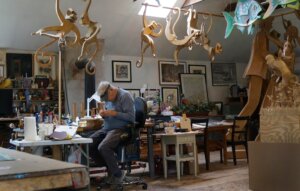
Later in the film, the Museum Contemporary Art in Westport, Connecticut offers Grashow a retrospective exhibit of his work, with the new piece at the center. Grashow’s musings about death imbue the project with a sense of urgency and the proposed exhibit title is fittingly Man, Mortality: A Retrospective. However, when the museum refuses to fully fund the show, Grashow and Guzzy are left scrambling for a way to showcase his life’s work.
As Grashow wrestles with his own corporality, his art is both an escape from and an expression of his worries.
“When I’m doing demons, I know that it’s a little boy playing,” he said. “And an old man being terribly afraid.”
Jimmy & the Demons opens in New York at the Quad Cinema on April 3, 2026.
This is a moment of great uncertainty. Here’s what you can do about it.
We hope you appreciated this article. Before you go, we’d like to ask you to please support the Forward’s independent Jewish news this Passover. All donations are being matched by the Forward Board - up to $100,000.
This is a moment of great uncertainty for the news media, for the Jewish people, and for our sacred democracy. It is a time of confusion and declining trust in public institutions. An era in which we need humans to report facts, conduct investigations that hold power to account, tell stories that matter and share honest discourse on all that divides us.
With no paywall or subscriptions, the Forward is entirely supported by readers like you. Every dollar you give this Passover is invested in the future of the Forward — and telling the American Jewish story fully and fairly.
The Forward doesn’t rely on funding from institutions like governments or your local Jewish federation. There are thousands of readers like you who give us $18 or $36 or $100 each month or year.
Support our mission to tell the Jewish story fully and fairly.