Could this be the most Jewish musical that never admits its own Jewishness?
A new production of ‘Oliver!’ featuring Simon Lipkin as Fagin brings back the sounds and rhythms of a Friday night dinner table
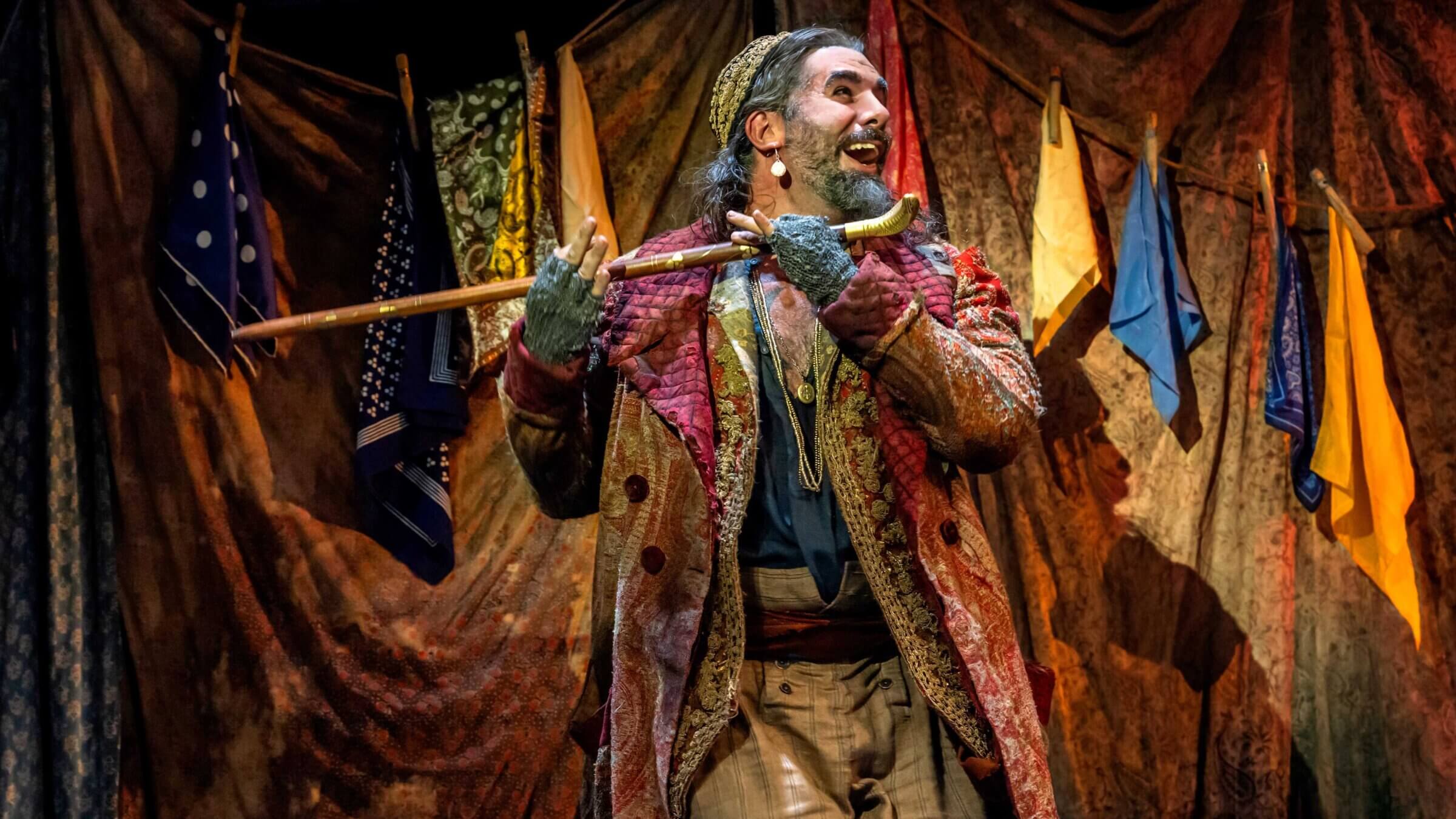
Simon Lipkin plays Fagin in the West End revival of ‘Oliver!’ Photo by Johan Persson
There’s a moment in the musical Oliver! when Fagin launches into one of Lionel Bart’s deliciously minor-key melodies, and suddenly the show feels about as Victorian as a hot pastrami on rye. Oliver! may be the most Jewish musical ever written that refuses to admit as much, and watching Simon Lipkin’s sly, buoyant portrayal of Fagin on London’s West End recently, I felt a jolt of something I hadn’t expected:
Home.
Not literal home, but the emotional topography of my family’s Friday night dinner tables where Holocaust survivors, former Yiddish theater actors and comedians filled the empty chairs left behind by Auschwitz itself. Improbably, Oliver! belonged to them too.
The musical’s West End revival underscores this. At a moment when antisemitism is still frighteningly on the rise, and theaters everywhere are re-examining the stories they tell and who gets to tell them, Oliver! has slipped into surprisingly contemporary territory. Matthew Bourne’s production doesn’t necessarily announce that it is a “Jewish” interpretation, but it acknowledges the show’s long, complicated history with a lighter touch and a sharper awareness. Watching Lipkin lean into the character’s humor and inherent Jewishness (“Oy, a broch!” he cries out emphatically at one point, beating his heart with his fist) but without the burden of caricature, I realized how the work has evolved — quietly, confidently — and how audiences have evolved along with it.
It’s impossible to miss the Jewish musical DNA in Bart’s score. The minor keys, the phrasing (“Such a sky you never did see!”), the cantorial wails that hold joy and heartbreak in the same breath: These were familiar to me long before I knew what to call them. Bart may have been writing about Victorian street urchins, but he couldn’t escape the musical instincts of his upbringing in London’s East End where he was born Lionel Begleiter. The melody of “Pick a Pocket or Two” could pass for a klezmer romp at a Hasidic wedding; “Reviewing the Situation,” sung by Fagin when he finds himself at a moral crossroads, is practically a cantor’s aria, ornamented with flourishes I’ve heard at countless High Holiday services.
There’s nothing explicitly Jewish in the script — no references or labels — yet many of the melodies feel instinctively Jewish in their rhythms and slyness. And that instinct carried me back to a question I’ve often considered since childhood:
How did Ron Moody, who originated this comic version of Fagin in 1960 and reimagined him for the 1968 film, manage to get away with it?
When I first saw Moody’s Fagin on screen, I was captivated by his portrayal. But I also didn’t understand how someone could play such a Jewish rogue at a time when Dickens’ caricature of “the Jew” still hovered uneasily in our cultural memory. Whenever I try to think of famous Jews on stage, the first two that pop into my head are villains: Shylock and Fagin. Shakespeare’s Merchant of Venice has been around forever, first published in 1600. But Oliver! debuted only 14 years after the Holocaust — the role should have been a minefield. Yet critics adored him, Jewish audiences embraced him, and Moody’s Fagin became beloved, not reviled.
Years later, when my friendship with Moody began — after he’d expressed interest in playing a villain opposite Carrie Fisher in a horror-comedy film I’d written — I was surprised by how different he was from the man onscreen. Soft-spoken and unmistakably British; nothing like the quicksilver trickster he was so skilled at portraying. He could summon that twinkle instantly, of course, but it wasn’t his resting state. He was in his early 60s then, newly delighted by late-in-life fatherhood, devoted to his younger wife Therese and their first child (whom he called “Boo-boo” with disarming tenderness). As more children arrived — he ultimately had six — I would tease him about assembling his own soccer team, which amused him to no end.
His Fagin, I came to realize, wasn’t a caricature but a cultural inheritance he carried lightly — a set of rhythms and comic cadences he understood from growing up as Ronald Moodnick in a warm Jewish household. And that was why the performance didn’t offend, and why it felt so familiar.
Though my mother lit the Sabbath candles and whispered the Hebrew blessing each Friday night, our dinners were less about religious ritual than about the rebuilding of a life she had salvaged from Auschwitz with nothing but willpower and the hope of joy still intact. In New York, she fashioned a new family out of survivors, actors from the Yiddish theater, and intellectuals whose humor carried both bruises and brilliance. These friends became surrogate aunts and uncles to my sister and me.
My mother was endlessly curious and had a gift for gathering people. She co-hosted a weekly language club with radio personality Barry Farber, a Southerner who startled me by speaking fluent, musical Yiddish. Occasionally he’d turn up at our Friday night table alongside an unlikely combination of guests, including my Bostonian Jewish piano teacher, a wryly funny family friend who once published an anarchist newspaper in Cuba until Castro forced him to flee, other European Holocaust survivors, and whichever schoolmates of mine my mother decided ought to be fed. The orbit was colorful and improbable, but it made sense. These were people who made her feel alive.
Some of our guests were well-known in the Yiddish arts — like Fyvush Finkel and his wife, Trudi; Broadway stage actors Muni Seroff and Irving Jacobson; Malvina Rappel, who had appeared in the classic Yiddish film Motel the Operator (Motl der Operator) and later hosted a radio program on WEVD back when it still broadcast in Yiddish.
Friday nights tended to unfold the same way: dinner first, then an impromptu cabaret. Someone sat down at the piano; someone else — usually my parents — burst into song or shtick. In an instant, our modest living room became a sort of vaudeville house. It was unself-conscious and exuberant, a weekly affirmation that even those who had lost everything could conjure laughter with astonishing force.
I didn’t know it then, but this was an education. Not in religion, but in rhythm. In timing. In the strange alchemy that binds sorrow to humor. Long before I ever wrote a script, I had already absorbed the comedic cadences that would shape my work.
As I grew older, that early immersion quietly charted the course of my career. Writing my book They’ll Never Put That on the Air brought me into long, generous conversations with some of the greatest architects of American television comedy — Carl Reiner, Larry Gelbart, Norman Lear, David Steinberg — artists whose work dismantled censorship and altered the medium. They offered insights I hear in my head to this day when I write.
In one of those unlikely, full-circle pinch-me moments, a few years ago I found myself directing Mel Brooks in the recording booth for Flower of the Dawn, an animated musical film I co-wrote and produced. Mel quickly corrected a joke of mine on the spot: “You’re cluttering the line with all this extra stuff at the end. End it here, with the punch!”
What stayed with me wasn’t just the correction; it was the realization that the comic instincts I’d carried since childhood had an architecture. Mel didn’t echo my family’s living room cabaret; he clarified what all that laughter had taught me.
So when I sat in the Gielgud Theatre watching Simon Lipkin give Fagin new life, it felt less like a reinterpretation than a recognition. Lipkin wasn’t parroting Moody — he was putting his own youthful spin on the role, while tapping into the same emotional and musical DNA: a blend of humor, vulnerability and those unmistakable minor-key inflections that carry an entire history inside them.
Not everyone in that audience heard what I heard. But I did. And for a moment, the distance between my family’s living room and a West End stage felt very small.
This is a moment of great uncertainty. Here’s what you can do about it.
We hope you appreciated this article. Before you go, we’d like to ask you to please support the Forward’s independent Jewish news this Passover. All donations are being matched by the Forward Board - up to $100,000.
This is a moment of great uncertainty for the news media, for the Jewish people, and for our sacred democracy. It is a time of confusion and declining trust in public institutions. An era in which we need humans to report facts, conduct investigations that hold power to account, tell stories that matter and share honest discourse on all that divides us.
With no paywall or subscriptions, the Forward is entirely supported by readers like you. Every dollar you give this Passover is invested in the future of the Forward — and telling the American Jewish story fully and fairly.
The Forward doesn’t rely on funding from institutions like governments or your local Jewish federation. There are thousands of readers like you who give us $18 or $36 or $100 each month or year.
Support our mission to tell the Jewish story fully and fairly.