4 Jewish things to know about Fran Drescher, leader of the Screen Actors’ Guild strike
Drescher, best known for her breakout role in ‘The Nanny,’ is helming the largest actors’ strike in decades
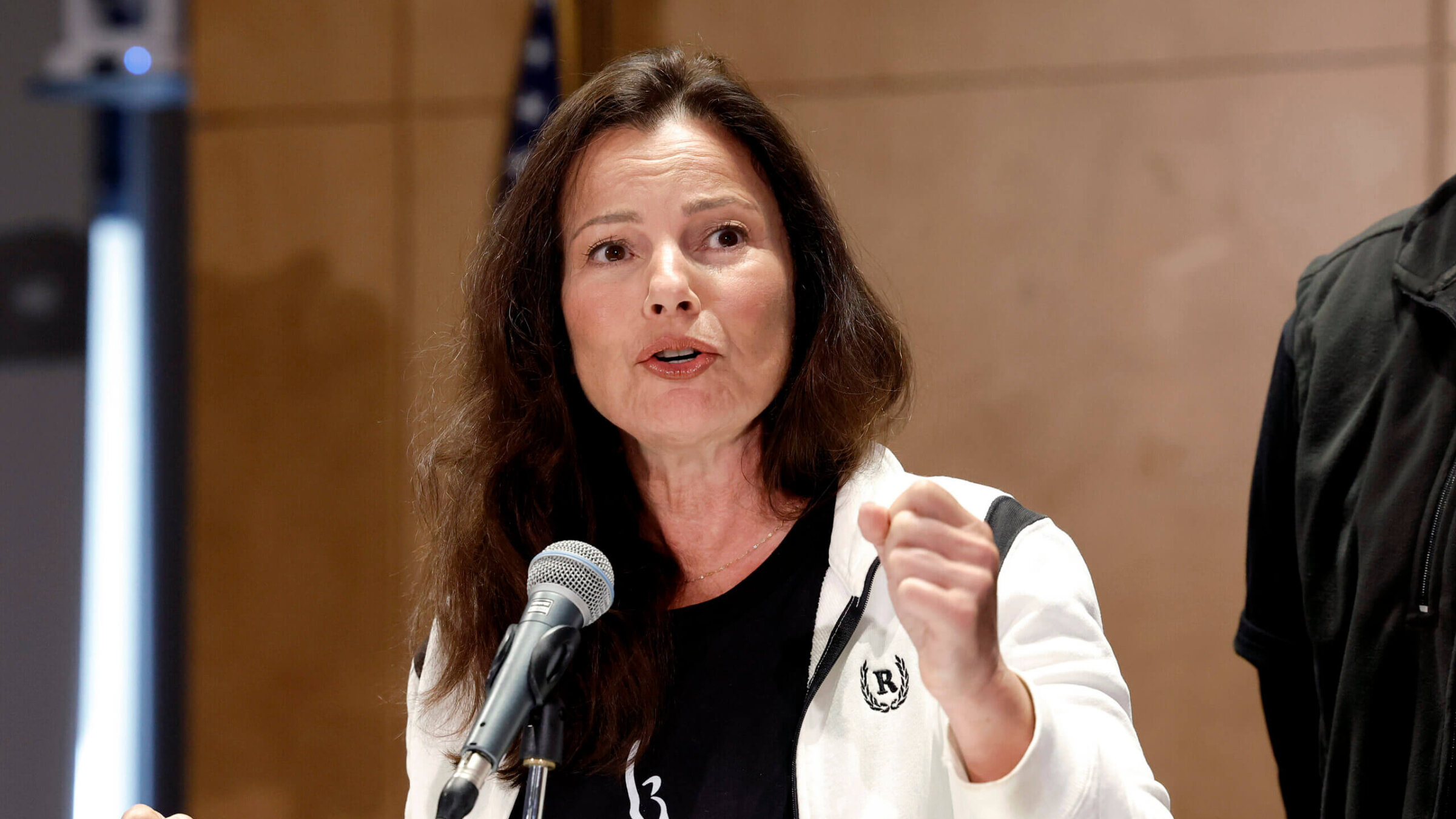
SAG President Fran Drescher announced an impending SAG-AFTRA strike on Thursday. Photo by Frazer Harrison/Getty Images

By Ella Goldblum and Talya ZaxJuly 13, 2023
With the Screen Actors’ Guild formally going on strike, union president Fran Drescher is back in the spotlight.
In the lead-up to the SAG-AFTRA strike, the actor and comedian was criticized by union members for attending recent Dolce & Gabbana festivities in Italy amid critical contract talks just last weekend. She also drew ire for perceived indecisiveness in May, when she told Deadline magazine she thought the possibility of a strike was a “very big, complicated conversation.” And she raised eyebrows last year for appearing to draw a parallel between vaccine mandates and fascism in a TikTok video.
With Drescher now the face of the most dramatic actors’ strike in decades, pressure on her is sure to intensify. Here are four things to know about the Jewish star’s history with organized labor — onscreen and off.
Drescher’s most famous character was pro-union
Drescher is best known for starring as Fran Fine in the 1990s sitcom The Nanny, which she created and produced with her ex-husband. Fine, whose backstory Drescher based on her own, was raised in a working-class Jewish family in Queens. In one of the show’s famous episodes, she refused to cross a picket line, primarily on the grounds that doing so would hurt her family of American-Jewish union members..
She’s making the SAG-AFTRA strike look very, very Jewish
Drescher announced SAG-AFTRA’s intention to strike in an impassioned speech Thursday that immediately had viewers comparing her to union heroes of the past — real and fictional. Vulture compared her to Norma Rae Webster, the fictional heroine of the 1979 film Norma Rae, written by Jewish screenwriters Harriet Frank Jr. and Irving Ravetch. One Twitter user drew a link between her and Clara Lemlich, the pioneering Jewish labor activist who led the 1910 garment workers’ strike. And Drescher peppered her Thursday speech with Yiddishisms, saying the major Hollywood studios at the table have acted like what her “mother called a leck and a schmeck.”
She’s interested in a more political contemporary Nanny reboot
Speaking to TV Insider in January, Drescher mused over what a reboot of her trademark show might look like in 2023, 30 years after it premiered. Fran Fine, she said, “was hellbent on getting married,” but in the 2020s, she’d envision Fine carving her “own independent path” and expressing herself “separately and apart” from a husband and children.
She would also focus on the character’s “politics” — a natural extension of Fine’s grounding in Drescher’s own life. “If I didn’t have that instinct to challenge authority and keep looking for something that makes more sense to me,” she told Vanity Fair in 2022, “I’d probably not be alive today.”
She’s supported labor-friendly and ‘revolutionary’ politics
In 2016, Drescher criticized Bernie Sanders for what she deemed his shift toward the center as a Democratic party candidate: “You don’t run as a Democrat if you’re really revolutionary,” she told Jezebel. And in 2020, she appeared to endorse the idea of a general strike on Twitter, writing “When profit is at the expence [sic] of all things of true value, we gotta problem.”
This is a moment of great uncertainty. Here’s what you can do about it.
We hope you appreciated this article. Before you go, we’d like to ask you to please support the Forward’s independent Jewish news this Passover. All donations are being matched by the Forward Board - up to $100,000.
This is a moment of great uncertainty for the news media, for the Jewish people, and for our sacred democracy. It is a time of confusion and declining trust in public institutions. An era in which we need humans to report facts, conduct investigations that hold power to account, tell stories that matter and share honest discourse on all that divides us.
With no paywall or subscriptions, the Forward is entirely supported by readers like you. Every dollar you give this Passover is invested in the future of the Forward — and telling the American Jewish story fully and fairly.
The Forward doesn’t rely on funding from institutions like governments or your local Jewish federation. There are thousands of readers like you who give us $18 or $36 or $100 each month or year.
Support our mission to tell the Jewish story fully and fairly.