NYC synagogue protest bill tasks police with developing a protection plan. Mamdani still hasn’t committed to sign
Amended to head off legal challenges, the City Council measure would let protesters be heard near houses of worship but allow arrest for crossing NYPD lines
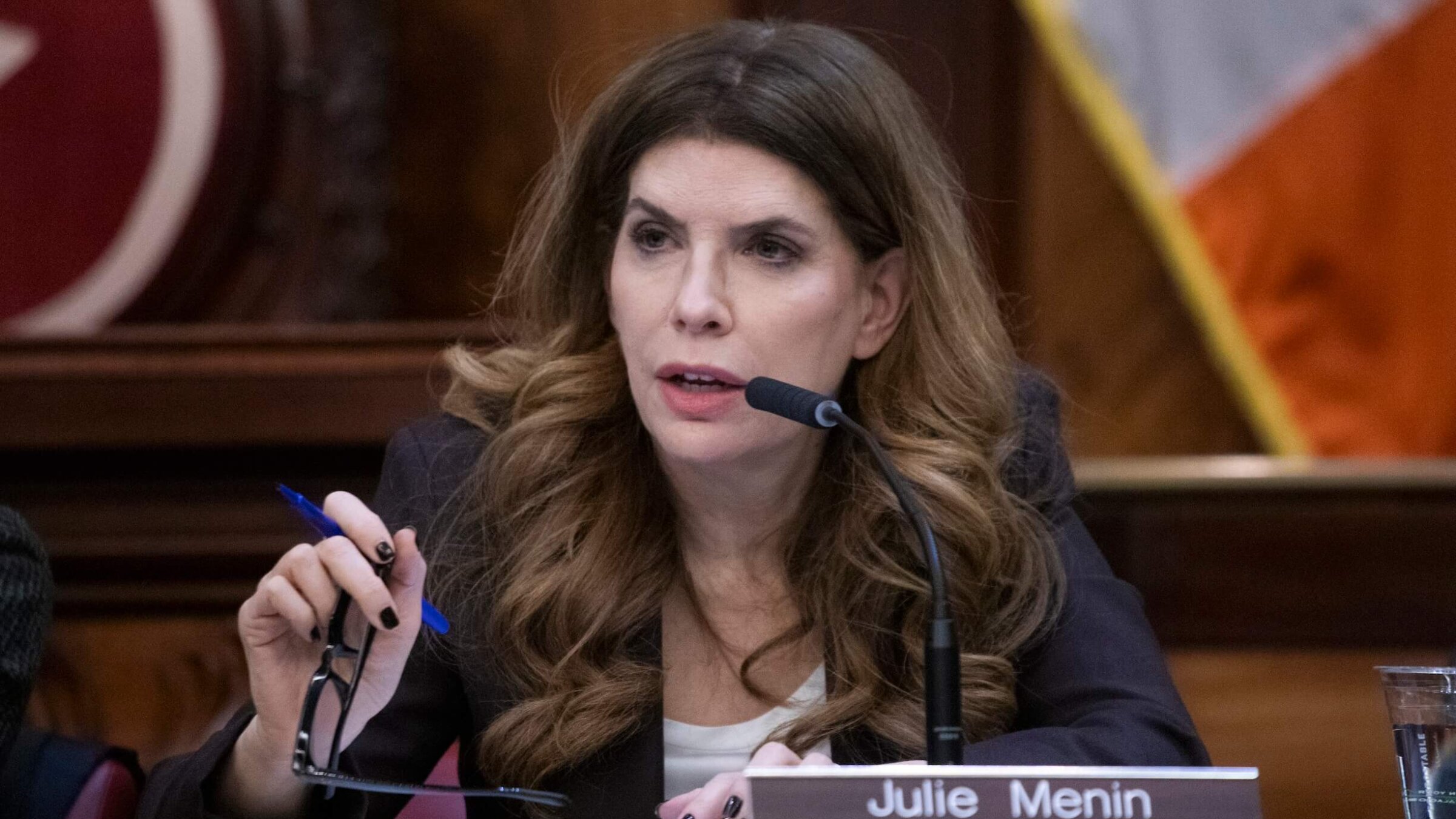
New York City Council Speaker Julie Menin on Feb. 25. Photo by John McCarten/NYC Council Media Unit

By Jacob Kornbluh February 25, 2026
The New York City Council has ditched a proposal for a strict up to 100-foot buffer zone for protests outside houses of worship and instead aims to direct the NYPD to develop a plan outlining how it would protect congregants from constitutionally protected protests.
The changes come in the face of reservations from Mayor Zohran Mamdani as well as civil liberties groups that have raised concerns that the measure could limit First Amendment rights.
Michael Gerber, the police department’s deputy commissioner for legal affairs, told council members Wednesday that the NYPD will craft a framework that carefully weighs constitutional considerations, balancing public safety with free speech rights and establishing clear procedures for managing protests.
The bill, introduced by Council Speaker Julie Menin, follows disruptive demonstrations at synagogues that targeted events promoting land sales in Israel and settlements and featured antisemitic slogans and chants. It initially proposed creating a perimeter of up to 100 feet to ensure access to services and events without harassment or being blocked at the door.
It is part of the Council speaker’s five-point plan to combat antisemitism, in conjunction with a new task force she appointed, as anti-Jewish incidents continue to account for a majority of reported hate crimes in New York City. In recent months, at least two protests outside synagogues featured antisemitic slogans and chants, heightening tensions and drawing condemnation. Last month, a person rammed a car into an entrance of the Chabad-Lubavitch world headquarters in Brooklyn.
Police Commissioner Jessica Tisch, who, like Menin, is Jewish, reportedly cautioned that a one-size-fits-all rule might not withstand legal challenge and could prove unworkable across neighborhoods with vastly different street layouts. Mamdani said he ordered his law department and police leadership to review the proposal’s legality. On his first day in office, Mamdani revoked an executive order issued by former Mayor Eric Adams in December that called on Tisch to evaluate proposals for establishing a buffer zone of at least 15 feet outside houses of worship.
Mamdani cited Tisch’s concerns in an interview with CNN earlier this week when asked for his position on the bill.
However, after internal discussions, the Council agreed to revise the language of the bill, placing implementation authority squarely with the police department rather than codifying a specific distance requirement.
Free speech protections
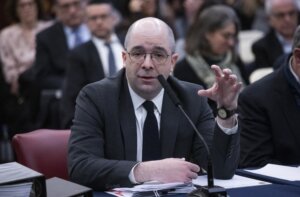
At a hearing by the newly created Committee to Combat Hate, Gerber, one of Tisch’s Jewish deputies, said the NYPD supports the legislation — describing the buffer as a “frozen zone.” — and is committed to transparency. The department will ensure protesters retain “sight and sound to the entrance of that location consistent with the First Amendment,” he said, referencing the right to peacefully protest. “At the same time, the protesters will not be permitted to obstruct, impede or interfere.” He added that demonstrators who enter frozen zones could be subject to arrest.
In response to questioning from Councilmember Shahana Hanif of Brooklyn, an Israel critic, Gerber said that anti-Zionist and antisemitic slogans, “with some extremely narrow exceptions,” will be safeguarded. He pointed to the 1977 neo-Nazi march in Skokie, Illinois, which the court said was protected speech.
Mainstream Jewish groups that testified, including the Anti-Defamation League, the UJA-Federation of New York and the Jewish Community Relations Council, said they back the bill. At a rally held inside City Hall Wednesday morning, two Muslim imams and a Catholic clergyman also voiced their support.
The progressive group Jews For Racial & Economic Justice, which endorsed Mamdani through its affiliated political arm, and other groups supportive of the Palestinian cause, are lobbying Council members to oppose the bill. Mamdani, at an unrelated press conference, said the amended bill is a “distinct shift” from the original proposal but declined to commit to signing it until he sees its “final version.” A City Hall spokesperson referred back to the mayor’s comments when asked by the Forward whether the new language addressed his concerns.
At the hearing, Menin addressed what she described as “misconceptions” about the measure. “The First Amendment freedom of speech is truly sacrosanct, and it is a freedom that these bills will uphold,” Menin said. “What we will not allow people to do is abuse that freedom to harass and intimidate others outside religious and educational institutions.”
The council speaker said the November 19, 2025 demonstration outside Manhattan’s Park East Synagogue, which hosted an event promoting migration to Israel, “was not a peaceful protest.”
The legislation is “absolutely needed,” Menin said, to ensure that such demonstrations never happen again. “We can’t brush that under the rug,” she said. “I think any suggestion that the bills aren’t needed is just minimizing what the impact has been to the Jewish community.”
Gov. Kathy Hochul recently introduced similar legislation, which would create a 25-foot buffer zone around houses of worship across New York State.
This is a moment of great uncertainty. Here’s what you can do about it.
We hope you appreciated this article. Before you go, we’d like to ask you to please support the Forward’s independent Jewish news this Passover. All donations are being matched by the Forward Board - up to $100,000.
This is a moment of great uncertainty for the news media, for the Jewish people, and for our sacred democracy. It is a time of confusion and declining trust in public institutions. An era in which we need humans to report facts, conduct investigations that hold power to account, tell stories that matter and share honest discourse on all that divides us.
With no paywall or subscriptions, the Forward is entirely supported by readers like you. Every dollar you give this Passover is invested in the future of the Forward — and telling the American Jewish story fully and fairly.
The Forward doesn’t rely on funding from institutions like governments or your local Jewish federation. There are thousands of readers like you who give us $18 or $36 or $100 each month or year.
Support our mission to tell the Jewish story fully and fairly.