Pulitzer Prize awarded to Palestinian photographer who captured ‘devastation and starvation in Gaza’
Saher Alghorra was honored for work that appeared in The New York Times
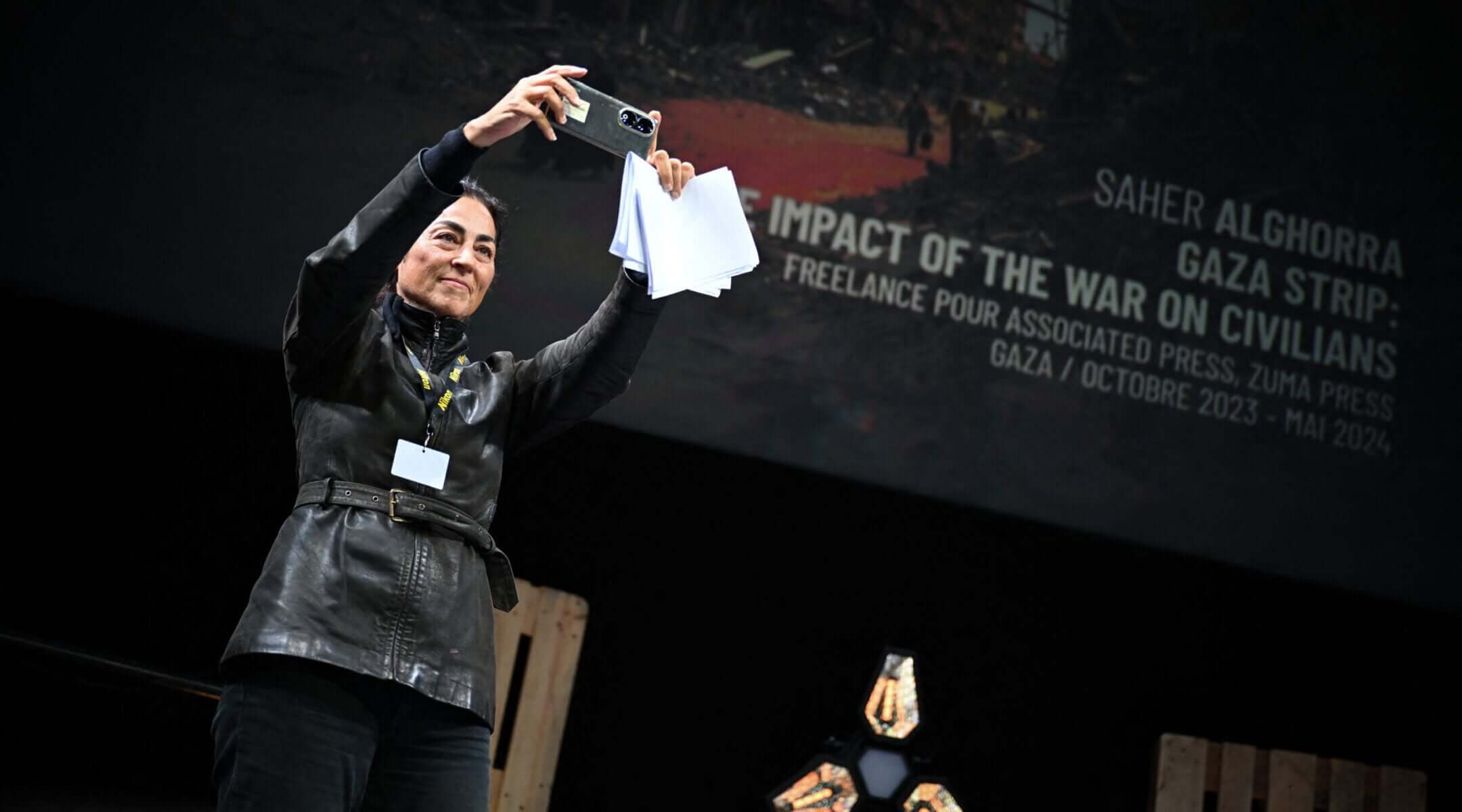
A representative of the Palestinian photographer Saher Alghorra takes a picture as Alghorra receives the ‘Young Reporter Trophy’ during the 2024 Prix Bayeux Calvados-Normandie in France, Oct. 12, 2024. Photo by Lou Benoist/AFP via Getty Photos
(JTA) — A New York Times photographer working in Gaza was awarded the 2025 Pulitzer Prize for photography for pictures taken during the war with Israel there.
The prize committee said it was honoring Saher Alghorra “for his haunting, sensitive series showing the devastation and starvation in Gaza resulting from the war with Israel.”
One of Alghorra’s front-page pictures, published in July 2025, showed an emaciated boy being cradled by his mother, becoming a symbol of the hunger crisis in the territory — and a target of criticism by those, including the Israeli government, who rejected the claim that Gaza Palestinians were starving because of the Israeli military campaign.
The New York Times subsequently altered the story to note that the boy suffered from a medical issue that inhibited muscle development and removed a quote from his mother saying that he had been healthy before the war began on Oct. 7, 2023. But it did not back away from the story’s other claims about starvation in Gaza.
The photographs for which Alghorra was recognized include snapshots of Gazans queuing for food, bringing wounded children for medical care and marking Ramadan inside bombed buildings. They also include a picture of a different emaciated child who became a face of the hunger crisis without attracting the same specific criticism.
Israeli officials acknowledged areas with food scarcity in Gaza last year but denied that a blockade on aid entering the territory was causing a mass crisis, saying instead that Hamas was preventing aid from reaching Palestinian civilians. But after President Donald Trump said images from the enclave had convinced him that there was “real starvation,” Israel and the United States worked together in an attempt to improve aid distribution.
Alghorra, 28, did not immediately comment online on the Pulitzer, but he wrote on Instagram after winning a different prize last month for a similar set of images, the World Press Photo Award, about what it meant to have his work recognized.
“My heart is heavy with what I have witnessed — and what I was compelled to photograph: lives lost, lives shattered, displacement, hunger, total destruction, and relentless suffering,” he wrote. “Each image in this series carries the weight of what we have lived through. The images—and the screams—are engraved in me.”
Palestinian American author Hala Alyan’s book I’ll Tell You When I’m Home: A Memoir, which interweaves Alyan’s story of infertility with her family’s story of displacement, was a finalist in the memoir and autobiography category.
Several Jewish authors were honored in the prizes, announced Monday afternoon, though none for storytelling about Israel. M Gessen won for opinion writing in The New York Times about rising authoritarianism in the United States, while Bess Wohl won in the drama category for “Liberation,” a play about the 1970s women’s liberation movement that includes a prominent Jewish character.
This article originally appeared on JTA.org.

Hello, fellow Forward reader! I’m Joel Brown, a Forward reader and supporter for more than 15 years, and currently the chair of the board of directors.
I’m an avid Forward reader because it ticks so many of my essential boxes: excellent journalism, Jewish focus and diverse viewpoints. In today’s political climate, what I most appreciate is the Forward’s independence — made possible by the generosity of its membership.
The Forward is committed to bringing you unbiased, nuanced Jewish news. From my position as board chair, I see an exciting future as we expand our position as the definitive independent voice of contemporary American Judaism.
That’s why I’m paying it Forward, by matching $36,000 of reader gifts. It’s an investment in the Forward’s newsroom, to continue telling the American Jewish story with truth and independence.
— Joel Brown, Forward board chair
Support our mission to tell the Jewish story fully and fairly.