ADL says antisemitic incidents dropped by a third in 2025, but assaults reached record levels
In 2025, three people were killed in antisemitic attacks, the first such deaths since 2019
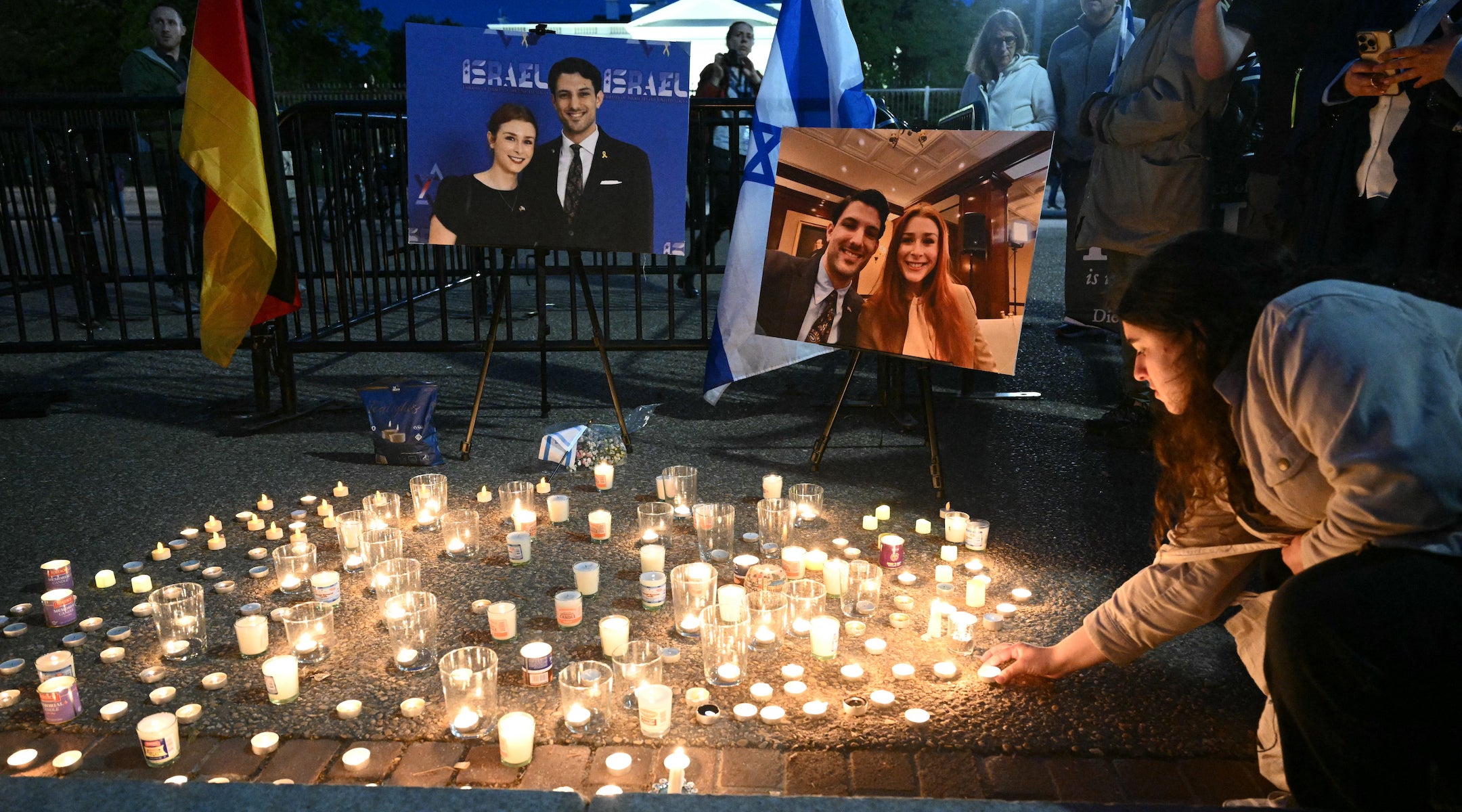
People attend a candlelight vigil at Lafayette Square across from the White House in Washington, DC on May 22, 2025, following a shooting that left two Israeli embassy staffers dead. Photo by Mandel NGAN / AFP
(JTA) — Antisemitic incidents in the United States fell sharply in 2025 from record highs in the previous two years, but physical assaults, including deadly attacks, continued to rise, according to the Anti-Defamation League’s annual audit.
In 2025, the ADL recorded 6,274 antisemitic incidents across the country, marking a 33% decrease compared to 2024, when it recorded 9,354 incidents. (Antisemitic incidents increased by 5% from 2023 to 2024.)
Still, 2025 marked the third-highest year for antisemitic incidents since the ADL began tracking them in 1979 — after 2023 and 2024.
And incidents of assault involving a deadly weapon, which included the firebombing of Pennsylvania Gov. Josh Shapiro’s residence, increased by 39%, from 23 in 2024 to 32 last year.
“Our 2025 Audit, which shows it was one of the most violent years for American Jews on record, is a reminder of how dramatically the threat landscape has shifted. Numbers that would have shocked us five years ago are now our floor,” Jonathan Greenblatt, the ADL’s CEO and national director, said in a statement. “People are being murdered because of antisemitism on American soil, and thousands more are threatened. ADL will not stop until that baseline changes.”
While antisemitic harassment and vandalism both declined from 2024 levels, from 6,552 to 4,003 incidents of harassment and 2,606 to 2,068 cases of vandalism, the ADL’s report found that incidents of assault rose from 196 to 203, a 4% increase from 2024 to 2025. At least 300 victims were targeted by incidents of assault, according to the report.
Last year also saw the first time since 2019 that murders were recorded in antisemitic attacks, including two Israeli embassy staffers shot to death outside the Capital Jewish Museum last May and another victim who died of injuries sustained during the June firebombing attack at a Boulder, Colorado, demonstration for Israeli hostages.
“Behind every one of these incidents is a real person: a family threatened at their synagogue, a rabbi attacked on the street, a student harassed on campus,” Oren Segal, the ADL’s senior vice president for Counter-Extremism and Intelligence, said in a statement. “2025 brought some of the most violent antisemitic attacks in recent memory.”
The ADL’s annual antisemitism audit, which has widely been viewed as an authoritative survey of antisemitism in the country, also found a significant drop in antisemitic incidents reported on college campuses, with incidents dropping by 66% from 1,694 in 2024 to to 583 in 2025.
Antisemitic incidents related to anti-Israel protests, including encampments, also decreased by 83% on college campuses in 2025 compared to 2024, according to the survey.
That decline dovetailed with a number of universities across the country that, following the wave of pro-Palestinian protests on college campuses in 2024, moved to restrict or dismantle encampments and adopt stricter policies governing demonstrations.
Incidents directed at Jewish institutions decreased from 1,702 incidents in 2024 to 1,129 this year, marking a 34% drop. Bomb threats to Jewish institutions also dramatically decreased, with the ADL recording 59 bomb threats against Jewish institutions in 2025 compared to 627 in 2024 and 996 in 2023.
In non-Jewish K-12 schools, incidents decreased slightly from 860 in 2024 to 825 in 2025, with the ADL reporting that the “vast majority of incidents involve individual, peer-to-peer behavior, such as antisemitic bullying or students vandalizing classrooms with swastikas.”
The audit also reported a nearly 50% drop in the distribution of white supremacist propaganda.
The ADL has long drawn criticism from pro-Palestinian voices for tallying incidents of anti-Israel sentiments as antisemitic. This year, the group reported that 45% of all incidents it tracked were related to Israel or Zionism, down from 58% in 2024.
The ADL said its counts “do not include legitimate political protest of Israeli policies or general pro-Palestinian activism,” and cited examples of antisemitic protest including celebrations of violence against Jews and glorification for terror groups like Hezbollah and Hamas.
The ADL attributed the drop in Israel-related antisemitic incidents to a “lower level of antisemitic activity at rallies organized by anti-Israel groups,” with incidents occurring in the vicinity of anti-Israel protests decreasing by 67% from 2024 and 2025.
Other examples of antisemitic incidents included in this year’s tally were an anti-Israel protest at the University of Oregon in February in which protesters displayed signs that read “From the river to the sea, Palestine will be free,” as well as a message spray-painted on a sidewalk in Los Angeles in October that read “Stop the new Holocaust. Boycott, shame Zionism fascists [sic].”
Aryeh Tuchman, an antisemitism researcher who spent two decades at the ADL before joining the rival Nexus Project, said that despite criticism of the audit, it is “the best data set of antisemitic incidents that anyone can compile in the United States.”
“No one agrees with anyone at this point on what constitutes, you know, antisemitism and anti-Zionism, like even those two words don’t mean very much anymore, and so people certainly are going to disagree with ADL,” Tuchman said, later adding. “Everybody who feels maybe a little bit differently than the ADL, or lots differently from the ADL, they need to engage with the audit on their own terms and find the value to them.”
This article originally appeared on JTA.org.

Hello, fellow Forward reader! I’m Joel Brown, a Forward reader and supporter for more than 15 years, and currently the chair of the board of directors.
I’m an avid Forward reader because it ticks so many of my essential boxes: excellent journalism, Jewish focus and diverse viewpoints. In today’s political climate, what I most appreciate is the Forward’s independence — made possible by the generosity of its membership.
The Forward is committed to bringing you unbiased, nuanced Jewish news. From my position as board chair, I see an exciting future as we expand our position as the definitive independent voice of contemporary American Judaism.
That’s why I’m paying it Forward, by matching $36,000 of reader gifts. It’s an investment in the Forward’s newsroom, to continue telling the American Jewish story with truth and independence.
— Joel Brown, Forward board chair
Support our mission to tell the Jewish story fully and fairly.