Christians are displaying menorahs in their windows post-Bondi Beach attack. Why some Jews object
Some see the practice as an act of solidarity, while others are wary of cultural appropriation
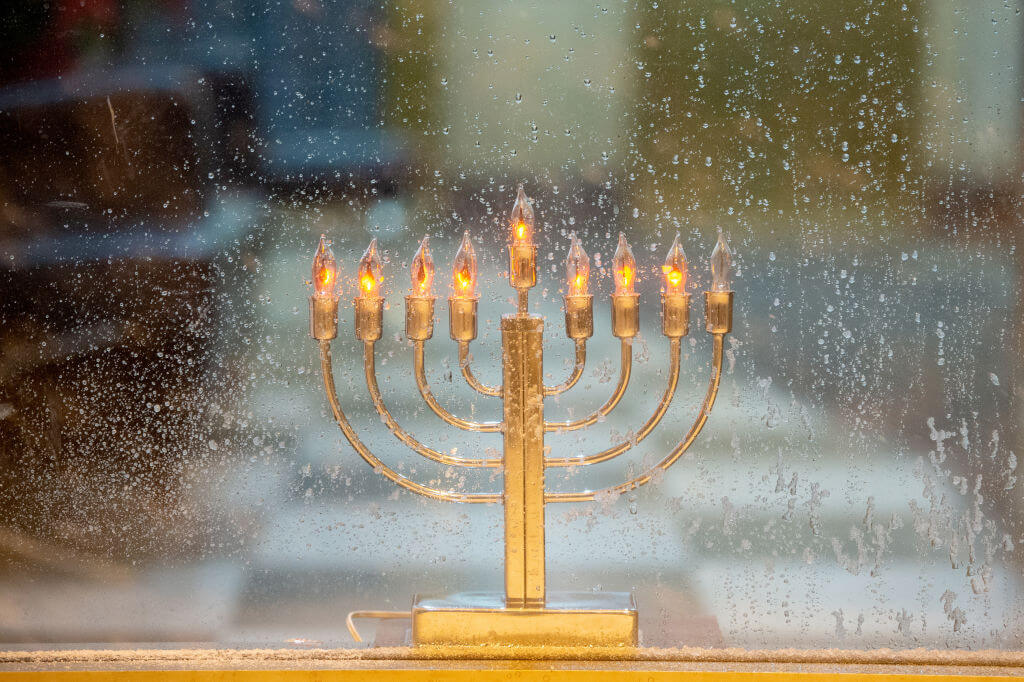
A Hanukkah menorah is displayed in a window on the seventh night of the holiday. Photo by Alexi Rosenfeld/Getty Images

By Hannah Feuer December 16, 2025
In the wake of Sunday’s attack on a Hanukkah celebration in Sydney, some non-Jews are placing menorahs in their windows as a visible show of support for their Jewish neighbors.
“My family is not Jewish. Our house is decorated for Christmas. Tonight we are adding a menorah in the front window,” one Threads user posted and received 17,000 likes. “We stand with our Jewish neighbors. 🕎 #hanukkah”
That was one of several viral posts shared by non-Jews lighting hanukkiot after the Bondi Beach attack, which left 15 people dead, including a Chabad rabbi, a Holocaust survivor, and a 10-year-old girl.
The practice, however, has also exposed a divide between Jews who welcome the gesture as an expression of solidarity and those who view it as a form of appropriation.
“Lighting a menorah is a closed practice and is not meant to be done by someone outside of our community,” one user replied to a non-Jew posting about her Hanukkah candles.
“We love you for this! You’re a mensch,” another commented in support.
An act of solidarity
In November 2023, Adam Kulbersh founded Project Menorah, an initiative that encourages non-Jews to display menorahs in their windows as a way to fight antisemitism. The practice gained traction in the aftermath of Oct. 7, he said, drawing thousands of participants across 16 countries and all 50 U.S. states.
After Sunday’s attack at Bondi Beach, Kulbersh, who is Jewish, said he noticed another surge in social media activity around the idea.
“This happens in a cyclical way, where non-Jews in many cases underestimate the amount of antisemitism that’s out there, and then it spikes, and they go, Oh, right, these are our friends and neighbors, and we can’t close our eyes,” he said in an interview with the Forward.
The idea for Project Menorah grew out of Kulbersh’s personal experience. When his then-6-year-old son, Jack, asked to put up Hanukkah decorations at their Los Angeles home, Kulbersh hesitated, worried that a visibly Jewish display could make them a target.
He mentioned the concern to a non-Jewish neighbor, who responded by offering to place a menorah in her window to show the family they weren’t alone.
Moved by the gesture, Kulbersh went all out with “flashy” Hanukkah decorations that year. Soon after, he launched Project Menorah to encourage other non-Jews to follow his neighbor’s example.
“I thought, This is an answer,” Kulbersh said. “We don’t need to wait for governments to solve all the problems. This is something neighbors can do for neighbors.”
It wasn’t the first time menorah displays had been proposed as a means of fighting hate: In Billings, Montana, in 1993, neo-Nazis threw a brick through a 6-year-old Jewish boy’s bedroom window, which was displaying a menorah. In response, thousands of residents taped paper menorahs to their windows in solidarity — and the neo-Nazis retreated from town.
A ‘closed practice’?
The idea of non-Jews displaying menorahs, however, has elicited a different response from some Jews who take offense.
“I understand that the gentiles who are lighting their own menorahs as a show of solidarity mean well but that’s not for y’all to be doing. Judaism is a closed practice,” one user posted. “Get the circumcision first, then we’ll talk.”
The term “closed practice” reflects the fact that Judaism is a non-proselytizing religion and does not encourage people to adopt it casually. Unlike Christianity, which generally welcomes anyone who accepts Jesus Christ as their lord and savior, Jewish identity is not defined solely by belief. Becoming Jewish requires a formal and demanding conversion process, typically involving extensive study and approval by a rabbinic court.
The backlash may also reflect anxiety about increased adoption of Jewish rituals and symbols by Messianic Jews and Christians. These practices tend to put off Jews who believe groups are co-opting Jewish rituals without fully appreciating their history and meanings — from “Jesus mezuzahs,” to Christian Passover seders and shofar blowing, to observing a “Jewish Sabbath,” aka Shabbat.
But for others, it’s possible to distinguish between those who combine Jewish symbols with Christian symbols, and well-meaning non-Jews want to express support.
For its part, Project Menorah offers paper cut-outs of menorahs on its website, not instructions for actually observing the holiday.
“If people want to light an actual menorah and put it in their window, great, and if they want to say a prayer that works with their religious beliefs, great,” he said. “But I’m not encouraging anyone who’s not Jewish to participate in the Jewish ritual, the Jewish prayers.”
He added that when he started the initiative, he consulted rabbis about the practice. As is often the case when asking a group of Jews about anything, he said, opinions varied.
But the majority, he said, agreed that “when the house is on fire, we don’t question the people who want to help put the fire out.”
This is a moment of great uncertainty. Here’s what you can do about it.
We hope you appreciated this article. Before you go, we’d like to ask you to please support the Forward’s independent Jewish news this Passover. All donations are being matched by the Forward Board - up to $100,000.
This is a moment of great uncertainty for the news media, for the Jewish people, and for our sacred democracy. It is a time of confusion and declining trust in public institutions. An era in which we need humans to report facts, conduct investigations that hold power to account, tell stories that matter and share honest discourse on all that divides us.
With no paywall or subscriptions, the Forward is entirely supported by readers like you. Every dollar you give this Passover is invested in the future of the Forward — and telling the American Jewish story fully and fairly.
The Forward doesn’t rely on funding from institutions like governments or your local Jewish federation. There are thousands of readers like you who give us $18 or $36 or $100 each month or year.
Support our mission to tell the Jewish story fully and fairly.