How the push to unionize at Breads Bakery became a debate over the Israeli-Palestinian conflict
Global politics have been injected into a discussion of labor grievances at Breads — not everyone is happy about it
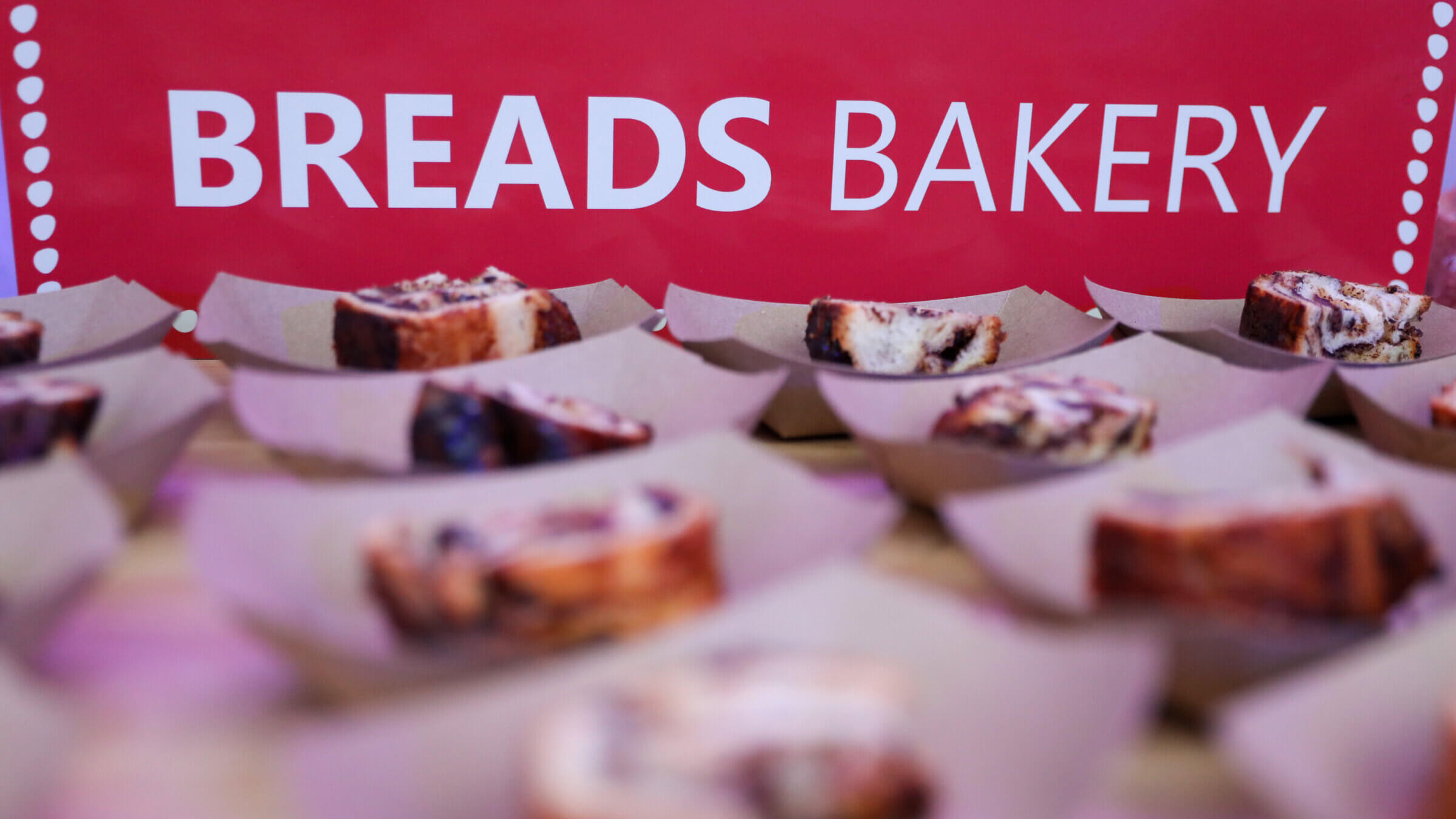
A view of a Breads Bakery display at the New York City Food & Wine Festival. Photo by Monica Schipper/Getty Images for NYCWFF
By Andrew Silverstein January 20, 2026
When Ellie, a barista for Breads Bakery, learned that some of her co-workers were forming a labor union, she was interested. The 24-year-old, Brooklyn-based artist who has worked at the Israeli-owned bakery for less than a year, thought it could lead to increased pay and benefits. And she believed her employers could afford it; they regularly sell out of their $18 babkas at their seven different New York locations.
“It started out about wages and conditions,” said Ellie, who, like many of the people I spoke with, asked to be quoted anonymously or with a pseudonym, “but it’s turned into Israel/Palestine.”
At the start of the new year, 30% of the 275 employees had signed union authorization cards for the United Auto Workers Local 2179, the percentage necessary to petition the National Labor Relations Board for a union election. Calling itself “Breaking Breads,” the group put out a press release, stating, “Workers are demanding a living wage, safe workplace, and basic respect.”
But beyond discussing cost-of-living issues and what was portrayed as management’s discriminatory practices, the press release included a demand “to cease Breads’ support for the genocide in Gaza.”
New Yorkers are generally supportive of workers’ campaigns. But in this case, after news of the demands was published in the press, there were lines outside of Breads’ locations to purchase babkas and challahs in support of management. The workers’ refusal to “participate in Zionist projects” like painting Israeli flags on cookies, was interpreted by many as demanding the Israeli bakery stop being Israeli.
Louis Putman, a 62-year-old delivery driver who has worked for Breads for six years, was surprised by his co-workers’ demands. “I’m not political like that,” said the Brooklyn native after he had parked his truck outside the bakery’s Union Square flagship. Putman told me he supports unionization — in the past he was a member of the powerful Service Employees Industry Union — but thinks the campaign shouldn’t focus on the owners’ politics. “They have their views and I have mine,” he said.
Eric Milner, a labor attorney whose firm represents unions in the New York area, said that while unions often support political causes, making political demands of an employer is unusual and unlikely to succeed. “A union can’t legitimately tell the boss what products they can or can’t sell, or who they can sell to,” he said. “That’s a core business decision, not a term or condition of employment.”
But organizers say these issues are linked. “We see our struggles for fair pay, respect, and safety as connected to struggles against genocide and forces of exploitation around the world,” Leah A., a worker whom the union says was illegally fired for organizing, said in the press release.
This isn’t the first time that Local 2179 has injected Gaza into their organizing. Last winter, members in the midst of negotiating their first contract with Alamo Drafthouse movie theaters petitioned the cinema to cancel the movie September 5, about the massacre of Israeli athletes at the 1972 Olympics, which they called “Zionist propaganda.”
Johannah King-Slutzky, an official of a different UAW local and a student leader of Columbia University’s 2024 campus encampments, is acting as a media contact for Breaking Breads. While her name does not appear on the press release, I received it from her personal Gmail; she is also listed as the owner of photos linked from Google Drive in the release, and her phone number is the contact.
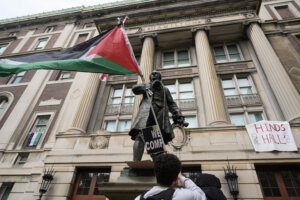
King-Slutzky and Local 2179 declined to comment or clarify her role in the union drive. The doctoral candidate in English and comparative literature is a sergeant-at-arms for Student Workers of Columbia, a local of UAW, which represents the school’s teaching assistants, instructors and researchers. In 2024, she was arrested at the campus encampment and subsequently suspended. She also acted as a spokesperson for the dozens of students who occupied Hamilton Hall.
Ellie, the barista, identifies as pro-Palestinian but says she regrets that more attention hasn’t been given to the other issues. The company’s recent job listings for both the front and back of the house start at the city’s minimum wage of $17 while the union says the business’ revenue is more than $30 million a year. Employees complain of unpredictable schedules, and the union says a worker was hospitalized after an unsecured locker fell on them. The union also says that management has prohibited workers from playing Spanish-language music and speaking in Arabic, which, if true, would be a violation of anti-discrimination law.
Neither Breads’ owners nor their representatives responded to requests for comment on these and other issues.
Both workers and a manager told me that the company told them not to discuss the union while on the clock, something Milner says would most likely be a violation of the National Labor Relations Act and could have a chilling effect. Off the clock, workers were hesitant to discuss the topic with me even anonymously, though several told me they support the union and consider themselves pro-Palestinian.
After two years of Israel’s aggressive response to the Hamas attack, for the first time a majority of Americans have an unfavorable view of Israel. Many of Breads’ workers are in their 20s, a cohort far more likely to view Israel’s military campaign as a genocide. A New York Times/Siena poll found adults under 30 are three times more likely to sympathize with Palestinians than Israelis. For young workers at businesses that have publicly supported Israel, that creates an uncomfortable position.
One counter worker, who also asked not to be named, said her differences with the bosses over Israel didn’t affect her work, until pro-Israel customers began confronting employees after the news of the union drive broke. “One woman came in and ordered a cappuccino,” she said. “I asked if I could get her anything else and she said, ‘Yeah, I’d like that with a side of Zionism.'”
Breads is a spinoff of the popular Tel Aviv bakery Lehanim, and is operated by Israeli-Americans — Chief Executive Yonatan Floman and owner Gadi Peleg. After its opening in 2013, the bakery set off a babka boom and has since become known for its festive challahs, rugelach, and Hanukkah sufganiyot. After the Hamas Oct. 7 attack, locations sold heart-shaped challahs as a fundraiser for Magen David Adom, the Israeli equivalent of the Red Cross. Otherwise, while the bakery is identifiably Jewish and Israeli, it does not regularly display flags or political messages.
“We make babka, we don’t engage in politics,” the bakery said in a statement on Jan. 14. “We celebrate peace and embrace people of all cultures and beliefs. We’ve always been a workplace where people of all backgrounds and viewpoints can come together around a shared purpose, the joy found at a bakery, and we find it troubling that divisive political issues are being introduced into our workplace.”
But some may find the philanthropy of the bakery’s leadership difficult to separate from supporting Israel’s actions in Gaza. Floman and Breads Bakery are listed as sponsors of an October 2024 fundraising gala on the Facebook page of American Friends of Unit 669, which supports the elite Israeli Air Force’s combat search and rescue unit that extracts downed pilots and other soldiers in distress behind enemy lines. Peleg actively supports and previously served as a committee chair for American Friends of Rabin Medical Center, which raises funds for an Israeli hospital that, in addition to civilian care, treats soldiers wounded in combat. Neither cause is unusual among pro-Israel Jewish Americans, but for some who view the Gaza campaign as a genocide, even well-intended support of Israel is unacceptable.
The Breaking Breads campaign reflects a split within the UAW. Graduate students now account for a quarter of the union’s membership, and Region 9a, which includes Local 2179 and represents workers at Columbia, Harvard and other elite universities, has become a base for pro-Palestinian activists. In 2023, members from the northeast formed UAW Labor for Palestine, pushing the union to cut ties with Israeli unions and divest over $400,000 in Israeli bonds. The national leadership has resisted. When the UAW endorsed President Joe Biden in 2024, King-Slutzky and other activists disrupted his UAW convention speech with chants of “Ceasefire now!” and were dragged off the floor.
Not every Breads worker is galvanized by Gaza. Two Ecuadorian workers who don’t speak English told me that other Latin American co-workers had talked with them about the union, but the Middle East conflict was never mentioned. Ellie doesn’t think it’s a union issue. “I’ve worked for evil corporations,” she said. “You never know where the money goes.” In her months on the job, she hasn’t been asked to do anything that may directly support Israel.
“Once you start bringing in politics that divide people, you’re taking away from what you’re actually trying to do, which is to unify the workforce and get better wages,” said Milner. He believes it will also make it harder to gain the support of customers.
Still, for some workers, even if a union contract can’t change their bosses’ politics, they think it’s worth taking a stand and making a statement.
“I support the Union efforts and I support Palestine,” the counter worker I spoke to about tensions between staff and customers texted me. “I also know that the owners’ support of Israel is deeply rooted and pretty unlikely to budge.”
This is a moment of great uncertainty. Here’s what you can do about it.
We hope you appreciated this article. Before you go, we’d like to ask you to please support the Forward’s independent Jewish news this Passover. All donations are being matched by the Forward Board - up to $100,000.
This is a moment of great uncertainty for the news media, for the Jewish people, and for our sacred democracy. It is a time of confusion and declining trust in public institutions. An era in which we need humans to report facts, conduct investigations that hold power to account, tell stories that matter and share honest discourse on all that divides us.
With no paywall or subscriptions, the Forward is entirely supported by readers like you. Every dollar you give this Passover is invested in the future of the Forward — and telling the American Jewish story fully and fairly.
The Forward doesn’t rely on funding from institutions like governments or your local Jewish federation. There are thousands of readers like you who give us $18 or $36 or $100 each month or year.
Support our mission to tell the Jewish story fully and fairly.