Netanyahu returns to Washington — this time to shape a deal with Iran, not fight one
The Israeli prime minister is betting that proximity to Trump will prevent Israel from being outflanked on Iran
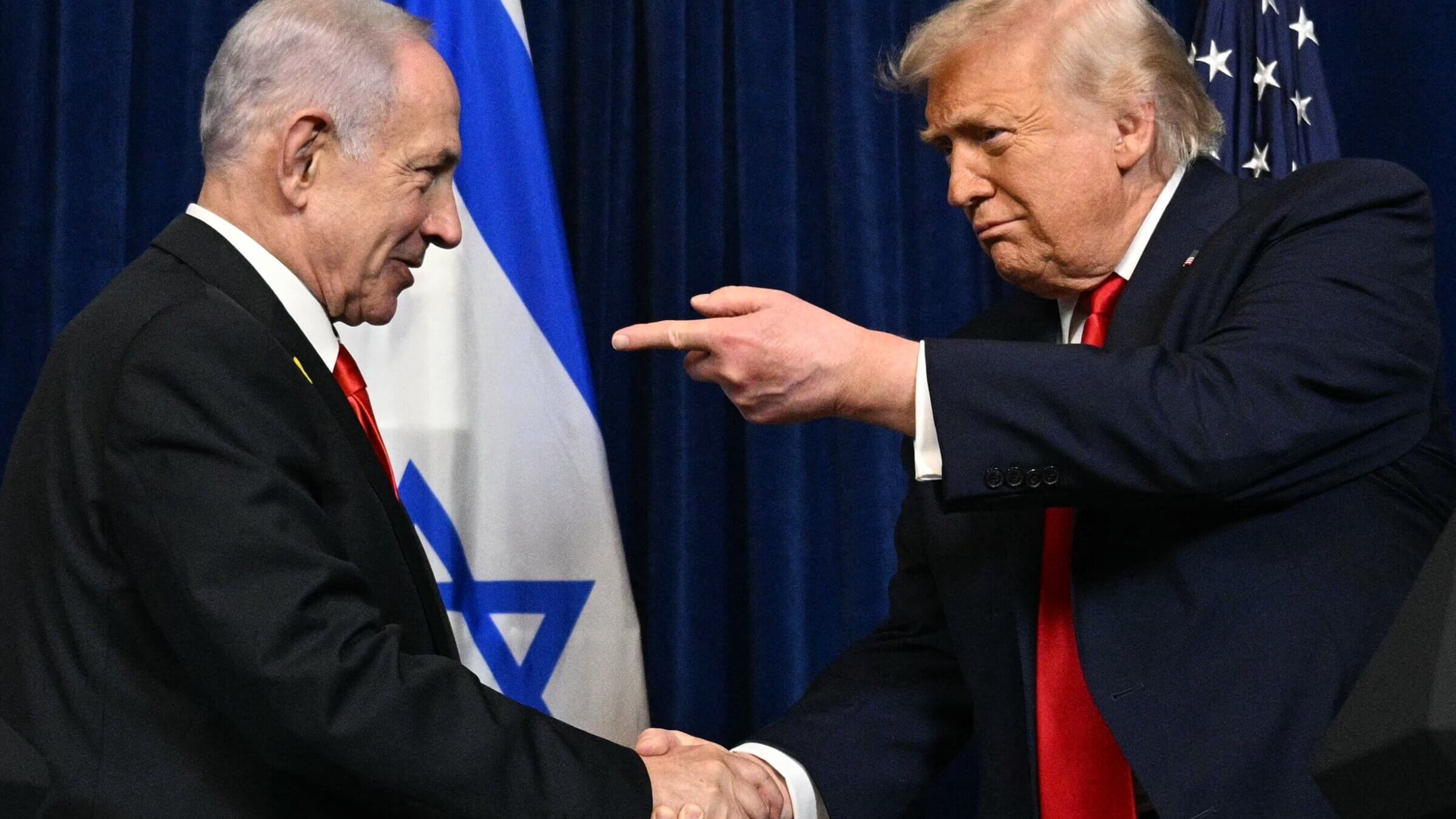
President Donald Trump (right) and Israeli Prime Minister Benjamin Netanyahu on Dec. 29, 2025. Photo by Jim Watson/AFP

By Jacob Kornbluh February 11, 2026
When President Donald Trump and Israeli Prime Minister Benjamin Netanyahu meet at the White House today — their sixth meeting in the U.S. in the last year — their discussion will focus on a shared commitment to confronting the Iranian nuclear threat, but the stakes are different for each of them.
For Trump, a nuclear agreement could cement his legacy as a peacemaker, perhaps even earn him a long-coveted Nobel Peace Prize. For Netanyahu, a deal could bolster his political standing back home in a difficult election year.
In 2015, when President Obama was on the verge of signing a nuclear deal with Iran, Netanyahu cast himself as the indispensable interpreter of the Iranian threat to Washington, as he has again. But back then, Netanyahu came to publicly oppose what he called “a very bad” Iran deal, pushing back against the U.S. president. Now, he is visiting the White House with the hope of shaping U.S. policy on Iran, not challenging the president.
Trump has described the first round of discussions with Iran as “very good,” even as U.S. aircraft carriers and other military assets build up in the region. He has insisted that Tehran is “wanting to make a deal very badly.” Israel, for its part, has made clear that any agreement must go beyond limits on uranium enrichment and also address Iran’s ballistic missile program and its network of regional proxies — Hamas, Hezbollah, the Houthis — that have been attacking Israel.
Netanyahu has said he plans to present the president with Israel’s approach to the nuclear talks led by Trump’s close advisers, son-in-law Jared Kushner and Mideast envoy Steve Witkoff.
Netanyahu is betting that intimacy equals influence. That being the leader who shows up in person — again and again — ensures Israel is not outflanked as decisions are made. Last June, that strategy appeared to pay off. Netanyahu launched a charm offensive aimed at drawing Trump into a more active role in dismantling Iran’s nuclear program. If talks fail, Trump could act again. “Either we will make a deal, or we will have to do something very tough like last time,” Trump told Axios.
But the frequency of these meetings also reflects some vulnerability. It showcases a prime minister who cannot afford distance and disagreement with the White House.
The domestic clock is ticking
The longest-serving Israeli leader is facing a real risk that Israel’s legislature, the Knesset, will dissolve in the coming weeks if his coalition fails to resolve the explosive issue of military conscription for Haredi yeshiva students. The Haredi parties have threatened to vote against the budget ahead of the March 31 deadline — a move that would trigger elections as early as June.
If Netanyahu emerges from the White House visit with rhetorical alignment or symbolic support, he could buy himself time and political oxygen.
These gestures matter for Israel, where the education minister, Yoav Kisch, has formally invited Trump to attend the Israel Prize ceremony on Independence Day in Jerusalem to receive the prestigious award for a “Unique Contribution to the Jewish People.” Israeli officials have also invited him to participate in the annual torch-lighting ceremony, one of the most emotionally charged moments on the Israeli civic calendar.
If Trump accepts the invitation and travels to Israel again, it would be a political gift of the highest order. For Netanyahu’s supporters, that imagery could energize turnout and blunt opposition momentum. For undecided voters, it reinforces a familiar argument: Whatever Netanyahu’s flaws at home, replacing him would risk destabilizing Israel’s most important relationship abroad and its closest ally in any confrontation with Iran.
But Trump’s current position on Iran may still cross Netanyahu’s red lines. And Trump has shown before that he is willing to act unilaterally, even without backing from allies.
Still, he is very popular in Israel, and that benefits Netanyahu. A new survey by the Jewish People Policy Institute showed that 73% of Israelis rate Trump as a better-than-average U.S. president for Israel’s interests and 54% of Jews in Israel view Trump as one of the best presidents in U.S. history.
This is a moment of great uncertainty. Here’s what you can do about it.
We hope you appreciated this article. Before you go, we’d like to ask you to please support the Forward’s independent Jewish news this Passover. All donations are being matched by the Forward Board - up to $100,000.
This is a moment of great uncertainty for the news media, for the Jewish people, and for our sacred democracy. It is a time of confusion and declining trust in public institutions. An era in which we need humans to report facts, conduct investigations that hold power to account, tell stories that matter and share honest discourse on all that divides us.
With no paywall or subscriptions, the Forward is entirely supported by readers like you. Every dollar you give this Passover is invested in the future of the Forward — and telling the American Jewish story fully and fairly.
The Forward doesn’t rely on funding from institutions like governments or your local Jewish federation. There are thousands of readers like you who give us $18 or $36 or $100 each month or year.
Support our mission to tell the Jewish story fully and fairly.