As Iran’s Jews prepare for Purim, their government calls its story proof of a past genocide
A besieged community navigates the holiday’s themes in real time — measuring loyalty to the regime against survival
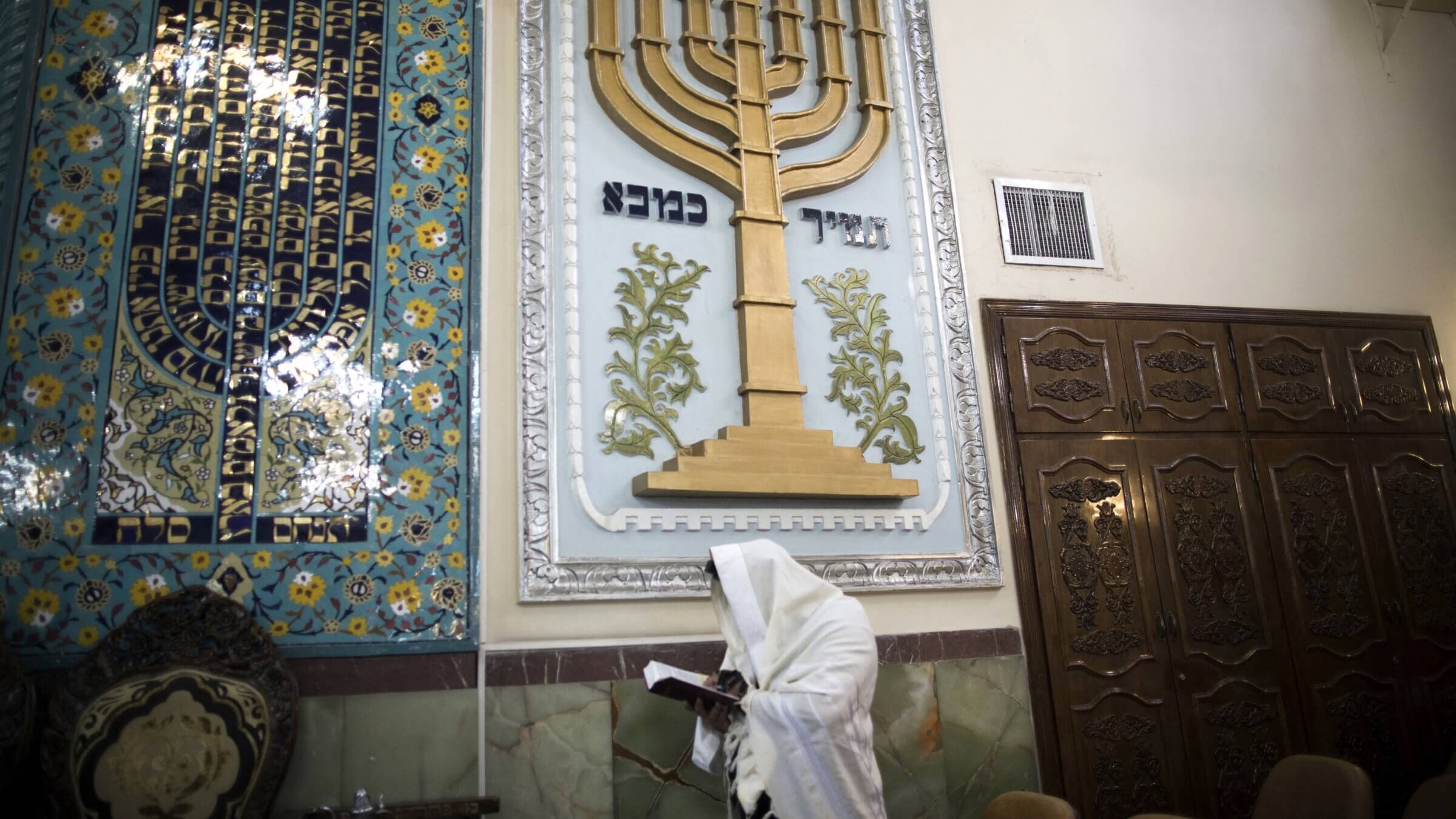
An Iranian Jewish man, wearing a Tallit, reads the Torah during morning prayer at Youssef Abad synagogue in Tehran on Sept. 30, 2013. Photo by Behrouz Mehri/AFP via Getty Images

By Simone Saidmehr February 27, 2026
At the center of Hamadan, Iran, one of the oldest continually inhabited cities in the world, stands the holiest site for Jews in Iran: a small brick mausoleum traditionally believed to hold the tombs of Esther and Mordechai.
For at least the past 15 years, the tomb has become a flashpoint for protest reacting to Iranian regime–propagated narratives that frame the Book of Esther not as a tale of Jewish survival, but as a genocide of 75,000 Iranians perpetrated by the Jews. Each year on Purim, protesters gather outside the mausoleum. At times, they have thrown Molotov cocktails at the building or burned Israeli flags.
Iranian Jewish leaders have responded with carefully worded appeals to the Interior Ministry, emphasizing their loyalty to the state and asking that protests not be held at the sacred site. And even as the possibility of a U.S.-led attack looms, Iranian Jews are preparing to celebrate Purim with discreet customs reflective of the culture at large — though with dispensation to consume alcohol at home.
Jews in Iran celebrate Purim “with a very low profile” because of “all this antisemitic propaganda,” said Thamar E. Gindin, author of The Book of Esther Unmasked and a research fellow at Haifa University’s Ezri Center for Iran and Persian Gulf Research.
Loyalty as survival
Before the Islamic Revolution, approximately 100,000 Jews lived in Iran and enjoyed significant religious freedom under the Shah, who maintained ties with the United States and Israel. Some Jews fleeing hostile conditions in Arab countries even sought refuge in Iran.
After 1979, however, Sharia law was imposed, political instability grew, and life for religious minorities changed dramatically. Several members of the Jewish community were imprisoned on false accusations of being Zionist spies. A mass exodus of Jewish Iranians followed, with many fleeing to the United States or Israel.
Today, approximately 9,000 to 10,000 Jews remain in Iran — the largest Jewish community in the Middle East outside Israel. While they are allowed to practice their religion freely, they face significant discrimination. Jews are barred from holding senior government positions, with a single parliamentary seat reserved for a Jewish representative who, according to Beni Sabti, an Iran expert at the Institute for National Security Studies, is a “puppet.”
“He praises the regime all the time, and he calls Israel ‘the Zionist entity’ and says it must be erased,” said Sabti, referencing the label commonly used by the state’s military opponents. Jews also face legal inequalities, including the diminished weight of their testimony compared to that of Muslims.
Accusations of Zionist espionage remain common and can carry dire consequences. While this has been the case since 1979, the situation worsened for Jews following the 12-Day War in June 2025. Since the war, over 30 Jewish Iranians have been taken prisoner on accusations that they collaborated with the Mossad or Israel.
In an effort to protect community members, Jewish Iranians go to great lengths to demonstrate allegiance to the regime and distance themselves from Israel.
In January, Jewish community leader Rabbi Younes Hamami Lalehzar participated in a memorial service for Islamic Revolutionary Guard Corps commander Qassem Soleimani, who was killed by the U.S. in a 2020 drone strike. Lalehzar publicly praised Soleimani, who was a key architect in developing Iran’s terror network across the Middle East, and attended the event alongside Hezbollah and Hamas representatives.
According to Sabti, amid a recent wave of protests, the Jewish community has made a concerted effort to remain invisible. “They didn’t come out from their houses,” he said. If they did, it was just “to buy very basic products.” He said the community learned a painful lesson during the 2022 Women, Life, Freedom protests in Iran, which coincided with Jewish High Holidays. During that time, “The Jews just went for synagogue. But when you go with your family or five, six guys together, it looks like a protest, and they were just arrested.”
During this latest round of unrest, the Iranian Jewish Community Association’s Telegram channel filled with carefully neutral messages announcing synagogue closures. “They said, ‘Don’t go to the synagogue.’ They don’t say why. But of course, all know why,” Sabti said — an effort, he explained, to avoid any gathering that could be misinterpreted as anti-regime activity. He added that pro-regime messages have also appeared in the channel.
At the same time, said Gindin, many in the Jewish community are being used as “propaganda hostages” by the regime amid ongoing protests and instability in the country. For example, Jewish community leaders recently participated in a pro-regime Iranian Revolutionary parade. “If they tell you to gather your people to protest against Israel, you don’t have the prerogative to say no when the lives of [thousands of] people are dependent on your collaboration with the regime.”
Despite these efforts, several members of the Jewish community have been arrested on suspicion of involvement in anti-regime protests. Senior community members have publicly denounced the demonstrations and denied any connection to them. Some have reportedly worked behind the scenes to secure the release of those they say were mistakenly accused.
Rewriting the Book of Esther
Each year, in the weeks before Purim, a familiar narrative begins circulating through regime-sponsored media, school lectures, television programs and academic articles. “I saw it in a lot of blog posts when blogs were a thing. I see it in regime media. It’s really everywhere,” said Gindin.
The Book of Esther does not end gently. Its climactic scenes depict sanctioned violence against the enemies of the Jews. But it is widely considered not to be a verifiable historical account, and there is no independent Persian record of the events it describes.
According to Gindin, many prominent analysts, specifically well-known Iranian political commentator Ali Akbar Raaefi-Pour, push the idea that the narrative is that the story told in the Book of Esther is a false account of historical events. For them, the real historical story of Purim is that Mordechai manipulated the king into banishing Queen Vashti and installing Esther as part of a scheme. Haman sought to expel the Jews because they were oppressing others, but Esther and Mordechai ultimately secured royal approval for the Jews to kill 77,000 Iranians.
Some even link Purim to Sizdah Bedar, the Iranian spring picnic day, claiming that Persians commemorate the day Iranians fled their homes to escape a Jewish massacre by gathering outdoors.
A holy site turned political
Despite the efforts of Iranian Jews to demonstrate allegiance to the regime and hatred of Israel, the tomb of Esther and Mordechai has repeatedly become a stage for anti-Israel and anti-Jewish protests.
As early as 2011, demonstrators hung a banner on the fence reading “the Holocaust of 77,000 Iranians” and burned Israeli flags. After the Oct. 7 attacks in 2023, the mausoleum was again a magnet: Protesters burned Israeli flags and waved Palestinian and Basij militia flags. During that time, calls circulated on Iranian social media to convert the tomb into a museum commemorating alleged Jewish crimes against Iranians.
In the years following, Jewish Iranians making pilgrimages to the site have been met with the sight of a Palestinian flag hanging from the entrance gate.
More recently, after an Israeli strike killed seven IRGC commanders in Damascus in 2024, a Molotov cocktail was thrown at the site.
Meanwhile, attempts to push back on the official Purim story have led to arrests of even foreign visitors, according to Gindin, who recounted that several years ago, two American Jewish tourists were detained: “They wrote graffiti in Iran that said ‘Death to Haman.’”
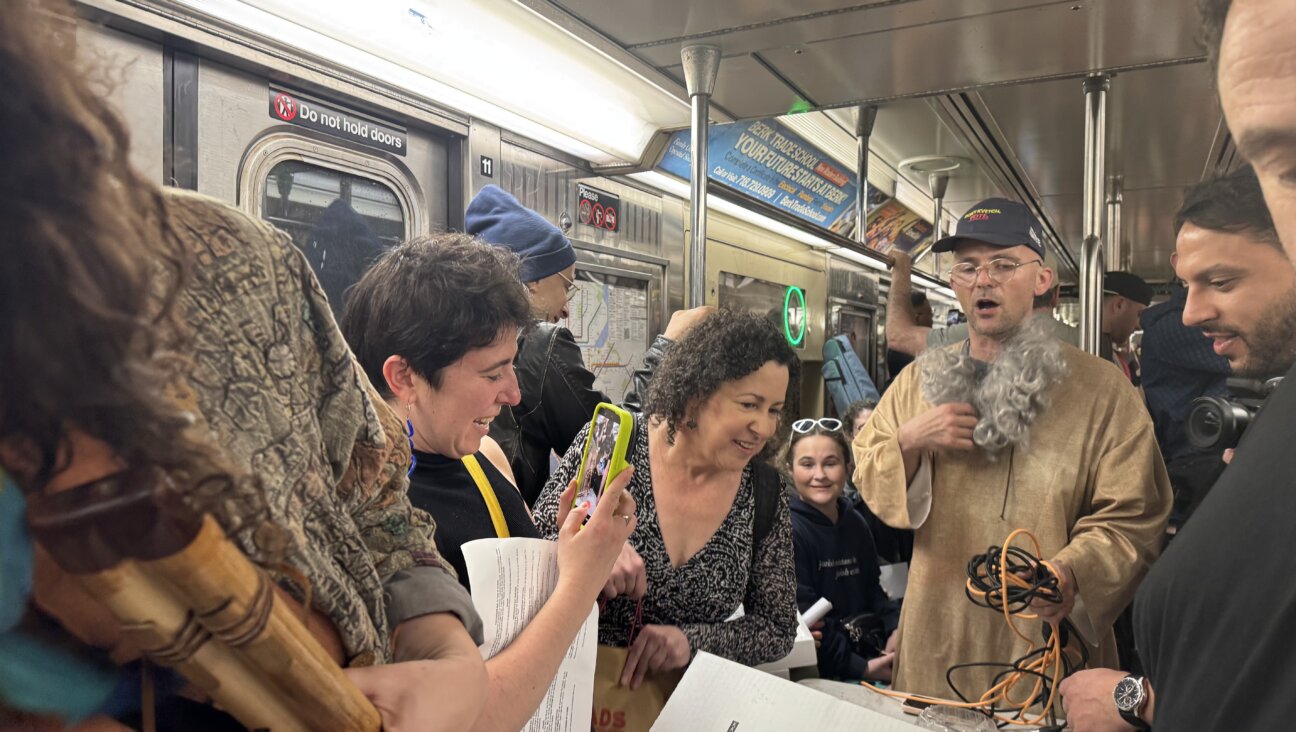
So long as renewed military strikes don’t shut the country down, the megillah will be read in synagogues on Purim in distinctively Iranian style, with limited booing for decorum purposes. Costumes will be omitted (a custom that reflects Iran’s modesty norms), and instead of mishloach manot, some will prepare halva. Despite Iran being officially alcohol-free, Jews will be permitted to drink inside their homes for religious purposes.
But they will also continue to play a careful game, showing loyalty to the state in an attempt to secure their own safety.
This is a moment of great uncertainty. Here’s what you can do about it.
We hope you appreciated this article. Before you go, we’d like to ask you to please support the Forward’s independent Jewish news this Passover. All donations are being matched by the Forward Board - up to $100,000.
This is a moment of great uncertainty for the news media, for the Jewish people, and for our sacred democracy. It is a time of confusion and declining trust in public institutions. An era in which we need humans to report facts, conduct investigations that hold power to account, tell stories that matter and share honest discourse on all that divides us.
With no paywall or subscriptions, the Forward is entirely supported by readers like you. Every dollar you give this Passover is invested in the future of the Forward — and telling the American Jewish story fully and fairly.
The Forward doesn’t rely on funding from institutions like governments or your local Jewish federation. There are thousands of readers like you who give us $18 or $36 or $100 each month or year.
Support our mission to tell the Jewish story fully and fairly.