In two controversial ads, a tale of how not to fight antisemitism — or support Israel
Jews are tired of being treated like we must always be afraid

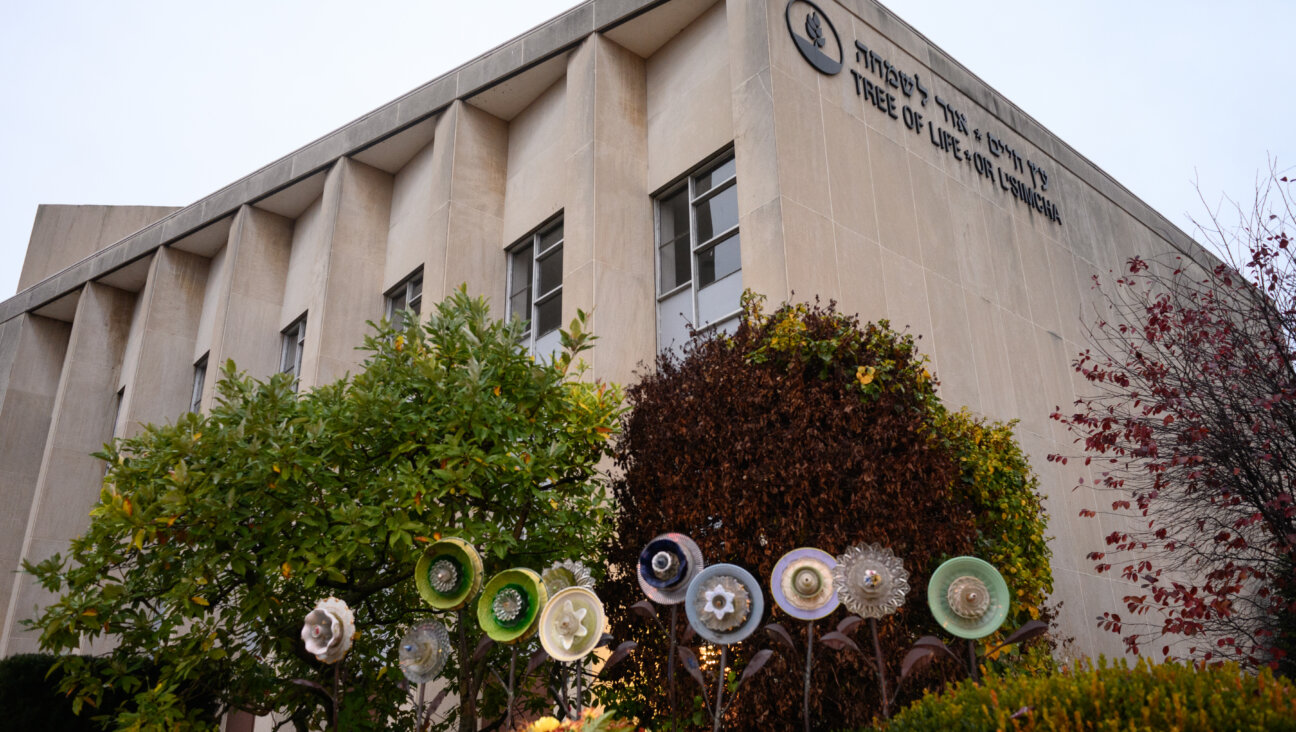
Why are some representations of Jewish concerns about antisemitism and Israel struggling to resonate with their target audiences? Image by Forward Collage/Canva
Multimillion-dollar ad campaigns aimed at scaring Jews, or scaring others on Jews’ behalf, are not working.
They are not effectively combating antisemitism. They are not strengthening Jewish life. And they are not persuading Americans to embrace Israel or its government’s current course of action. They are, in fact, backfiring.
That was recently made clear in two very different contexts: A New Jersey congressional race, and the Super Bowl. The reactions to two disparate ads — one attacking former Rep. Tom Malinowski, and one advocating an approach for fighting antisemitism that some found dated — sent the same message.
We Jews are tired. We are tired of being told that the only way to be Jewish in the United States is to defend Israel’s indefensible actions. We are tired of being blamed for every policy choice the Israeli government makes. We are in a precarious moment in history, possibly a pivotal one — and we are tired of being shown half-hearted solutions. We are tired of being afraid.
Fear is not a strategy. It is a reflex. And acting reflexively will not help us build a strong future.
A telling political miscalculation
The United Democracy Project, the super PAC affiliated with AIPAC, spent at least $2.3 million attempting to defeat Tom Malinowski in the race to replace now-New Jersey Gov. Mikie Sherill in the House of Representatives. Malinowski is no fringe critic of Israel. He is a longtime supporter of the Jewish state, who has said he would not deny the country what it needs to defend itself.
His only deviation from AIPAC orthodoxy was that he refused to rule out placing conditions on U.S. aid. For that, he became a target.
The AIPAC-backed ads themselves did not mention Israel at all. Instead, they criticized Malinowski for a vote on immigration enforcement funding during President Donald Trump’s first term in a clear attempt to paint him as unreliable on domestic security issues. The goal, as a spokesperson for the PAC stated openly, was to push votes toward the group’s preferred candidate in the crowded primary.
Instead, Analilia Mejia, a left-leaning organizer who openly stated she believes Israel committed genocide in Gaza, surged to the lead. She declared victory on Tuesday.
In other words, after $2.3 million in negative ads, the candidate who most directly accused Israel of genocide appeared to benefit the most.
Many of AIPAC’s choices in this matter could be criticized, including their stance that openness to any conditions on aid is anti-Israel or, worse, antisemitic. But perhaps the most important one was their decision to treat the issue of support for Israel as one that must be smuggled into a race under cover of unrelated issues.
If the case for unconditional support of Israel’s current government is strong, then why cloak it in ads about ICE? If such support is as morally and politically sound as its architects insist, it should be able to stand in the open.
The choice to obscure it suggests something else: that traditional, narrow support for the current Israeli government and its military campaigns no longer carries the traction it once did. Voters can sense when an argument is being rerouted through unrelated fears. And when they do, it breeds not persuasion but distrust.
Post-it advocacy
Then there was the Super Bowl.
An ad funded by Patriots owner Robert Kraft’s Blue Square Alliance Against Hate, formerly known as the Foundation to Combat Antisemitism, ran during the game. In it, a teenage Jewish boy walks down a school hallway, not knowing that someone has put a Post-it on his backpack reading “dirty Jew.” He looks small and isolated.
A larger Black classmate notices, covers the note with a blue square, then puts another blue square on his own chest in solidarity. The message is that allies can stand up to antisemitism.
But the image felt oddly untethered from the current moment. It asked viewers to see Jews primarily as vulnerable targets of crude prejudice. It did not speak to the nuance of Jewish life in America today. It did not grapple with the political entanglements or technological shifts shaping public debate. It flattened Jewish identity to an experience of persecution.
The same broadcast gave us a chance to understand the risks of that approach — of acting like minorities live in a state of constant endangerment.
Puerto Rican artist Bad Bunny headlined the halftime show with a performance that was an act of cultural declaration. His staging celebrated Puerto Rican life and heritage, in all its complexity. There were the sugar cane fields, where enslaved people were forced to labor before emancipation, turned into a site of essential but emotionally mixed heritage. There were joyful community scenes interspersed with critiques of infrastructural failure. He performed almost entirely in Spanish, ending with a roll call of countries across the Americas and a message of unity that transcended borders and expectations.
That was a radical act at a time when this country is rife with state violence largely targeting Spanish speakers from many of those countries — U.S. Immigration and Customs Enforcement raids, deportations, and threats against immigrants that have left families terrified and communities in crisis. Just days before his performance, Bad Bunny used his Grammy acceptance speech for album of the year to demand “ICE out,” a protest call to make clear that immigration enforcement’s brutality was unacceptable and dehumanizing.
The contrast could not be sharper.
Bad Bunny’s presence, his language choice, his celebration of heritage spoke to millions; it was the most-watched halftime show ever. It’s hard to imagine it being so successful if he had focused exclusively on the Latinx experience of persecution in the U.S.
Cultural vitality is an essential partner to moral clarity in building a stronger future. That building means saying no to violence, but also yes to life, even when it is complex and unsettled. It means joy. It means pride.
The AIPAC-funded ad against Malinowski and the Blue Square Alliance-funded one about fighting antisemitism made the same mistake. Fear alone does not persuade people to seek change. Faith in the good that life has to offer must be part of the picture.
In the classic Jewish text The Big Lebowski, Walter Sobchak delivers a vocal celebration of our identity. “Three thousand years of beautiful tradition from Moses to Sandy Koufax,” he says. “You’re goddamn right I’m living in the past.”
It’s a funny line. But it’s also a reminder.
We come from a civilization of argument, poetry, exile, reinvention, baseball heroes, mystics, storytellers, radicals, comedians, ping-pong hustlers and stubborn moral voices. We do not need to be reduced to frightened caricatures. We do not need to outsource our dignity for protection. We do not need to insist on adherence to dated principles in order to prove our belonging.
If we are going to invoke thousands of years of Jewish history, let it be the history of ethical wrestling, cultural creativity, and unapologetic presence. Let it be a Judaism that refuses both erasure and weaponization.
That is the Jewish future worth living for.
This is a moment of great uncertainty. Here’s what you can do about it.
We hope you appreciated this article. Before you go, we’d like to ask you to please support the Forward’s independent Jewish news this Passover. All donations are being matched by the Forward Board - up to $100,000.
This is a moment of great uncertainty for the news media, for the Jewish people, and for our sacred democracy. It is a time of confusion and declining trust in public institutions. An era in which we need humans to report facts, conduct investigations that hold power to account, tell stories that matter and share honest discourse on all that divides us.
With no paywall or subscriptions, the Forward is entirely supported by readers like you. Every dollar you give this Passover is invested in the future of the Forward — and telling the American Jewish story fully and fairly.
The Forward doesn’t rely on funding from institutions like governments or your local Jewish federation. There are thousands of readers like you who give us $18 or $36 or $100 each month or year.
Support our mission to tell the Jewish story fully and fairly.