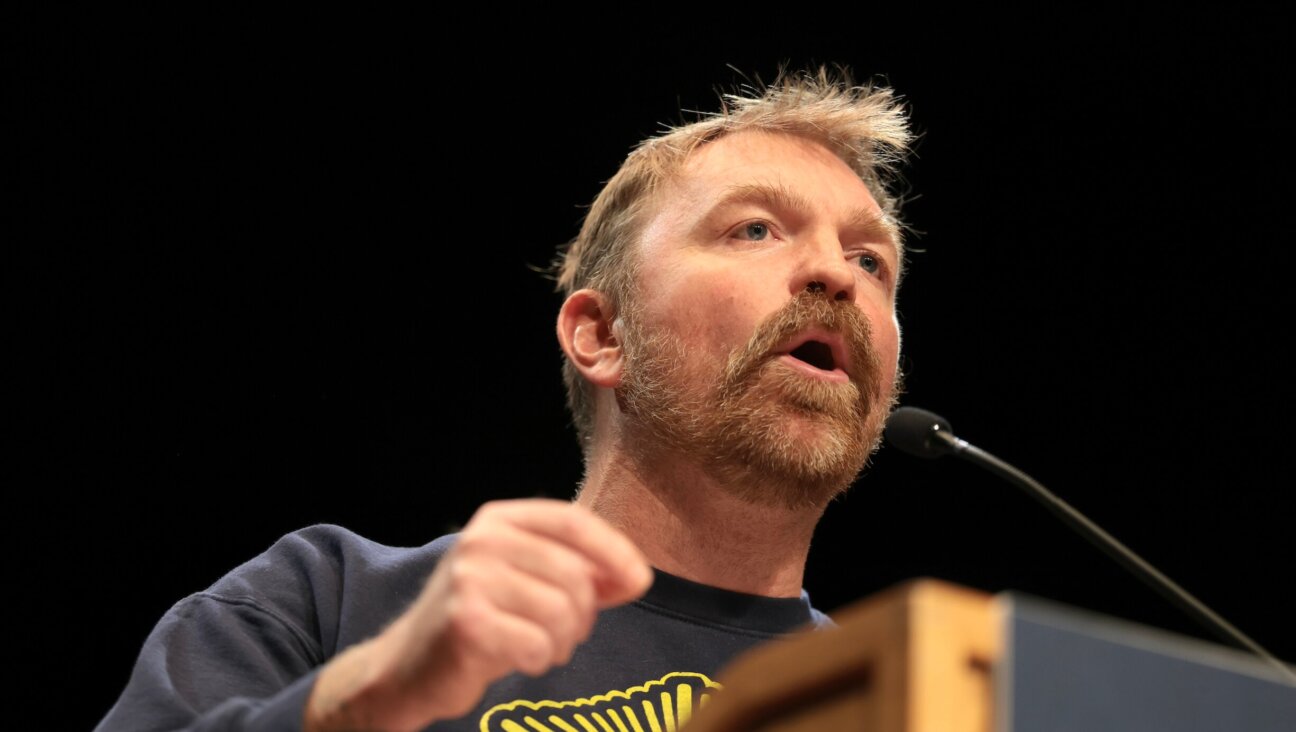
Boris Cyrulnik and the Art of Creative Disobedience
Graphic by Angelie Zaslavsky

By Benjamin Ivry June 30, 2010
Born in 1937, the French neuropsychiatrist Boris Cyrulnik has long been a media darling for his insights into such varied subjects as workplace violence, the wonders of nature, and scientific/technological progress in general. Although Cyrulnik’s public advice is sometimes leavened with lighthearted whimsy, his utterly serious understanding of the importance of psychological resilience, or surviving life’s traumas, has been his most essential contribution.
Now, an astonishing 2009 memoir from Les éditions l’Esprit du Temps, newly reprinted by Les Éditions Odile Jacob, explains the source of Cyrulnik’s insights.
“I Remember…” (“Je me souviens…”), echoing the title of a renowned work by French Jewish author Georges Perec, details how Cyrulnik’s Polish Jewish parents were deported to Auschwitz. Placed in a series of foster homes where he concealed his Judaism, Cyrulnik was finally caught in a 1944 roundup of Jews in Bordeaux, but managed to escape by hiding in the toilets of a synagogue where the prisoners were held before being shipped off to their deaths.
Cyrulnik describes these childhood experiences with the acuity of a trained ethnologist, making this a uniquely understanding account of how wartime persecution affected Jews. When he was hidden in farming communities, he notes that children were not spoken to, but merely set to work. Cyrulnik derived personal resilience from a Biblical engraving by Gustave Doré of Lot’s wife turning into a pillar of salt, from which he deduced: “I must always go forward, never weep, never complain, and never turn back.”
Cyrulnik also notes how a capacity for rebelliousness was paramount to his survival. He cites a fellow French Jewish psychiatrist Henri Parens, author of “Renewal of Life: Healing from the Holocaust” from Schreiber Publishing, who describes himself as a merry imp at the time of his own escape, a disobediently exuberant initiative. This kind of refractory personality, Cyrulnik explains, makes other people want to help when they can.
Cyrulnik notes about himself: “I had the will to disobey,” whereas placid, well-behaved children who did as they were told were promptly deported and gassed. The lesson Cyrulnik drew from his experience was: “Never listen to adults, because if you do, you will die.” Concluding that while doubtless he was lucky, Cyrulnik actively created his own luck by refusing to follow orders.
Watch Boris Cyrulnik discuss how trauma can inspire us to better enjoy life:
I’m personally matching all gifts to the Forward, up to $36,000. Can I match your gift now?

Hello, fellow Forward reader! I’m Joel Brown, a Forward reader and supporter for more than 15 years, and currently the chair of the board of directors.
I’m an avid Forward reader because it ticks so many of my essential boxes: excellent journalism, Jewish focus and diverse viewpoints. In today’s political climate, what I most appreciate is the Forward’s independence — made possible by the generosity of its membership.
The Forward is committed to bringing you unbiased, nuanced Jewish news. From my position as board chair, I see an exciting future as we expand our position as the definitive independent voice of contemporary American Judaism.
— Joel Brown, Forward board chair
Support our mission to tell the Jewish story fully and fairly.