Slideshow: A Sculptor at Work
Graphic by Angelie Zaslavsky

By Ezra Glinter June 28, 2011
Arnold Newman, Chaim Gross with ‘Happy Mother,’ 1942. Courtesy of the Renee and Chaim Gross Foundation and the Arnold Newman Archive.
During the 1939-40 New York World’s Fair, sculptor Chaim Gross (1904-1991) spent two summer months outdoors, working in front of crowds that totalled some 80,000 people. “I would look them over and if they looked intelligent I would answer their questions but if not I would keep on working,” he told the New York Herald Tribune.
It wasn’t just tourists and passersby that stopped to see Gross work. LIFE Magazine photographer Eliot Elisofon also came by, and took several striking pictures of the sculptor, busy in the act of creation.
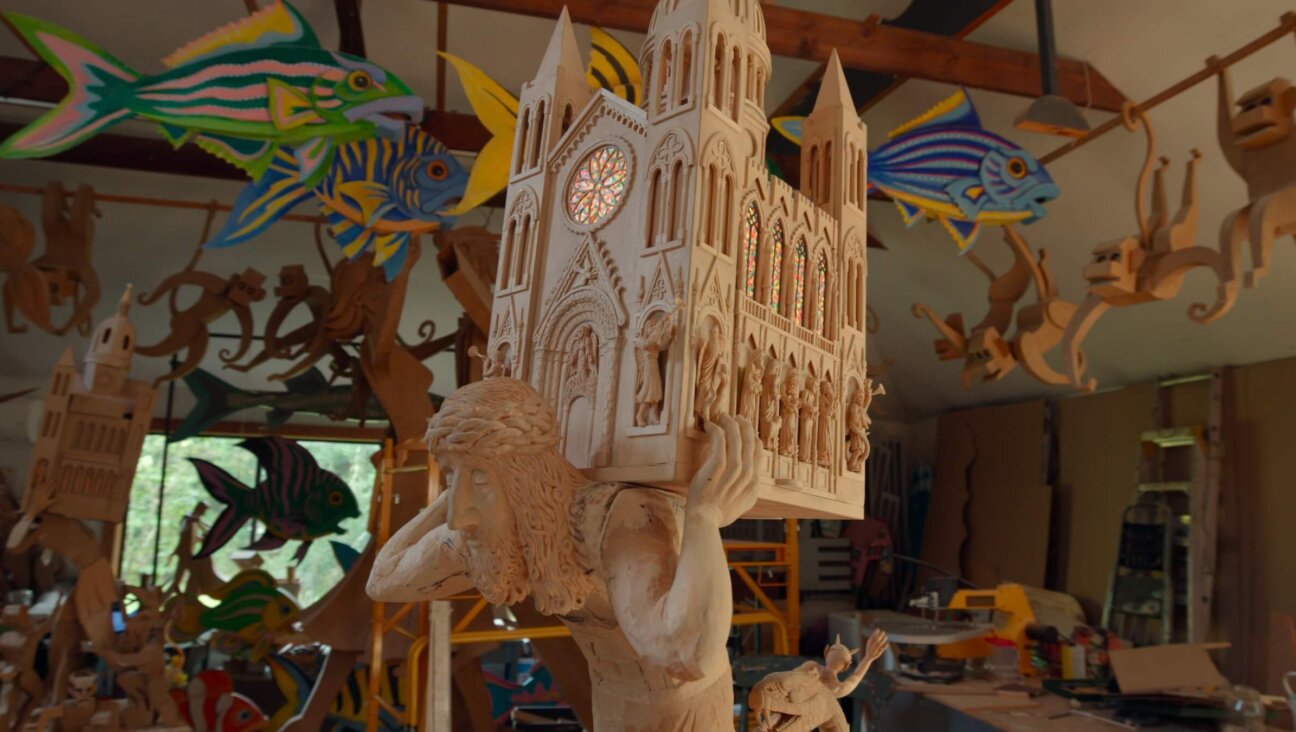
Those photos are part of a current exhibit, “Displayed: Stages for Sculpture,” on view until December 16 at the Renee and Chaim Gross Foundation in New York. A practitioner of the “direct carving” method who created totemic human figures out of wood and stone, Gross was a perfect subject for photographers who wanted to capture his creative process.
Born in Austrian Galicia, Gross immigrated to New York in 1921, where he took art classes at the Educational Alliance at night while working as a delivery boy by day. Later, he also studied at The Beaux-Arts Institute of Design and the Art Students League of New York. He began to have some success in 1930 when he was commissioned by the U.S. Treasury Department to create a sculpture for the Washington, D.C. Post Office Department Building; in 1935 his “Handlebar Riders” sculpture was acquired by the Museum of Modern Art. Today his work can be found at the Art Institute of Chicago, the Hirschhorn Museum and Sculpture Garden in Washington, D.C., and the Metropolitan Museum of Art, among other places.
The current exhibit, curated by archivist Zak Vreeland, includes photographs by Elisofon as well as by Arnold Newman, Rudy Burckhardt, Robert M. Damora, Soichi Sunami, Walter Rosenblum and Arnold Eagle. Many of these photographers were personal friends of Gross, particularly Elisofon and Newman, and were engaged by him to photograph his work. Their pictures highlight the complex relationship between sculpture and photography, focusing on Gross’s work in some cases, while serving as artworks in their own right in others.
In addition to photographs of completed and in-progress sculptures, the exhibit also features pictures of window displays that included Gross’s pieces, created by designer Gene Moore at stores such as Tiffany’s, Bonwit Teller and Saks Fifth Avenue.
View a slideshow of images from ‘Displayed: Stages for Sculpture’:
This is a moment of great uncertainty. Here’s what you can do about it.
We hope you appreciated this article. Before you go, we’d like to ask you to please support the Forward’s independent Jewish news this Passover. All donations are being matched by the Forward Board - up to $100,000.
This is a moment of great uncertainty for the news media, for the Jewish people, and for our sacred democracy. It is a time of confusion and declining trust in public institutions. An era in which we need humans to report facts, conduct investigations that hold power to account, tell stories that matter and share honest discourse on all that divides us.
With no paywall or subscriptions, the Forward is entirely supported by readers like you. Every dollar you give this Passover is invested in the future of the Forward — and telling the American Jewish story fully and fairly.
The Forward doesn’t rely on funding from institutions like governments or your local Jewish federation. There are thousands of readers like you who give us $18 or $36 or $100 each month or year.
Support our mission to tell the Jewish story fully and fairly.