Why Alice Walker and Michigan Are Both Wrong
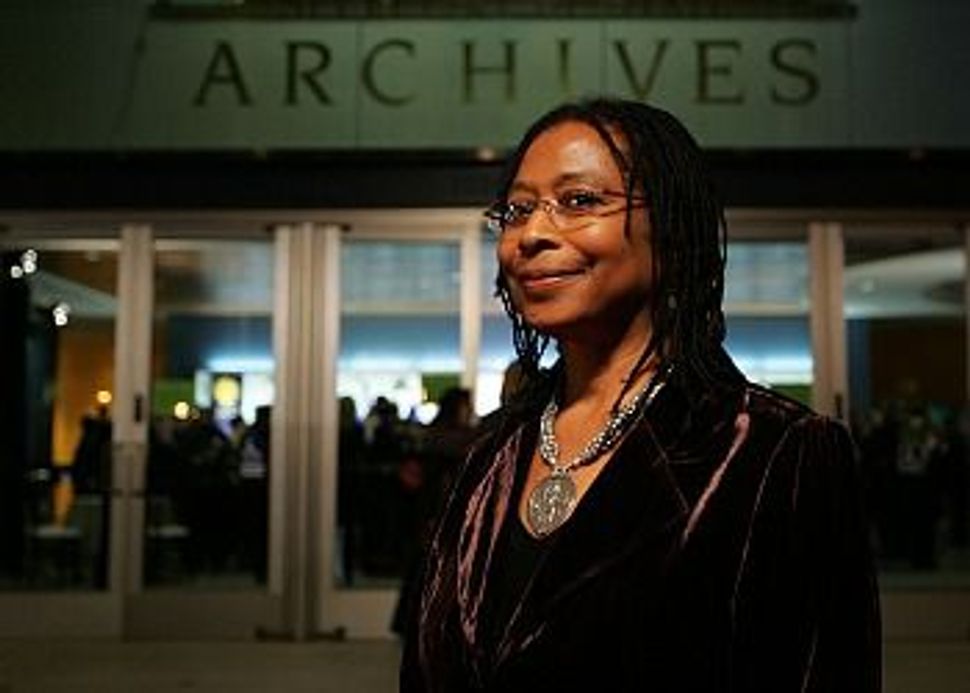
Pulitzer Prize-winning author Alice Walker. Image by Getty Images

By Sarah Seltzer August 22, 2013
Alice Walker and the University of Michigan Center for Education for Women — which disinvited her from a speaking engagement at its 50th anniversary celebration, as the Sisterhood’s Erika Dreifus recently wrote about, then later re-invited her to speak at a public forum on campus — are both misguided. It was foolish of Alice Walker to boycott an Israeli publisher because of her anger at Israel’s occupation. But it was wrong, also, for the Center to rescind their invitation because of Walker’s support of Boycott, Divestment and Sanctions against Israel.
How can I stand against them both? Easy. Because I believe academic, cultural and intellectual boycotts in almost all circumstances (with some obvious exceptions) are lazy. They embody people’s fear of having their own opinions challenged by the deep nuances and multi-faceted nature of reality, of art, of the world of ideas. Art is a vehicle for revealing the grey areas of human existence. We should share it as widely as we can, and welcome the way it interrogates us and our dogmas.
I was disappointed with Walker’s decision to avoid allowing her words to be read by Israeli audiences because it seemed a loss — a loss of a chance to foster an exchange that would be helpful to both sides; a loss for Walker to confront the existence and humanity of her Israeli readers and fans, and a loss for those readers to understand Walker’s point of view.
But whether Walker is right or wrong, the folks at American universities should not insulate themselves from thinkers who don’t march in lockstep on Middle Eastern policy. Whether or not supporters of Israel want to hear it, opposition to the philosophy of Zionism is a legitimate intellectual position — and that is true even if some of its adherents are anti-Semitic. Walker’s opponents and Dreifus certainly wouldn’t want all supporters of the Israeli government to be tarred with the same brush as extremely racist Israeli politicians like Avigdor Lieberman. So we can’t dismiss all critics of Israel, even the most virulent, as being the same as those wackos who fulminate about Zionist conspiracies to take over the world.
Both sides have extremists — and those extremists have been far too effective at stalling any sort of concord, even the halting kind. It breaks my heart when conflicts over borders spill over to the cultural realm, a place best suited for building bridges.
This is a moment of great uncertainty. Here’s what you can do about it.
We hope you appreciated this article. Before you go, we’d like to ask you to please support the Forward’s independent Jewish news this Passover.
This is a moment of great uncertainty for the news media, for the Jewish people, and for our sacred democracy. It is a time of confusion and declining trust in public institutions. An era in which we need humans to report facts, conduct investigations that hold power to account, tell stories that matter and share honest discourse on all that divides us.
With no paywall or subscriptions, the Forward is entirely supported by readers like you. Every dollar you give this Passover is invested in the future of the Forward — and telling the American Jewish story fully and fairly.
The Forward doesn’t rely on funding from institutions like governments or your local Jewish federation. There are thousands of readers like you who give us $18 or $36 or $100 each month or year.
Support our mission to tell the Jewish story fully and fairly.