Praise for soccer star Leo Messi in new album of Yiddish songs for kids
Songwriter Jordan Wax’s previous album had heavier subject matter but here he shows that Yiddish culture can be silly, too

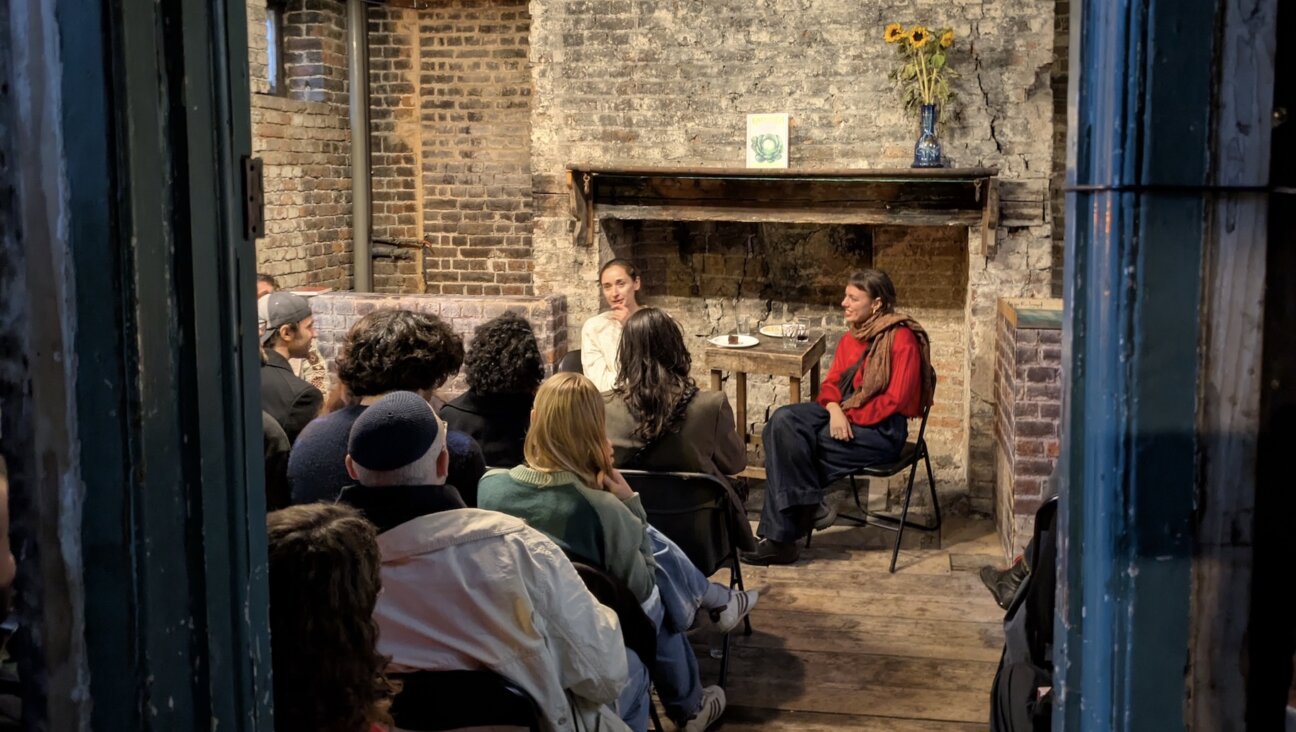
Jordan Wax, outside his home in Santa Fe, New Mexico Photo by Annie Quick

By Zach Golden December 10, 2025
Jordan Wax, a Santa Fe-based composer and performer of Yiddish and New Mexican regional music, has just released a record of original secular Yiddish children’s songs. When asked why, he didn’t skip a beat: “My day job is doing kids’ music,” he said.
It started eight years ago when Wax, who’s a vocalist and multi-instrumentalist, took a job singing bilingual Spanish-English songs for toddlers across the three branches of the Santa Fe public library. The repertoire included traditional songs from New Mexico and Mexico, as well as his own adaptations of traditional songs to make them bilingual and participatory.
Now, he’s a regular feature at the local Jewish preschool, in Temple Beth Shalom. The songs are still bilingual — but this time, they’re in Yiddish and English.
In his new album Pantakozak and Other New Yiddish Songs for Kids, some of the songs were actually written in collaboration with these very preschoolers. “The Polar Bear song came from one of them who was kind of grumpy that day, and just wanted to roar and be ferocious and express rage,” he said.
The album was released by the Yiddish specialist label Borscht Beat in late November of this year.
Wax’s background with children’s music might seem surprising if you’ve heard his other album, the recently-released Taytsh [The Heart Deciphers], which features heavy subject matter like the bloodlust of power, the loss of culture, perpetual war and the fallout of late-stage capitalism, all sung in Yiddish.
At the same time, he’s very comfortable with being silly, and wants people to know that Yiddish culture is, too. “Yiddish music does have a lot of seriousness. It does have a lot of political commentary. It has a lot of spiritual commentary. But it also has fun and goofiness.” For example, “Bulbes,” a nonsense song about eating potatoes everyday, is part of the traditional Yiddish canon.
Along with light humor, Pantakozak is deeply infused with stories and musical references to prewar Jewish Eastern Europe — material that Wax started recording in earnest during a visit to Moldova in 2023. He took a special interest in the traditional Romani Lăutari music of the Bessarabian region, which was once closely entwined with local klezmer music, and befriended the Lăutari band Taraf de Chișinău. They feature on several tracks, including the Hanukkah song Khanike iz Freylekh / Spin Around Like a Dreydl, where Vladislav Tanas’ cimbalom drives the pulsating rhythm.
The album reflects a deep Jewish connection to the Old World. Wax’s late friend, Misha Limanovitch, was a storyteller who grew up in a Yiddish-speaking home in Olechnowicze, formerly Poland, now part of Belarus. Limanovitch made the old world that felt nearly mythical to Wax feel close at hand until he passed away in 2023.
Limanovitch described a resident of the village called Itshke the Klezmer, a recording of which later became the introductory part of Wax’s song, “Itshke the Klezmer.” “He remembered this character in his village who would come around, who was a kind of itinerant musician, a klezmer,” Wax said. “That made a big impression on me after studying klezmer music.” Wax had heard a lot about the village musicians in Eastern Europe, and before hearing about Itshke the klezmer, it all felt “like a million light years away.”
Limanovich also told Wax the story of Pantakozak, the Cossack-like figure who threatened children that he would go into their cradles if they didn’t lay quiet — a story which his sister used to tell him before going to bed. Wax wasn’t sure if this young girl made up the story or not, since he couldn’t find any reference to this creature anywhere.
Wax also looked through the Yiddish Book Center’s OCR (optical character recognition) for phrases that Limanovich had told him about Pantakozak, like “ikh hob dray lange nezer, ikh trink fun draytsn glezer,” (I have three long noses, I drink from 13 glasses) and other absurd rhymes. He found the phrases in the Antologye, 500 yor yidishe poezye, a 1917 anthology of 500 years of Yiddish poetry, in a verse written by the compiler himself, Morris Bassin. Bassin called Pantakozak, the Cossack-monster, by a different name: Gonte Kozak.
Wax was enthused to see that his preschoolers enjoyed the resulting song he composed from the story. One of the preschool teachers sent him a phone video showing a group of four-year-olds sitting around a table during snack time, reciting lines from his song about Pantakozak: “My name is Panta Kozak! I blow up like a blozak! I put on stripey pants, I do my Panta dance!”
The structure of the album is designed not only for kids, but also for their parents and caretakers. The album begins with music aimed at motivating kids to move their bodies and wiggle. One is a Yiddish counting song, “Di hent af di fis un di fis af di hent” (“Your hands on your feet and your feet on your hands”). While it resembles the contemporary English children’s song “Head, Shoulders, Knees and Toes,” it contains references to a traditional Jewish “patsh-tants,” a hand-clapping dance.
Afterwards, the album settles into storytime legends old and new, featuring Limanovich’s tales and a ballad dedicated to Argentinian soccer star Leo Messi. (“There was a kid who wouldn’t sing about anything if it wasn’t Leo Messi,” Wax explained.) The songs then adopt a slower pace until they lead into the peaceful, moving lullaby, “Khayeles Viglid” (Little Chaya’s lullaby).
But when the kids are asleep, the album isn’t over. A more somber adult-oriented piece appears: “Yugnt-Himen” (“Anthem of the Young,” written in 1943 by Shmerke Kaczerginski, the Vilna Ghetto cultural organizer and member of the “Paper Brigade,” the group that smuggled important cultural materials into the ghetto. The melody was composed by Basye Rubin, a contemporary of Kaczerginski’s.
In an archival recording excerpted at the beginning of the track, Kaczerginski recalls the need to give courage to the younger generation through song. “Those times demanded, more than any other time, courage and spirit in the face of despair; I taught this song in the ghetto to children,” he says.
Wax sings the original along with adaptations of his own in English. Its stirring message is meant for everyone: “Yung iz yeder, yeder, yeder ver es vil nor,” anyone who wants to be young is indeed young.
Pantakozak’s lyrics, its embrace of intergenerational bonding and its meaningful historical references — as well as its high quality production and performances — are unusual in children’s music. The care that Wax put into this record comes from his idea that we should respect our children’s intelligence, just as Kaczeginski implied in his introduction to the song.
“They deserve to be given something that has the same integrity as what I would want to be given,” Wax said.
This is a moment of great uncertainty. Here’s what you can do about it.
We hope you appreciated this article. Before you go, we’d like to ask you to please support the Forward’s independent Jewish news. All donations are still being matched by the Forward Board - up to $100,000 until April 24.
This is a moment of great uncertainty for the news media, for the Jewish people, and for our sacred democracy. It is a time of confusion and declining trust in public institutions. An era in which we need humans to report facts, conduct investigations that hold power to account, tell stories that matter and share honest discourse on all that divides us.
With no paywall or subscriptions, the Forward is entirely supported by readers like you. Every dollar you give is invested in the future of the Forward — and telling the American Jewish story fully and fairly.
The Forward doesn’t rely on funding from institutions like governments or your local Jewish federation. There are thousands of readers like you who give us $18 or $36 or $100 each month or year.

Support our mission to tell the Jewish story fully and fairly.