This Pennsylvania rabbi fuses liberal Judaism with Hasidic Yiddish
Born to a Christian mother, Rabbi Cody Bahir had a remarkable journey to the rabbinate that included studying Chinese Buddhism
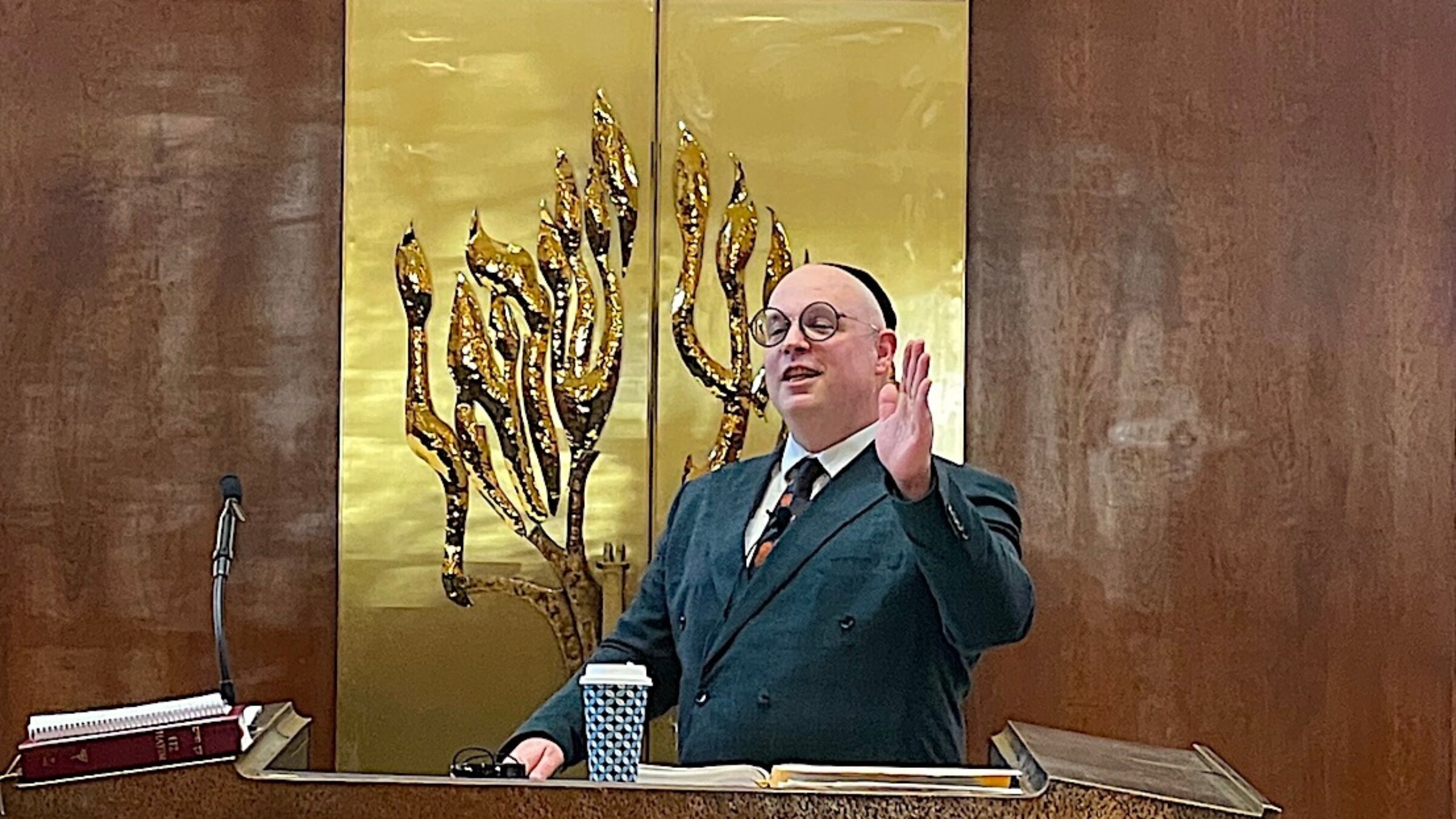
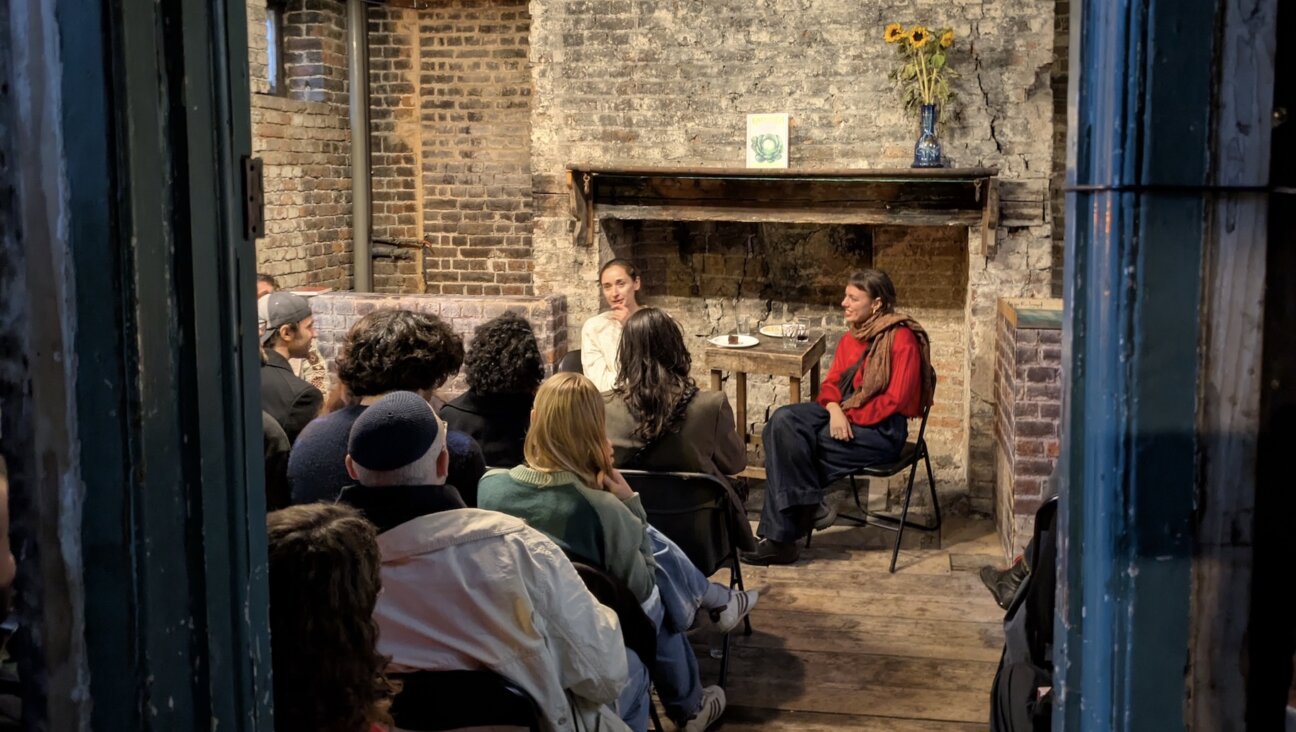
Rabbi Cody Bahir speaking to a local Hadassah chapter at the Congregation Brothers of Israel synagogue in Newtown, Pennsylvania, in early December. Photo by Sonia Bahir
When Americans want to learn Yiddish, they usually sign up for classes at YIVO, the Yiddish Book Center or the Workers Circle. But when someone asks Rabbi Cody Bahir, the newly installed head of a Conservative congregation in Bucks County, Pennsylvania, where he learned Yiddish, he lists a different set of classrooms: a half-dozen Hasidic communities, from Sanz to Satmar.
So how did a Kentucky-born Christian end up with a black homburg and a Southeast European accent in Yiddish?
Born to a Christian mother and a Jewish father who had converted and become a church deacon, Bahir had trouble with the Trinity from an early age. As a child, he would replace the wording “in Jesus’ name we pray” with “in God’s name we pray,” because he reasoned that “we should pray to the boss.”
One day, Bahir’s father received a surprising letter. It was written by his recently-deceased grandmother, who had instructed her attorney to send it to him after her death. She explained that she came from rabbinic stock, but because the family had fallen on hard times, she’d married his secular, well-to-do great-grandfather. She wrote that she felt guilty and heartbroken over her grandson’s lost Jewish heritage.
Moved by the letter, Bahir’s father began exploring Judaism and going to shul — bringing young Cody along. The rabbi there lent Cody a copy of Elie Wiesel’s Souls on Fire. Its Hasidic tales ignited a fascination that would change Bahir’s life.
A Kentucky boy at yeshiva
In the years that followed, Bahir pursued a Jewish education. At the age of nine, he underwent a Conservative conversion. He learned to read basic Hebrew at the Louisville JCC, and attended a traditional community Jewish day school for middle school. But he was soon searching for something more intense.
After an Orthodox conversion at age 14, Bahir left for Skokie, Illinois, to study Talmud and learn rabbinic Hebrew and Aramaic at a Modern Orthodox yeshiva. But the environment proved too modern for him. “They had color TVs, they wore T-shirts — I was looking for something ekht khsidish, authentically Hasidic,” Bahir recalls. To really join the Hasidic world, however, Bahir would need not only the Talmudic skills he was swiftly acquiring, but also something else: fluent, spoken Yiddish.
Bahir spent the next few years studying rabbinic texts and Hasidic Yiddish simultaneously. He joined a Hasidic yeshiva in Monsey, NY and found a pair of Yiddish tutors from two different sects.
His textbook was a copy of Torah Berura — the Biblical text with a translation in modern Hasidic Yiddish (or “plain Yiddish, as it’s known in the community,” he remarked), rather than the older translations in so-called “bubbe Yiddish”, written in a more formal, literary style.
When even that immersion wasn’t enough for him, he crossed the Atlantic to study in Tsfat, Israel. Learning with two different tutors again, Bahir was able to get his Yiddish to the point where he could join a “fully Hasidic yeshiva where English wasn’t even allowed.”
Reflecting on his learning, Bahir said it was a “figure it out and absorb it” kind of experience. Given little formal grammar instruction, he was expected to read the Yiddish aloud, using the Hebrew for translation. On top of formal study, there was also the school of what Bahir called “full inculturation,” as he was encouraged by his tutors to visit specific shuls in Me’a She’arim, Jerusalem, where people spoke only Yiddish.
At the end of his two years of immersion, however, Bahir had doubts about his faith and lifestyle. The aspirational view he’d formed of Hasidism, as he’d understood it from books, didn’t align with his everyday reality as an adolescent in a yeshiva. He couldn’t reconcile his expectations with his perception of his peers: “They were Hasidish, but they were still typical teenagers.” A few months shy of 17, he cut off his sidelocks, changed into jeans and a T-shirt, threw his beaver hat over the Verazzano Bridge and returned to Kentucky.
A winding Jewish journey
Bahir’s path back to Yiddish and Yiddishkeit in the years that followed would take many curious twists. After yeshiva, he began a BA at the University of Louisville in Kentucky, but the culture shock after his yeshiva years was “extreme.” A year in, he “became a hippie” and tried to “find himself,” but ultimately decided he would need to do something with his life.
He set his sights on the American Jewish University in Los Angeles, which seemed like “the perfect place for a wandering Jew to land, where you had the opportunity to be as Jewish as you wanted to be, and were encouraged to figure that out.” And, he added, AJU “was culturally a lot closer to Boro Park than Kentucky.”
Bahir finished his BA at the AJU and then started an MA in Judaic Studies at Hebrew Union College. While still a student in the program, he joined the faculty. Tasked with creating a beit midrash program, Bahir used a Hasidic model he described in these words: “We pop open a sefer, a religious book, we bang our heads against it, we don’t use the dictionaries, we try to make it work.” He felt it was important to teach the students to “chant” the Gemara the same way he’d learned in yeshiva, rather than only to “learn about it.” His students seemed to appreciate this new kind of experience, and the program continued after he left.
When he finished his MA, Bahir felt his old restlessness kick in. He wanted to learn “something different, something newer, to broaden my horizons.” The result: He learned Chinese, did a doctorate involving six years of fieldwork in Taiwan (where he also met his wife, Sonia), and completed a post-doc on Chinese Buddhism at UC Berkeley. Bahir later returned to Jewish education, teaching Jewish studies at The Kehillah School, a high school in Palo Alto and K-8 students at the Tucson Hebrew Academy in Tucson, Arizona.
A new place for Yiddish
Yiddish, which had been such a major element of Bahir’s Jewish journey years before, would also propel him to the next stage in his Yiddishkeit: becoming a rabbi. At the height of the COVID-19 lockdown, Bahir took up Yiddish as his pandemic project. He downloaded some tkhines, Yiddish folk prayers, along with “a dreadful scan” of a Yiddish translation of the Zohar.
When he finally took a YIVO class — the intensive program had gone online for the summer — his own Yiddish was in for a surprise. “In YIVO Yiddish there’s correct, there’s incorrect. But in Hasidic Yiddish,” he noted, “you can make almost anything Yiddish.”
As he returned to the language of his yeshiva days, Bahir also reconnected with his religious side. “The deepest, most transformative spiritual experiences that I’d had in my life — all those happened in Yiddish. Once I started bringing Yiddish back into life, it was like a memory unlocked.”
By 2021, he’d received rabbinic ordination from Mesifta Adath Wolkowisk, an off-campus ordination program for mid-career Jewish professionals. When he saw a job ad for a rabbi in the Taiwan Jewish community, Bahir didn’t hesitate: it was a perfect fit.
In Taiwan, Bahir was eager to introduce “the joy and inclusivity that is the spirit of Hasidus” to his new congregation: “Clapping, singing, banging on the table, a bunch of kavannah,” or intention. The younger crowd at the shul was taken by everything from Rabbi Levi Yitzchok of Berditchev’s Kaddish tune to the music of modern Hasidic stars like Avrom Fried and Beri Weber. One of Bahir’s great successes was acquainting Taiwanese audiences with “Silent Tears,” a Canadian musical project based on the Yiddish testimonies and writings of female Holocaust survivors.
Still, by 2025, Bahir and Sonia were ready for their next adventure. Last summer, Bahir became the new rabbi at the Congregation Brothers of Israel in Newtown, Pennsylvania, and has continued to share his style of “progressive Hasid-ish” Judaism there.
Bahir’s vision of Yiddish remains dynamic: “Yiddish as a language is very emblematic of the Jewish people. It’s gone to so many different places. It collects different words, different phrases, different grammar from all sorts of places, just like we do.” He likes to paraphrase Yiddish sources, such as teachings from the Maggid of Zlotchov, in his sermons.
And these days he’s gearing up to teach Yiddish himself: his prospective class on Hasidic Yiddish will include Rav Nachman stories in the original.
Looking forward, Bahir has high hopes for this Newtown synagogue. Energized by the language’s potential, he believes the shul could very well become a “home for Yiddish in Bucks County.”
This is a moment of great uncertainty. Here’s what you can do about it.
We hope you appreciated this article. Before you go, we’d like to ask you to please support the Forward’s independent Jewish news this Passover. All donations are being matched by the Forward Board - up to $100,000.
This is a moment of great uncertainty for the news media, for the Jewish people, and for our sacred democracy. It is a time of confusion and declining trust in public institutions. An era in which we need humans to report facts, conduct investigations that hold power to account, tell stories that matter and share honest discourse on all that divides us.
With no paywall or subscriptions, the Forward is entirely supported by readers like you. Every dollar you give this Passover is invested in the future of the Forward — and telling the American Jewish story fully and fairly.
The Forward doesn’t rely on funding from institutions like governments or your local Jewish federation. There are thousands of readers like you who give us $18 or $36 or $100 each month or year.
Support our mission to tell the Jewish story fully and fairly.