The Yiddish wisdom of Tim Walz
In declaring ‘We’ll sleep when we’re dead,’ VP candidate Walz was invoking a particularly Yiddish philosophy and work ethic

Tim Walz and Kamala Harris during a campaign event in Philadelphia, Pennsylvania, US, on Tuesday, Aug. 6, 2024. Harris tapped Walz as her running mate, enlisting him to build an electoral coalition of coastal progressives and Midwest moderates to block Donald Trump from the White House. Photographer: Hannah Beier/Bloomberg via Getty Images Photo by Getty Images

By Chana Pollack August 7, 2024
When vice-presidential candidate Tim Walz declared, “We’ll sleep when we’re dead”after his formal introduction in Philadelphia, he was not only quoting rocker Warren Zevon or referencing American revolution tummler Benjamin Franklin who famously declared, “Up, Sluggard, and waste not life; in the grave will be sleeping enough.”
Turns out, Walz was also invoking a well-known Yiddish theme.
The Forverts was writing about shlofn and the science of sleep as early as 1905. And in 1907, in a testimonial for Carmel Wine, Dr. Charles Rayevsky suggested that the sweet ‘n’ ’kosher libation made for a great sleeping aid. Rayevsky noted that the wine was especially helpful for those suffering from lung infections, a common side effect of long hours in the sweatshops no doubt followed by shlof in a crowded tenement.
In 1914, Consolidated Gas of NY, the forerunner of Con Edison, ran a Yiddish ad that might have appealed to our cold weather and climate policy-friendly Minnesota nominee. While today, gas may no longer be sustainable, at the time, we strongly advised to switch from coal, purchase a gas heater, and enjoy the chance to sleep in, seeing as there would no longer be a need to rise early and shovel coal.
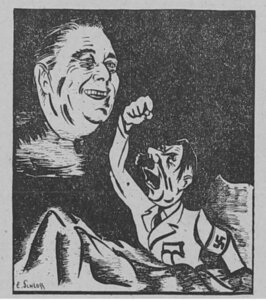
For those who cannot rise to Walz’s ultimate marathon challenge of all work and no sleep, and would prefer to take to your bed, Yiddish is not sympathetic. You’d be encouraged to shlof gikher, men darft di kishins! meaning, “sleep faster, we need the pillows.” And we wouldn’t wish that on the newest nominee whose satiric bursts recall a cartoon published in a 1941 Forverts by Latvian Jewish refugee and noted political illustrator Ezekiel Schloss depicting American President Roosevelt haunting Hitler’s fascist sleep.
Shloflozikayt or sleeplessness is another thing the Forverts has known about for ages. Given the trauma-based tossing and turning of the post-Holocaust era, we even featured an ad for Postum, an early coffee substitute made from roasted grains as a shlofmitl. “NERVOUS?” the ad asked in Yiddish. “Too much coffee? Unable to sleep?”’ Results, the ad promised, would be felt within one week.
Given this highly fraught election, sandwiched between ongoing wars, and the threat of a new one looming any minute in Israel, it may be hard to fall asleep these days. All of which calls to mind another phrase that every political candidate should take to heart: Dos lebn iz nit mer vi a kholem; ober vek mikh nit oyf. Life is nothing more than a dream — but don’t wake me up.
This is a moment of great uncertainty. Here’s what you can do about it.
We hope you appreciated this article. Before you go, we’d like to ask you to please support the Forward’s independent Jewish news this Passover. All donations are being matched by the Forward Board - up to $100,000.
This is a moment of great uncertainty for the news media, for the Jewish people, and for our sacred democracy. It is a time of confusion and declining trust in public institutions. An era in which we need humans to report facts, conduct investigations that hold power to account, tell stories that matter and share honest discourse on all that divides us.
With no paywall or subscriptions, the Forward is entirely supported by readers like you. Every dollar you give this Passover is invested in the future of the Forward — and telling the American Jewish story fully and fairly.
The Forward doesn’t rely on funding from institutions like governments or your local Jewish federation. There are thousands of readers like you who give us $18 or $36 or $100 each month or year.
Support our mission to tell the Jewish story fully and fairly.