Actor-Director Rob Reiner dies at 78
The ‘When Harry Met Sally’ and ‘Princess Bride’ filmmaker was found dead at his home
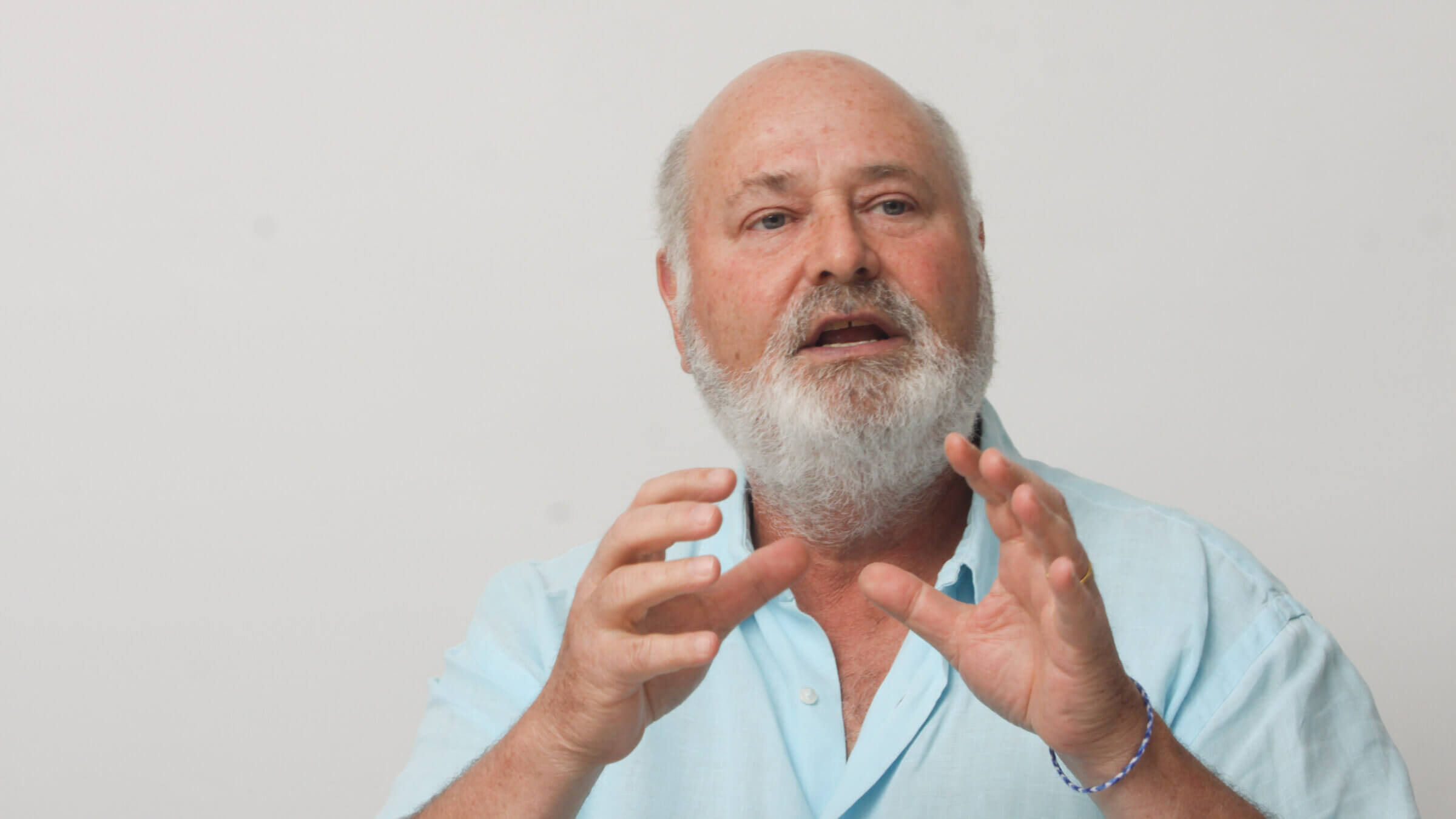
Rob Reiner was found dead with his wife at their home in Brentwood, Los Angeles. Photo by Munawar Hosain/Fotos International/Getty Images

By PJ Grisar December 14, 2025
Rob Reiner, who rose from an early career as a sitcom star to direct a run of film classics that included The Princess Bride and When Harry Met Sally…, has died at 78 along with his wife, photographer Michele Singer Reiner. A family spokesperson confirmed the deaths. Los Angeles authorities say the two were found dead in their home Sunday in what they are investigating as an apparent homicide.
Robert Reiner was born in the Bronx on March 6, 1947, to comedy writer, actor and director Carl Reiner and actress Estelle Reiner (née Lebost). In interviews, Rob Reiner said his early upbringing resembled that depicted in The Dick Van Dyke Show, which his father created, and originally intended to star in when it was called Head of the Family.
Describing his Jewish childhood to JTA in 2017, he recalled his Yiddish-speaking grandmother and his own Yiddish instruction. He described the experience as “home shuling.”
With a notable pedigree, Reiner distinguished himself, first in small TV roles and later as Michael “Meathead” Stivic in All in the Family, the bleeding-heart son-in-law of Archie Bunker. (Reiner, like his late father, was an outspoken progressive and critic of President Donald Trump.)
In a 1994 interview with 60 Minutes, Reiner estimated he’d been called Meathead 1,241 times in that week alone.
But beginning in the 1980s, Reiner emerged as a director, debuting with an immediate comedy classic in 1984’s This is Spinal Tap, arguably creating the genre of mockumentaries, in which he starred as the bumbling director Marty DiBergi.
While made with his friends, the feature was far from a lark. Reiner was instantly prolific, directing The Sure Thing, a modern update of It Happened One Night, the following year. The coming of age classic Stand By Me, based on a Stephen King short story, followed in 1986 and The Princess Bride in 1987, a streak of well-regarded films that, in their staying power, is virtually unrivaled in Hollywood.
Spanning genres from faux-rock doc to postmodern fantasy, Reiner proved his range almost immediately. When When Harry Met Sally… hit theaters in 1989, Roger Ebert dubbed Reiner “one of Hollywood’s very best directors of comedy” — a compliment to remember given some of the critic’s later notices. His next film was Misery, another, more conventionally scary Stephen King adaptation.
Reiner’s career as a filmmaker saw the introduction of screenwriter Aaron Sorkin to the big screen (1992’s A Few Good Men), a famously maligned comedy, North (which Roger Ebert said he “hated, hated, hated”) and more diminishing returns. But even the later works had their impact on the zeitgeist. While not approaching the quotability of Spinal Tap, Princess Bride or When Harry Met Sally… (Estelle Reiner was the one who said “I’ll have what she’s having”), the term “bucket list” entered the lexicon because of his 2007 film The Bucket List.
Beginning in the 2000s, Reiner’s work and public life were largely concerned with activism and civics. He cofounded the marriage equality group American Foundation for Equal Rights. He had a close circle of collaborators, directing a documentary about his best friend, Albert Brooks, but followed it up with the documentary God & Country, about Christian nationalism.
In a 2024 interview, explaining why, as a Jew, he pursued the project, he mentioned a trip he made with his wife the previous year, to Auschwitz, where his wife’s mother was an inmate and the rest of the family was murdered.
“You see what nationalism can do. You see the results of it,” Reiner said in an interview with the Baptist Joint Committee for Religious Liberty. “And so for us who are Jewish by birth, we know what the dangers are, and hopefully this film can at least be a little bit of a teaching tool to everybody.”
Describing his sense of humor, he told JTA there’s a reason Jews are funny. “You have Cossacks. You have Hitler. You have a lot of things weighing down on you. You have to have a sense of humor or you can’t survive.”
Reiner’s final film, Spinal Tap II: The End Continues, a sequel to his first, came out in October.