The Jew who put Hitler on trial — and the play that stages his story
The new play ‘Hans Litten: The Jew Who Cross-Examined Hitler’ recounts the little-known story of a young lawyer’s crusade
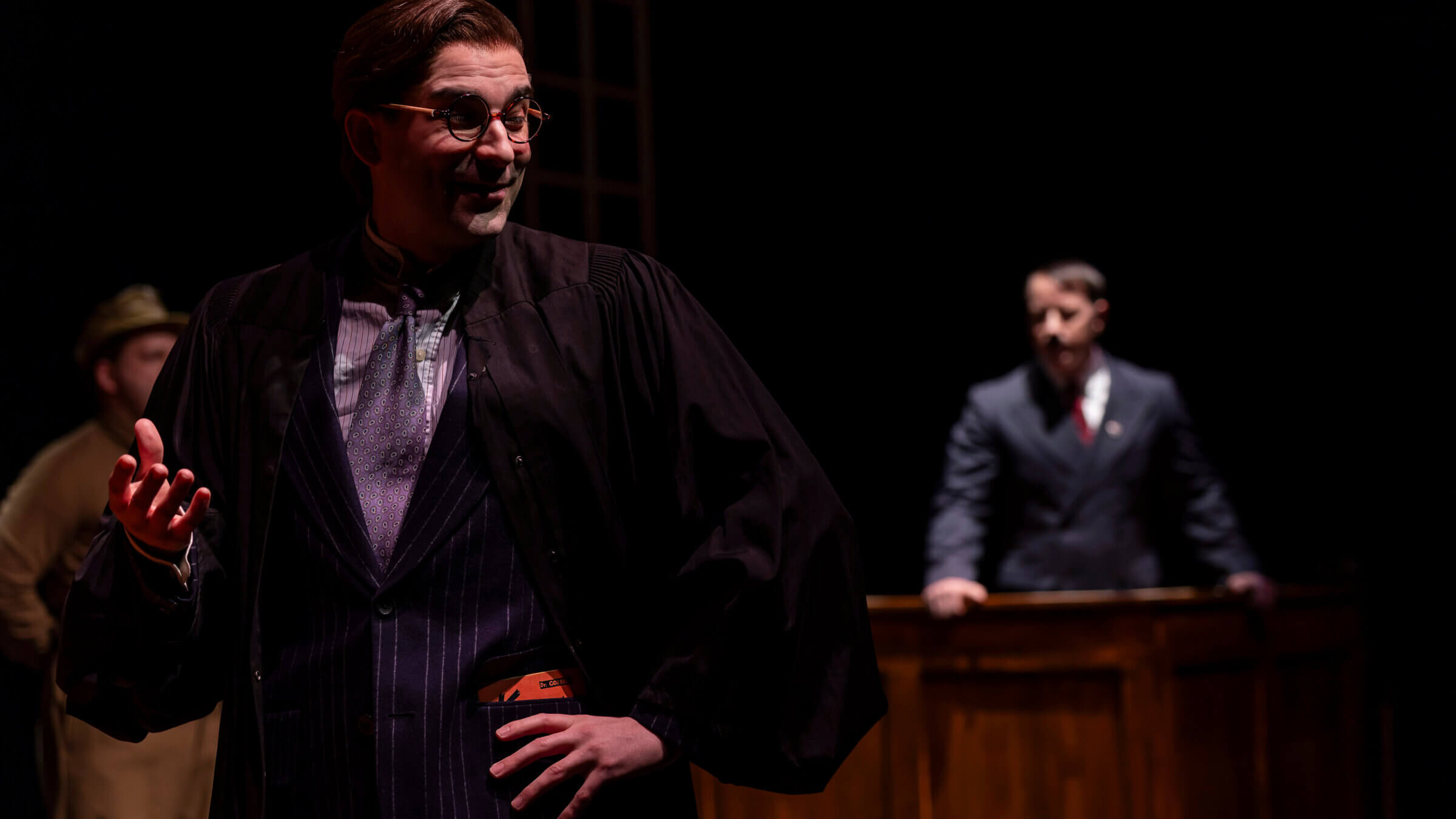
Daniel Yaiullo as Hans Litten and Zack Calhoon as Hitler in The Jew Who Cross-Examined Hitler. Photo by Ben Hider

By PJ Grisar February 5, 2026
An oft-forgotten chapter in Hitler’s life was one the Führer clung to with a vengeance.
In May of 1931, a 27-year-old Jewish lawyer named Hans Litten called the Nazi leader to the stand to answer for the violence of his Brownshirts and the role his rhetoric played in inciting them. Hitler did not like being questioned, and, when he rose to dictator from the ashes of the Reichstag Fire, he wasted no time in retribution.
Litten has seen something of a revival in recent years, with a 2011 BBC TV film, The Man Who Crossed Hitler, and, in a more fanciful vein, as a character in the Weimar noir series Babylon Berlin. Douglas P. Lackey’s play, Hans Litten: The Jew Who Cross-Examined Hitler, now playing Off-Broadway at Theater Row, is both more holistic, and hollower, than previous efforts.
Despite the title, the play, directed by Alexander Harrington, is not a courtroom drama. It begins in 1924 in Königsberg, with Litten’s law professor father, Friedrich (Stan Buturla), discussing his son’s career prospects and handily alluding to the family’s Protestant conversion. Hans (Daniel Yaiullo) is convinced to pursue law, not as a calling, but as a kind of default — tempted, perhaps, by Friedrich’s sunny view of the profession.
“We can change the rules of law to make the law better,” Herr Litten says.
The action jumps forward in fits and starts, finding Litten in his new Berlin practice, where he defends Communists with his party member partner Ludwig Barbasch (Dave Stishan).
One day, Barbasch arrives with news, asking Litten if he’d heard about the case of the Eden Dance Palace, where members of the Nazi SA attacked Communists and claimed self-defense. (Because the play demands this event be explained, Litten, who it is established in the prior scene “reads everything,” hadn’t yet heard of the incident even though it occurred months earlier.)
Litten decides that he will subpoena Hitler, but not before checking out The Three Penny Opera and getting soused afterwards with Bertolt Brecht (Marco Torriani) and Kurt Weill (Whit K. Lee.)
Lackey, a philosophy professor at Baruch College who’s written plays about Wittgenstein, Arendt and Heidegger, is at his best when Hitler is in the dock, within the formal rhythms of a trial. His dialogue has a dialectic quality that lays out characters’ ideas, historical context and a fair amount of musings on Kant with no real room for subtext. Zack Calhoon as Hitler, pretending to disavow violence but barely concealing his rage, sidesteps caricature.
Yaiullo does dependable work as Litten. He plays him as a pedant but as events conspire to haul him off to a series of concentration camps, he develops the aura of a martyr.
“He was a saint,” Benjamin Carter Hett, a Litten biographer said in a 2011 interview with the BBC. “But I have a feeling that, if I sat down to have a beer with him, I wouldn’t like him.”
His prickliness with people, and a doctrinaire commitment to his own personal, unclassifiable politics are hinted at, but soon dissipate as he endures torture, first at Sonnenberg and finally at Dachau. His devoted mother, Irmgard (Barbara McCulloh) visits him in jail, remarking often how people back home regard him as already canonized.
It is documented that while interned Litten would give lectures to his fellow inmates and recite poetry from Rilke. He also, as is shown in the play, defiantly sang Die Gedanken sind frei (“Thoughts Are Free”) when asked to sing the Horst-Wessel-Lied for a Nazi occasion.
That Litten once spoke truth to a rising power, exposing Hitler’s supposed moderation as a farce, will always make him a compelling character. But his example is ultimately dispiriting, showing that changes of law — for the better, at least — are often fruitless against the headwinds of nationalism and cults of personality.
In 1938, Litten ended his life with a noose in a latrine at Dachau. That we now commemorate him in dramas speaks to a sort of victory. That war is what got us there — and judgment at Nuremberg followed — is regrettable evidence of the law’s delay.
Douglas P. Lackey’s play, Hans Litten: The Jew Who Cross-Examined Hitler is playing at Theatre Row until Feb. 22, 2026. Tickets and more information can be found here.
This is a moment of great uncertainty. Here’s what you can do about it.
We hope you appreciated this article. Before you go, we’d like to ask you to please support the Forward’s independent Jewish news this Passover. All donations are being matched by the Forward Board - up to $100,000.
This is a moment of great uncertainty for the news media, for the Jewish people, and for our sacred democracy. It is a time of confusion and declining trust in public institutions. An era in which we need humans to report facts, conduct investigations that hold power to account, tell stories that matter and share honest discourse on all that divides us.
With no paywall or subscriptions, the Forward is entirely supported by readers like you. Every dollar you give this Passover is invested in the future of the Forward — and telling the American Jewish story fully and fairly.
The Forward doesn’t rely on funding from institutions like governments or your local Jewish federation. There are thousands of readers like you who give us $18 or $36 or $100 each month or year.
Support our mission to tell the Jewish story fully and fairly.