Jimmy Carter is 100. In biblical times, that’s a teenager.
Methuselah holds the record at 969, but lifespans dropped significantly after Noah and the flood. Here’s why
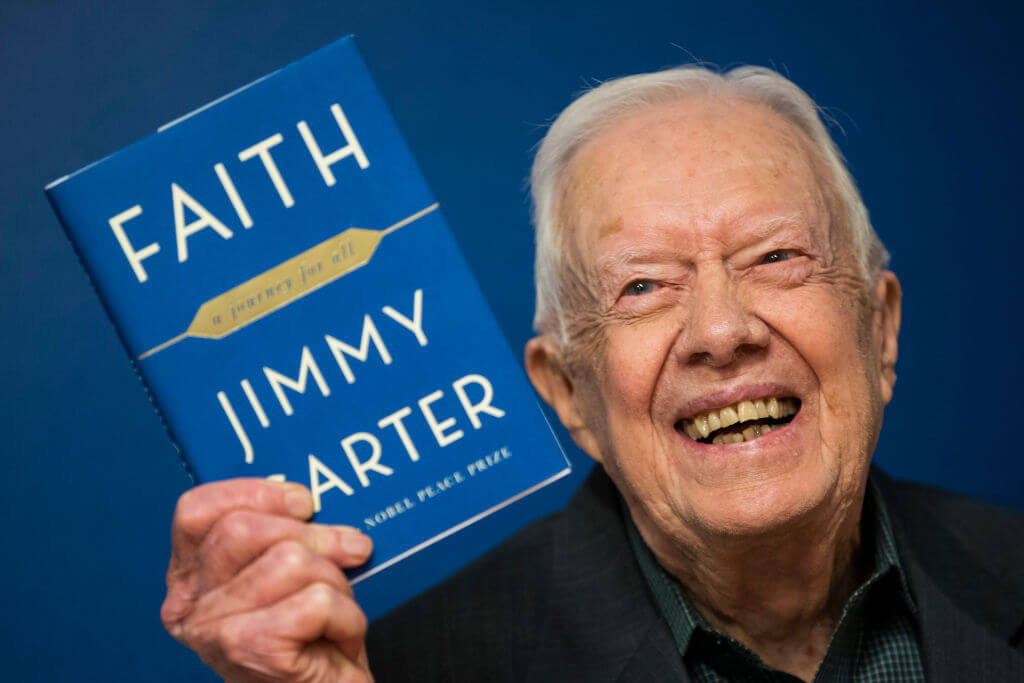
Former President Jimmy Carter holds a copy of his book, “Faith,” at an event in 2018. Photo by Drew Angerer/Getty Images

By Benyamin Cohen September 30, 2024
Benyamin Cohen will be turning 50 next year.
Jimmy Carter turns 100 Tuesday, making him the oldest-ever former president. George H.W. Bush came in second at 94. Gerald Ford and Ronald Reagan lived till 93. John Adams and Herbert Hoover made it to 90.
These all seem quite impressive, especially considering how much being the leader of the free world can age a person. But when you compare them to biblical figures, some of whom lived past 900, they seem like kinderlach.
In this context, Carter’s centennial seems more like a bar mitzvah.
Adam, the world’s first human, set the bar pretty high. Let’s be frank: he was showing off. He lived until 930. If Adam had stuck around another century, he could’ve been there to babysit baby Noah.
The early chapters of Genesis feature a who’s-who of people who lived past 900: Seth, Enosh and Yered. All men. The Bible, alas, is less upfront about the ages of women. Lamech, who is a seventh generation descendant of Adam and Eve, lived a relatively short life when he died at 777. He was mankind’s first musician; perhaps his rockstar lifestyle finally caught up with him.
If the Guinness World Records was around in the era of Genesis, the name Methuselah would be scrawled on the papyrus listing the oldest person ever. He died at 969. Granted, there are Bible scholars who think he wasn’t really that old: Some blame an ancient mistranslation. Musicians George and Ira Gershwin were among the Methuselah truthers; they cast doubt on Methuselah’s longevity in a song from Porgy and Bess, their 1935 opera written with DuBose Heyward.
Noah, who lived to 950, was the last of the super breed of supercentarians. Just like that, you started seeing ages drop: Noah’s son Shem lived to about 600. His grandson Selah? Just 433. Oof.
Something shifted after the flood, and Old Testament obituaries were never the same. So, what happened? Was there something in that floodwater?
Rabbi Chaim ibn Attar, a prominent 18th century Sephardic sage commonly referred to as the Ohr Hachaim, offered an answer. He explained that God’s original plan was for people to live for centuries. But God pivoted after seeing what humans were doing with all that extra time: Lying, cheating, scamming, launching a crypto pyramid scheme. Look, when you know you’re going to live past 900, you end up wasting a lot of time. You sin as much as you want, knowing that, hey, there’s always time to repent later.
“Part of the reason for the corruption was when someone knows they can live so long, they don’t sense the urgency of life,” explained Rabbi Daniel Cohen, the author of the book What Will They Say About You When You’re Gone? Creating a Life of Legacy and the oldest of my rabbinic brothers.
“God shortened the lifespan of mankind to force us to confront our mortality earlier,” my brother told me when I interrupted him while he was writing his High Holiday sermon. “This reminds us that we have to infuse our lives with more meaning and purpose.”
The bottom line: You have a limited time here on Earth. Make the most of it. Stop futzing around on TikTok all day and carpe that diem.
When God decided to wipe out everyone but Noah’s family, he decreed in Genesis 6:3 that a full life would last 120 years.
By that measure, Carter, a former Sunday School teacher, still has some time left on the clock. He’s already far exceeded expectations. The average hospice stay is three months. Carter, who entered hospice in February 2023, is starting his 20th.
A miracle of biblical proportions? Time will tell.
It’s our birthday and we’re still celebrating!
We hope you appreciated this article. Before you go, we’d like to ask you to please support the Forward’s independent Jewish news.
This week we celebrate 129 years of the Forward. We’re proud of our origins as a Yiddish print publication serving Jewish immigrants. And we’re just as proud of what we’ve become today: A trusted source of Jewish news and opinion, available digitally to anyone in the world without paywalls or subscriptions.
We’ve helped five generations of American Jews make sense of the news and the world around them — and we aren’t slowing down any time soon.
As a nonprofit newsroom, reader donations make it possible for us to do this work. Support independent, agenda-free Jewish journalism and our board will match your gift in honor of our birthday!
Support our mission to tell the Jewish story fully and fairly.