At soldiers’ graves, the rows keep growing: Israel’s Memorial Day is shaped by new loss
“Every day is Memorial Day for us,” said a mother whose son was killed in 2024
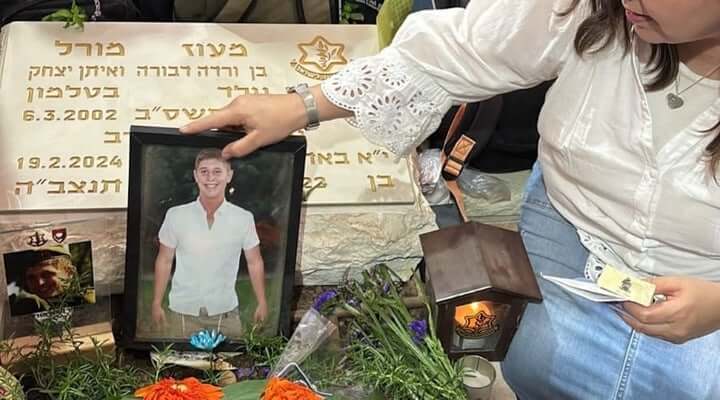
Varda Morrell lays a photo at the gravesite of her son, Israeli Staff Sgt. Maoz Morell, in 2025. (Courtesy Varda Morell)
(JTA) — TEL AVIV — When Varda Morell stands by her son’s grave in Jerusalem’s Mount Herzl military cemetery this Memorial Day, the official ceremony unfolding nearby will barely register. That was true in the two Memorial Days since Maoz was killed in Gaza in February 2024. What she will see instead is a swath of fresh graves, the once-empty section where he is buried now completely full.
“Each time we’ve come to visit his grave, there’s another row and another row and another row,” she said.
Across Israel, families marking Memorial Day, known as Yom Hazikaron, are doing so this year against a backdrop of continued fighting, successive ceasefires and a steady stream of new casualties, turning what is meant to be a day of remembrance into one that, for many, isn’t rooted in the past. The Israeli government says 170 soldiers and security personnel were killed since Yom Hazikaron last year.
For the sixth consecutive year, the official ceremonies did not follow their traditional format, after successive disruptions that began with the pandemic and later included political turmoil, wildfires and wartime restrictions.
For Morell, the recent “cleared for publication” announcements naming soldiers killed in Lebanon have brought it all back. “My heart feels sick just thinking about it,” she said on her way to deliver a Memorial Day talk at her son’s paratrooper base. “I remember what those first days were like, and what those families are going through now that they’ve joined this club. The club that no one wants to be a part of.”
In recent years, a growing number of bereaved families have chosen to boycott official ceremonies altogether. More than 150 signed a letter last week urging coalition lawmakers not to speak at military cemeteries, saying their loved ones’ graves should not be used as a “political platform for divisive messages.” Many still gather at the graveside with their families or communities, while others have said it was too painful to visit on the day itself.
Orit Shimon, who lost her son Dotan in September 2024, said that after her daughter Nufar was killed in a traffic accident in 2013, she came to see Yom Hazikaron as “as holy as Yom Kippur,” marking it by visiting her grave and then returning home to watch television programs about fallen soldiers. But after her son was killed in Gaza, she stopped watching altogether. Her connection to him, she said, is not at his grave but in the photos and videos she returns to again and again.
This year, despite her husband’s objections, Shimon chose not to send out messages inviting people to come and pay their respects, but expects that neighbors from her West Bank settlement of Elazar will come anyway.
“We don’t need a Memorial Day — it’s for other people. Every day is Memorial Day for us,” she said.
Shimon was among more than 450 bereaved parents who spent the weekend ahead of Memorial Day together at a Tel Aviv hotel, part of an annual retreat organized by OneFamily, an Israeli nonprofit that supports families of fallen soldiers and victims of terror. The organization held its own Yom Hazikaron ceremony in Jerusalem, designed as a space for bereaved families to share their stories openly with one another, rather than participate in the formal national commemorations. A day after Memorial Day, on Israel’s Independence Day, OneFamily founder, Chantal Belzberg, will officially receive the Israel Prize for lifetime achievement.
Amir Avivi, a retired top IDF official and founder of the Israel Defense and Security Forum, was slated to give an address over Shabbat on the regional geopolitical context. The weekend came just after successive ceasefires, first with Iran and then with Hezbollah, at a time when many Israelis argued the fighting had ended before the job was done — a question that, for some bereaved parents, was more acute, as they grappled with whether their sons’ deaths had been in vain.
But his message, Avivi said before the session, was “packed with optimism.”
“We need to look at the whole picture, not every ceasefire is the end of the world,” Avivi said, pointing to what he described as Israel’s string of gains since Oct. 7, from the degradation of Hamas and Hezbollah to the campaign against the regime in Tehran. “Who would have imagined America fighting side by side with Israel to take out an existential threat? I fully believe a golden age is coming.”
In another session, led by Eti Ablin, a clinical social worker and bereavement specialist, the discussion turned to the months and years after the loss. Some spoke about going from ceremony to ceremony in the first year, while others said that over time, the visits and calls from supporters had become less frequent.
One woman said that in the months after her son was killed, the constant presence of visitors had felt overwhelming, but that in the years since, she had noticed neighbors crossing the street to avoid her.
Another parent, whose son was killed at the Nova music festival, described organizing a birthday gathering in his memory that drew hundreds of people. “It’s up to us to make people come,” he said, before breaking down.
Ablin, who co-chairs a national forum on grief and bereavement, said hope requires an active effort. “Hope is not the same as saying, ‘it will be okay,’” she said. “There’s no expiration date to the pain. So you have to put boundaries around it and learn how to find your way out of it.”
Tali Marom from Ra’anana, whose son Roee, a squad commander, was killed early in the war, said that idea resonated. “We learn to live alongside the pit of despair and we build exit strategies for when we fall into it,” she said.
Being with other bereaved parents, she said, was one of those ways out.
“I don’t know how I would have gotten through this Shabbat without this,” she said, gesturing to the room. “I may not know who that woman is over there, but I know what she’s going through.”
At dinner, the conversation turned to a law requiring bereaved parents to sign off on combat service for surviving children. Marom said she had been asked to approve such a request for her daughter, describing it as a burden she had never imagined.
Another parent said he had to sign repeatedly as his son crossed into Lebanon during operations, because each crossing of an international border required renewed authorization, forcing him to confront the emotional weight of that decision each time.
“Thank God I don’t have that to deal with as well,” a third parent said.
Other discussions turned to what people did with their children’s belongings after their deaths.
Nechama Aharon, from Pardes Hanna, whose son Yogev was killed on Oct. 7 battling Hamas at the Kissufim base in the Gaza envelope, said she has no intention of parting with any of his belongings, saying it matters more to her than visiting his grave, which she does twice a year — on the anniversary of his death and on Memorial Day.
“No matter what happens, I’ll never touch anything in his room. I’m leaving absolutely everything the way it was,” she said. “I know that he might not be with me physically, but this way I feel like I’m preserving his memory.”
Shimon said that, for her, holding on to her son had come to mean making sense of the way he died.
“For a long time, I couldn’t think about anything except that I no longer had my son,” she said. “Another year has passed in which he could have been alive, and he’s not. But slowly I came to realize he didn’t die in a car accident. He was doing what he wanted to do. He went to bring the hostages back. His death was not meaningless.”
Morell said she has tried to preserve her son’s memory through projects in his name, including a film about his life for friends, family and Jewish communities in the United States, where she grew up, to connect to his story.
She contrasted the experience with America’s Memorial Day, describing it as largely detached from the reality of loss, marked more by sales and barbecues than remembrance.
“Here it’s so different,” she said. “It’s so moving to me that thousands and thousands of people, many of whom are strangers, come to pay their respects. And we know that even when we’re not around any more, a soldier will be sent to stand by Maoz’s grave. His legacy will live on. That gives us a lot of comfort.”
Did you know that only 2% of Forward readers donate to support our nonprofit newsroom? That 2% make it possible for millions to read the Forward without a paywall or subscription — removing any barriers to the full and fair Jewish story.
But while the Forward is free to read, it isn’t free to produce. Big stories — like deep dives into the antisemitism data, political scoops or reporting trips to college campuses — take months of research and fact-checking. All while we keep you informed of what you need to know each day.
— Rachel Fishman Feddersen, Forward Publisher & CEO
Support our mission to tell the Jewish story fully and fairly.