Netanyahu heckled at Israel’s official Memorial Day ceremony as bereaved families grasp for comfort
A different skirmish also broke out at a ceremony at Tel Aviv’s military cemetery
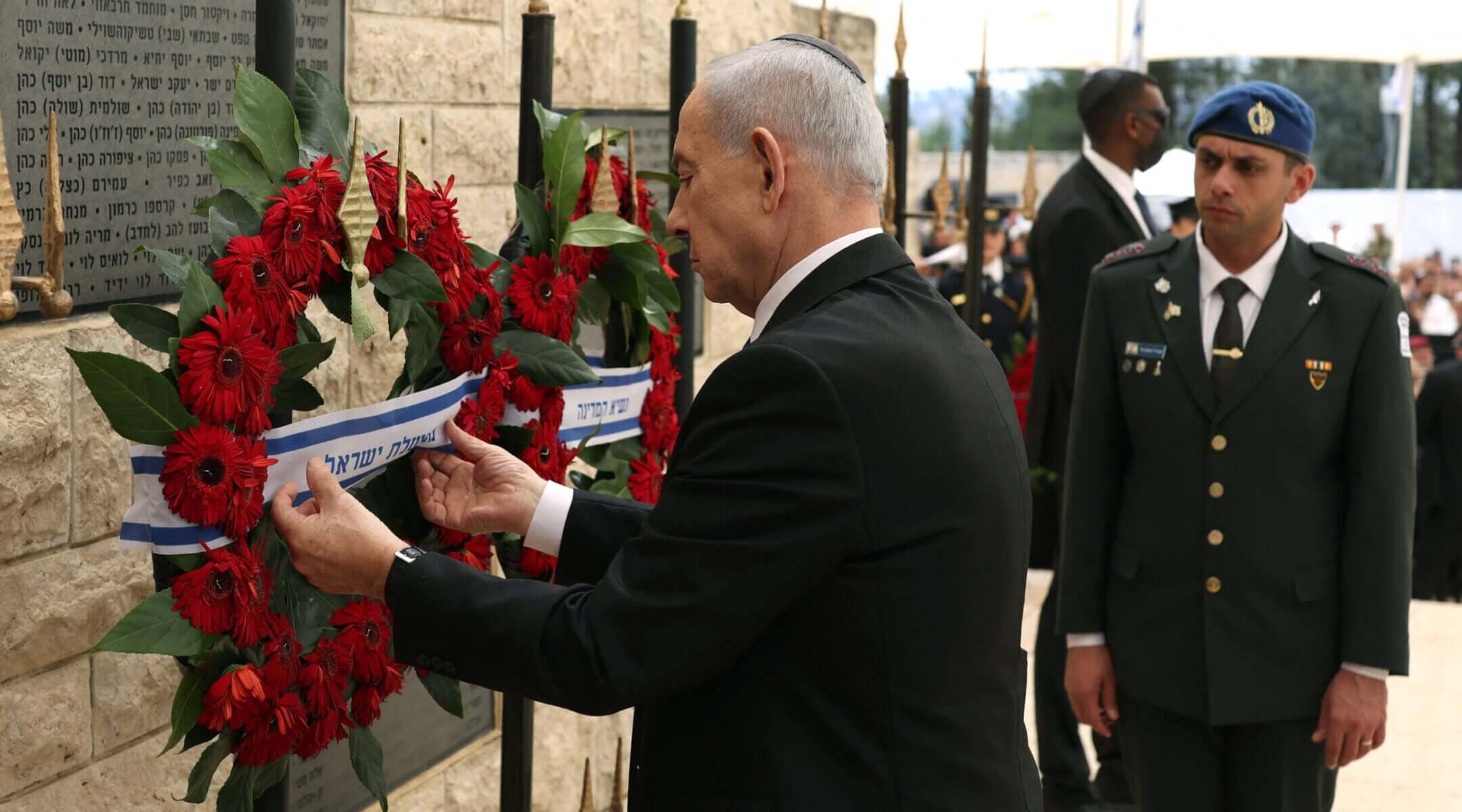
Israeli Prime Minister Benjamin Netanyahu places a wreath during a ceremony marking Israel’s Memorial Day for fallen soldiers at the military cemetery on Mount Herzl in Jerusalem, April 21, 2026. (Ilia Yefimovich / Pool / AFP via Getty Images)
(JTA) — TEL MOND, Israel — Thousands of Israelis gathered in cemeteries all over Israel to commemorate the nation’s fallen soldiers and terror victims on Memorial Day, as public mourning collided with political anger, fresh wartime uncertainty and the private aftershocks consuming bereaved families.
In a Memorial Day message to bereaved families, Prime Minister Benjamin Netanyahu also addressed the war against Iran and its Lebanese proxy Hezbollah, saying Israel has “already removed an existential threat.”
A short while later, President Donald Trump told CNBC’s Joe Kernan that he “expects to be bombing” Iran again if talks collapse ahead of Wednesday’s ceasefire deadline.
“We have returned all our hostages, struck our enemies hard, and made Israel a nation stronger than ever before,” Netanyahu said at an official Memorial Day ceremony at Mount Herzl in Jerusalem.
His comments prompted a heckler in the crowd to yell out, “Some of them died in tunnels,” in reference to the Israelis kidnapped to Gaza by the Hamas terror group and held underground.
Skirmishes broke out during a speech by MK Ofir Sofer, of the far-right Religious Zionist party at the Kiryat Shaul military cemetery in Tel Aviv, when attendees attempted to snatch signs held up by protesters that read “Government of death” and “I refuse to hear words of comfort from a government of criminals.”
At a cemetery in Tel Mond, Eyal Golan, whose sister Shirel died by suicide on her 22nd birthday, a year after surviving the Nova massacre near the Gaza border, also had harsh words for the government.
Reflecting on Knesset debates he attended after his sister’s death, as he pushed for a law in her name to provide unlimited, comprehensive mental health care to victims of terror, Golan said he was furious at what he described as the performative behavior of politicians from both the coalition and opposition.
“Off camera, they speak to each other normally,” he said. “But the moment the cameras turn on, it’s showtime. They fall into their roles, shouting and attacking each other. I’m sitting there thinking, how can this be real?”
“Instead of coming together, they just deepen the divide,” he said, but he credited two Knesset members from opposite sides of the political aisle — Moshe Gafni of United Torah Judaism and Merav Michaeli of Labor — with taking up the cause and advancing the legislation.
Eyal and other members of his family say the government failed Shirel as she grappled with acute PTSD in the months after the attack. Now advancing the bill, he said he hopes it will spare other families the same fate.
“The whole point of my crusade is to save others. No one will be able to bring back my sister. If I’m able to save one more soul, I’ve done my job,” he said.
The legislation, known informally as the Shirel Golan law, passed a preliminary reading in January 2026.
Sitting close to his daughter’s grave, covered in flowers, wreaths and candles, Eyal’s father Meir said he has fallen into a strange nightly ritual. Every night, he wakes up at 3 a.m. and makes himself a cup of coffee. He opens the smart TV to her YouTube account and for an hour or so watches the videos she had liked and subscribed to, including trance music emblematic of the Nova scene. At 4 a.m., he returns to bed.
“As soon as I turn it on, it says, ‘Hello Shirel, welcome back,’” Meir said, adding that it gives him a measure of tranquility, as if his daughter “is still around.”
Later, as Eyal made the 45-minute drive back to his home in the central Israeli city of Holon, he described the journey as the emotional hinge between mourning and the return to ordinary life.
“It’s a kind of magic hour during which I store the grief of the day in a box in my mind,” he said. “By Independence Day, I’ll go back to my main role, being a father to two daughters.”
He added, “That journey is a microcosm of Israeli society.”
Meir’s late-night visits to his daughter’s digital world are part of a wider private language of mourning that has taken hold among bereaved Israeli families, many of whom continue to reach for their dead through screens. On phones across the country, especially on the popular messaging platform WhatsApp, parents and siblings keep sending messages to loved ones who were killed, writing as if the conversation never ended. The messages, some of which were recorded in a special Memorial Day project by the Ynet news site, come at unguarded moments, during a football game, before a birthday, or in the middle of the night.
“What a goal, Yahav,” one father, Nir Maayan, wrote to his son, Yahav, who was killed in Gaza in January of last year.
Texting his son from his graveside, Nir wrote: “There are days of collapse, of longing, of not being able to accept reality. Moments when I try to imagine your final moments. What did you think? What did you feel? Answers I will never know. So I just rest my head on you, and somehow you comfort me and hold me. Someone is watching over me from above.”
“Tomorrow is your birthday, send mom a message,” a sister wrote to her deceased brother.
“The sky is beautiful today,” another wrote.
Dorit Ron keeps on texting her son Itai, who was killed on Oct. 7 at the Nahal Oz base near the Gaza border. “I expect an answer, a sign that he’s okay and with his father,” she said, according to the report. “Even though I know he won’t reply, to me he’s alive, just nearby, in another dimension.”
Did you know that only 2% of Forward readers donate to support our nonprofit newsroom? That 2% make it possible for millions to read the Forward without a paywall or subscription — removing any barriers to the full and fair Jewish story.
But while the Forward is free to read, it isn’t free to produce. Big stories — like deep dives into the antisemitism data, political scoops or reporting trips to college campuses — take months of research and fact-checking. All while we keep you informed of what you need to know each day.
— Rachel Fishman Feddersen, Forward Publisher & CEO
Support our mission to tell the Jewish story fully and fairly.