A suspect is charged in one of Toronto’s Jewish shootings — but the bigger picture remains murky
Police are still investigating whether there was any link between the recent synagogue and Jewish restaurant attacks in Toronto
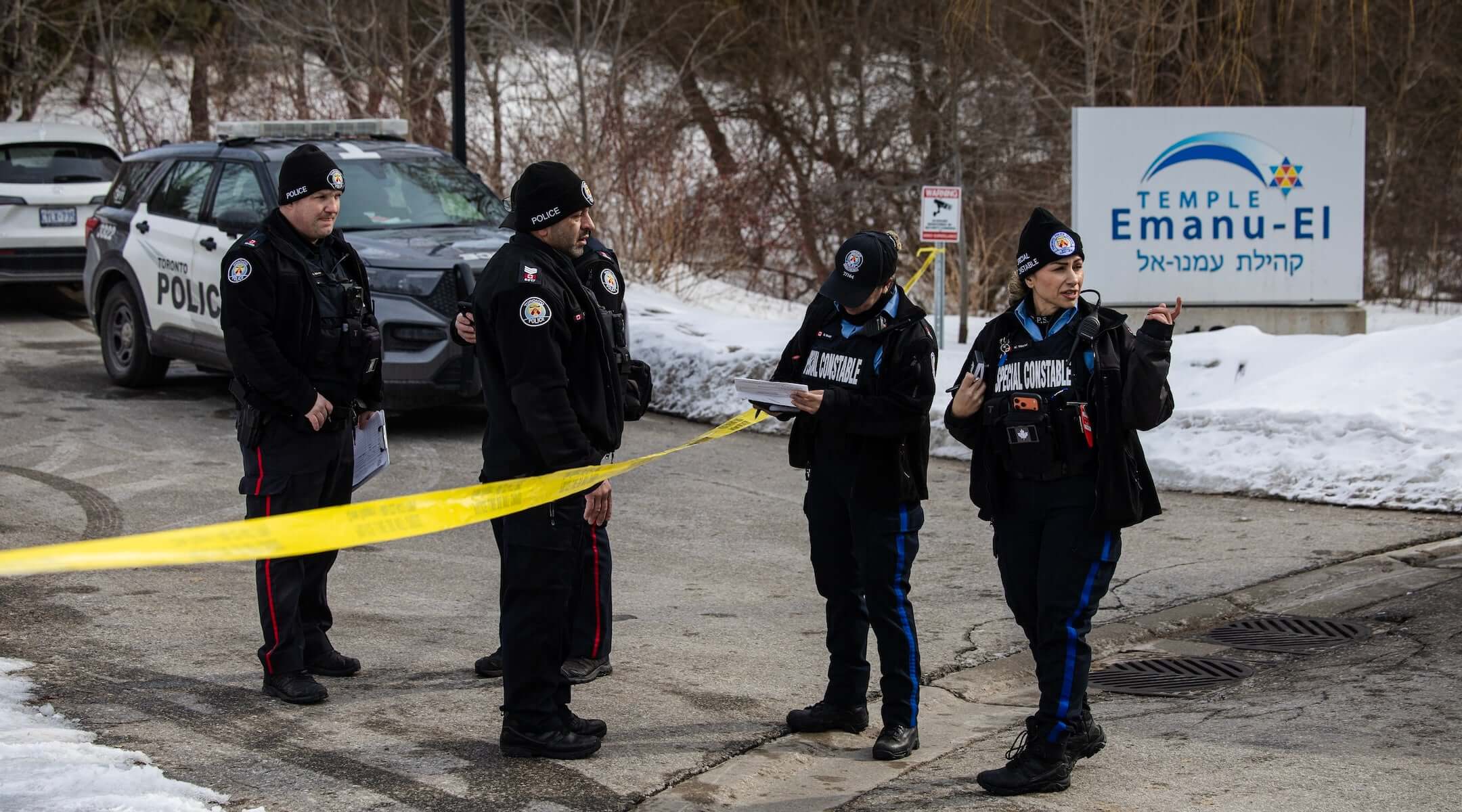
Police investigate the site of North York’s Temple Emanu-El after it was shot at late on a Monday night, Toronto, Mar. 3, 2026. Photo by Nick Lachance/Toronto Star via Getty Images
(JTA) — TORONTO — After a man riddled a Jewish-owned restaurant with bullets in uptown Toronto, police accomplished something earlier this month that they hadn’t done following previous attacks on Jewish sites: identify and charge a suspect.
The 35-year-old suspect, Mohamed Mahdi, was arrested just a few days after the April 3 attack and charged with on multiple gun-related offenses.
His arrest provided the first, and to this point only, public pieces of information that could chip away at the mystery that has roiled Toronto’s Jewish community: Who is shooting at these synagogues and Jewish businesses? And how do they keep getting away with it?
In early March, three synagogues were targeted with gunfire in the span of a week, one with the rabbi still inside following a Purim event. A different location of the Jewish-owned Old Avenue Restaurant was hit as well, about a month before the latest shooting.
Similar attacks took place in 2024, when a girls elementary school was hit with gunfire three times throughout the year.
The nature of these attacks have been nearly identical: A man approaches the building late at night with a mask or hood covering his face and fires bullets at the door or a window before driving or running off.
The recent string of shootings came as a number of Jewish institutions have been attacked around the world, with security groups urging heightened vigilance. It renewed the fears sparked by those 2024 shootings, and — until Mahdi’s arrest — frustrations over a lack of repercussions for the shooters.
“I know that a lot of people in Toronto, a lot of members of our Jewish community, are saying that the police are not doing enough,” said Guidy Mamann, the president of the Toronto Zionist Council who organized weekly pro-Israel hostage rallies.
Mamann said he does not himself agree, and thinks the police are doing what they can — but others have put the pressure on.
“Dispense with the thoughts and prayers and get to work,” Rabbi Daniel Korobkin, whose congregation, Beth Avraham Yosef of Toronto, was shot in March, told Global News at the time.
According to Jevon Greenblatt, CEO of Toronto’s Jewish Security Network, the attacks themselves have been planned in a way that minimizes the risk of getting caught.
“These types of attacks are unfortunately designed to be quick and low-risk for the person carrying them out, late at night, minimal time on site, and often no interaction with anyone,” Greenblatt said in an email to the Jewish Telegraphic Agency. “That often means fewer witnesses and less immediate evidence.”
Police credited the arrest to an increased deployment of officers — “both overt and covert” — to Jewish neighborhoods, which was especially pronounced during Passover, when the latest shooting took place.
“Specifically in the case, covert assets saw the suspect fleeing and gathered critical information that led to his arrest,” police chief Myron Demkiw said in a press conference.
Mamann said it was “great” that police were able to thwart the attack. But he also pointed out that Old Avenue Restaurant had already been targeted once, perhaps making it a prime location for police to monitor.
“They said they were able to find the suspect through covert measures, that’s great,” Mamann said. “Can you deploy those covert measures everywhere? Would they be effective? Would they be 24 hours? Or were those covert measures deployed because they had information that something might happen?”
A pair of incidents this past weekend added to Toronto Jews’ rising security concerns. One man assaulted a father on his way to Shabbat service at the Sephardic Kehilah Centre, after attempting to force his way inside; the following day, a rock was thrown through the window of a Judaica shop on the heavily Jewish Bathurst Street corridor. Both occurred in broad daylight, and neither suspect has been identified.
As for Old Avenue Restaurant, police said they are investigating why it was targeted twice. Its owner, Esther Bakinka, is a prominent pro-Israel advocate who organized hostage rallies alongside Mamann. Bakinka declined to comment; Mamann said she is “very strong” but that “that has got to leave you pretty shaken up.”
Even after Mahdi’s arrest, a number of question marks remain for Toronto’s Jewish community.
Chief among them is whether there is a direct link between the shootings that have taken place across the city. Greenblatt said the arrest was an “important development” and could potentially help answer that question while also dissuading copycat attackers.
“We’re hopeful this may help establish whether there are any links to the other incidents, and more broadly, that a visible arrest and charge acts as a deterrent,” Greenblatt said.
Unlike the 2024 shootings at Bais Chaya, the Jewish girls’ elementary school, the recent string of synagogue and Jewish restaurant attacks have come as Israel is at war with Iran. Iran has a long track record of sowing violence against Jewish and Israeli targets abroad. In the last couple of weeks, a string of arson attacks have targeted Jewish sites in the UK, with many being claimed by a new, Iran-linked group that says it is behind similar attacks across Europe. Jewish security groups have urged heightened caution since the war broke out, with one watchdog calling it “the most elevated and complex threat environment” in recent history.
Greenblatt said there is no evidence that there has been direct coordination between the incidents, but that a broader form of influence could be at play. He said that there is an “increased emphasis, similar to what we’ve seen from groups like ISIS and Hamas, on encouraging so-called ‘lone actor’ activity.”
“The rhetoric and messaging are often designed to inspire individuals to take action on their own, rather than operate under direct instruction,” Greenblatt said. “So, while there may not be evidence of direct coordination between incidents, they can still be linked by a shared influence or narrative environment that encourages this kind of behavior.”
Police upped their presence in Toronto after the outbreak of the Iran war, and announced a new Counter-Terrorism Security Unit following the three synagogue attacks. In the announcement, Demkiw highlighted “global conflicts, extremist ideologies, online radicalization, hostile foreign actors and heightened polarization” as “realities that impact both our work and the sense of safety in our communities.”
Demkiw also announced Task Force Guardian, an initiative that deploys officers armed with patrol rifles at key locations like houses of worship to deter potential attackers. A week later, Old Avenue Restaurant was hit with more than a dozen bullets.
The whole thing has left Jewish Torontonians feeling uneasy.
Even as police stand outside more houses of worship, carry bigger guns and gather more intelligence, Mamann said he worries that the community is vulnerable to a sudden attack like the shooting at Bondi Beach in Sydney in December that killed 15 people at a Hanukkah event.
And in his conversations with other Toronto Jews, Mamann said they’ve theorized about who’s been behind the shootings.
“We’re thinking like this: The folks that we deal with at Bathurst and Sheppard, some people consider them annoying or intimidating,” he said, referring to the pro-Palestinian protesters who would show up across the street from his group’s hostage rallies. “But it doesn’t appear that we’re dealing with that crowd.” The suspect, Mahdi, may have a criminal record. In 2019, a 29-year-old man named Mohamed Mahdi was arrested for attempted murder and unauthorized possession of a firearm, in connection with a shooting. Police did not confirm whether it was the same Mohamed Mahdi, but the ages line up, and both were identified as being from the suburb of Brampton.
Meanwhile, Mahdi’s arrest has put to rest some of the theories that these attacks have been false flags coordinated in order to drum up sympathy for the Jewish community.
Mamann said he believes the shooters are professionals with potential ties to the Islamic Revolutionary Guard Corps, who are willing to risk going to jail on firearm charges. Police in the UK said earlier this week that recent arson attacks may have been carried out in exchange for payments from Iran, based on emerging evidence.
“I think we’re dealing with a whole different cohort of people, and it could be state-sponsored, I don’t know,” Mamann said. “And that’s why it creates a lot of concern: We don’t know how to deal with this.”
This article originally appeared on JTA.org.
I’m personally matching all gifts to the Forward, up to $36,000. Can I match your gift now?

Hello, fellow Forward reader! I’m Joel Brown, a Forward reader and supporter for more than 15 years, and currently the chair of the board of directors.
I’m an avid Forward reader because it ticks so many of my essential boxes: excellent journalism, Jewish focus and diverse viewpoints. In today’s political climate, what I most appreciate is the Forward’s independence — made possible by the generosity of its membership.
The Forward is committed to bringing you unbiased, nuanced Jewish news. From my position as board chair, I see an exciting future as we expand our position as the definitive independent voice of contemporary American Judaism.
— Joel Brown, Forward board chair
Support our mission to tell the Jewish story fully and fairly.