Sex Therapy and the Holocaust
Graphic by Angelie Zaslavsky

By Naomi Zeveloff January 28, 2014
The fact that Dr. Ruth Westheimer, arguably the most famous sex therapist alive today, is also a Holocaust survivor always struck me as nothing more than a surprising coincidence. Survivors went on to occupy a range of professions — why not sex therapy, too?
But it turns out that enduring trauma — or at least living among the traumatized — can be a source of insight into the role erotic expression plays in rebuilding a healthy life.
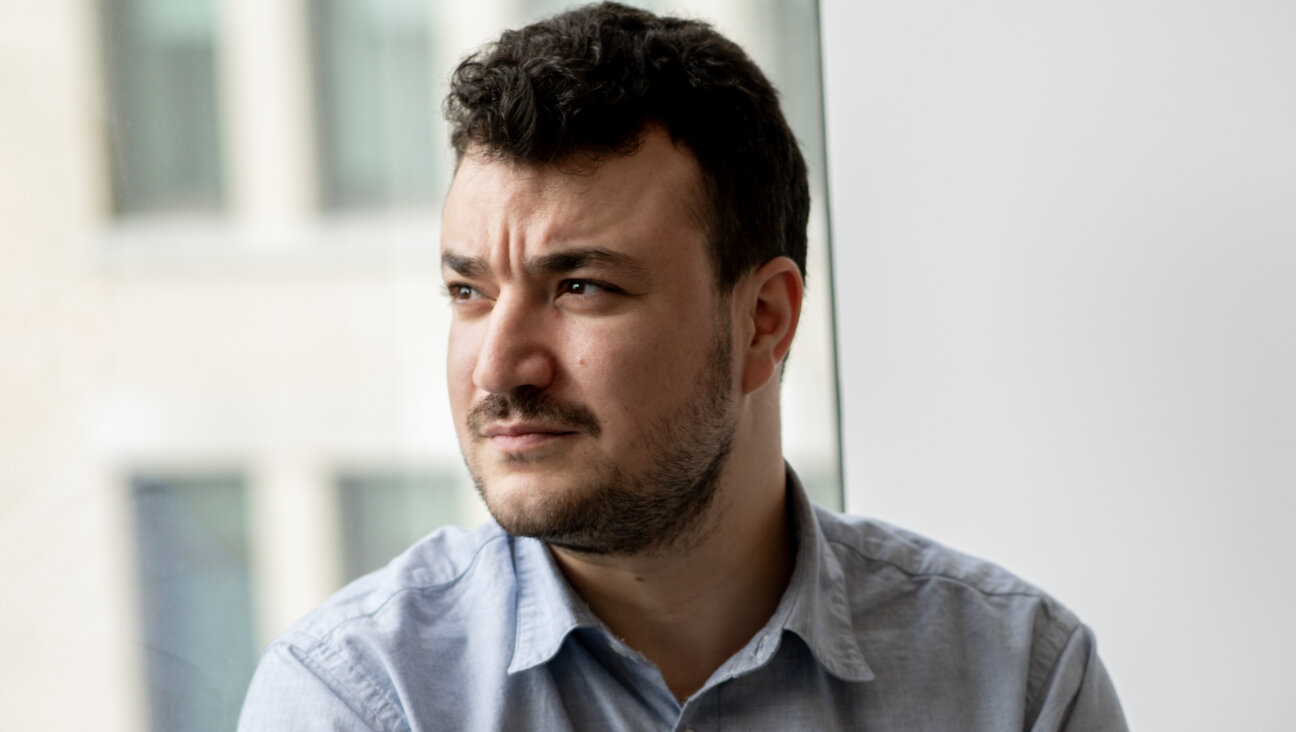
Esther Perel (pictured above), the author of “Mating in Captivity: Unlocking Erotic Intelligence” and the subject of a recent New York Times profile, grew up in a community of Holocaust survivors in Antwerp, Belgium. She noticed that some people, like her parents, seemed to regain joy in their lives while others didn’t. Later, as a therapist who worked with refugees, she made the link between erotic fulfillment and recovery.
Here’s Perel in an interview with Psychotherapy.net:
My husband directs the International Trauma Studies Program at Columbia, and he works a lot with torture survivors. I would wonder, “When do you know that you have reconnected with life after a traumatic experience?” It’s when people are once again able to be creative and playful, to go back into the world and into the parts of them that invite discovery, exploration, and expansiveness—when they’re once again able to claim the free elements of themselves and not only the security-oriented parts of themselves.
In the community of Holocaust concentration camp survivors in Antwerp, Belgium where I grew up, there were two groups: those who didn’t die, and those who came back to life. And those who didn’t die were people who lived tethered to the ground, afraid, untrusting. The world was dangerous, and pleasure was not an option. You cannot play, take risks, or be creative when you don’t have a minimum of safety, because you need a level of unself-consciousness to be able to experience excitement and pleasure. Those who came back to life were those who understood eroticism as an antidote to death.
Perel makes a distinction between sex and eroticism. Instead of focusing on the lack of sex in a couples’ life, she seeks to understand why one partner or both have lost a “feeling of aliveness.” Sometimes, the most communicative relationships preclude sexual connection. “How can you desire what you already have?” Perel is known to ask at public speaking events.
This attitude might distinguish Perel from Dr. Ruth, who sought to foster frank conversations about sex among couples, rather than help couples plug into the mystery of the erotic. The Times writes: “… If Dr. Ruth was trying to talk explicitly about the mechanics of sex in a pre-Lewinsky, relatively tame media environment, Ms. Perel has captured attention in the era of the oversexed. Instead of offering more explicitness, she writes and talks about the aspects of sexuality that can’t be captured on a screen, the hidden, psychological states that do or do not set the mechanics in motion.”
Though Dr. Ruth hasn’t talked directly about how Holocaust trauma shaped her thinking about sex, there is a subtle link. She told the Guardian in 2012:
“I was left with a feeling that because I was not killed by the Nazis – because I survived – I had an obligation to make a dent in the world. What I didn’t know was that that dent would end up being me talking about sex from morning to night.”
Photo credit Estherperel.com
This is a moment of great uncertainty. Here’s what you can do about it.
We hope you appreciated this article. Before you go, we’d like to ask you to please support the Forward’s independent Jewish news. All donations are still being matched by the Forward Board - up to $100,000 until April 24.
This is a moment of great uncertainty for the news media, for the Jewish people, and for our sacred democracy. It is a time of confusion and declining trust in public institutions. An era in which we need humans to report facts, conduct investigations that hold power to account, tell stories that matter and share honest discourse on all that divides us.
With no paywall or subscriptions, the Forward is entirely supported by readers like you. Every dollar you give is invested in the future of the Forward — and telling the American Jewish story fully and fairly.
The Forward doesn’t rely on funding from institutions like governments or your local Jewish federation. There are thousands of readers like you who give us $18 or $36 or $100 each month or year.

Support our mission to tell the Jewish story fully and fairly.