Israeli Sitcom ‘Traffic Light’ Stops TV Critics in Their Tracks

Graphic by Angelie Zaslavsky
Male midlife crisis is apparently a cross-cultural phenomenon. The television comedy “Traffic Light,” an Israeli import, is enjoying critical acclaim on the eve of its February 8 debut on the Fox network. Sitcom humor just may be able to cross the Israel-U.S. divide.
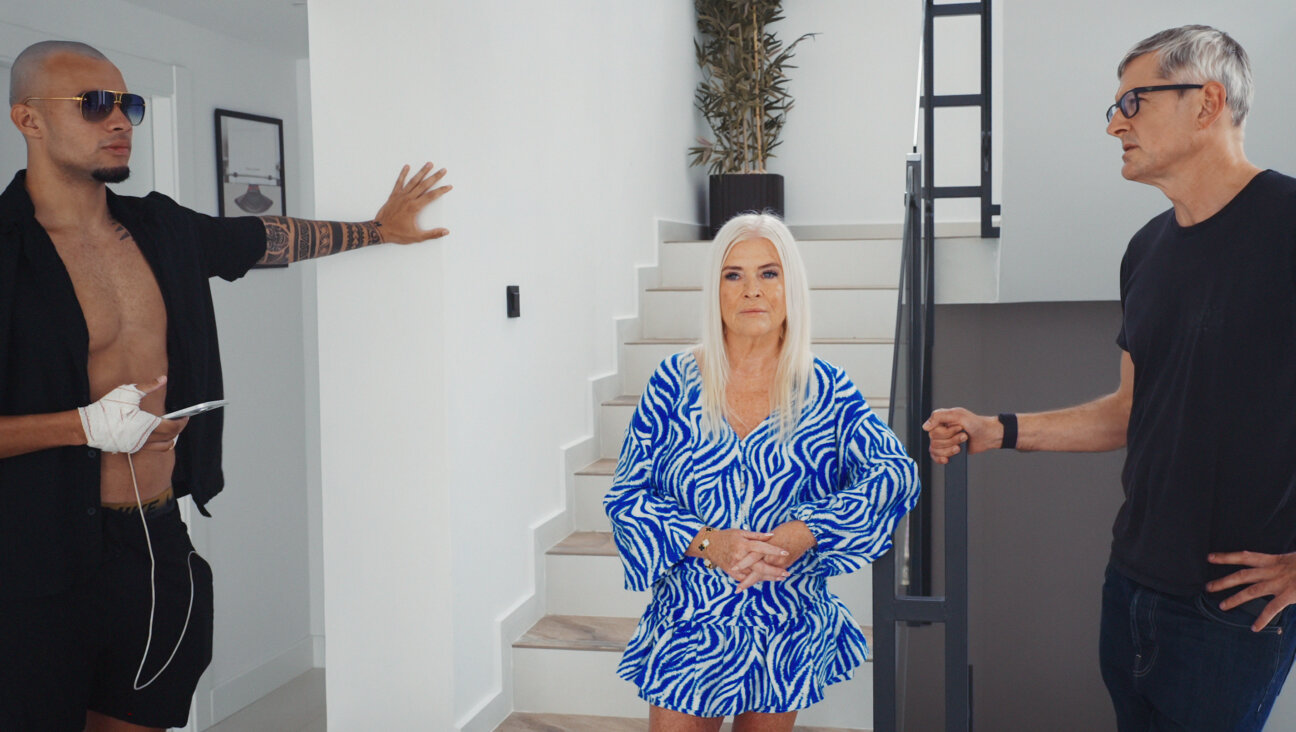
The show centers around three 30-something buddies, each of whom is at a very different stage of life when it comes to relationships with women. One has just moved in with his girlfriend, another is married with a toddler, and the third is a swinging bachelor who can’t commit to one girl but who has a very meaningful relationship with his dog. The comedy has enjoyed two successful seasons in Israel and its creator and star Adir Miller recently won an International Emmy award for best comedy.
American critics have similarly praised the show. Dorothy Rabinowitz of the Wall Street Journal dubbed it “a scintillating comedy brimming with confidence and wit,” adding that “the perilous situations that drive ‘Traffic Light’ are charged with a life and zest that’s good to see. The best comedy of the year, it seems, has arrived in midseason.”
The Hollywood Reporter’s Tim Goodman also greeted the new show warmly, saying that “in the same way that Modern Family has been able to mine comic gold out of everyday struggles, Light keeps the couple-banter and the friend-banter surprisingly relatable and, in the biggest shocker, enormously funny.”
If viewers are as enthusiastic about “Traffic Light” as the critics, it will mark a milestone for Israeli comedy. Until now, the only television show to successfully cross to the U.S. was the intense HBO drama “In Treatment.” A previous attempt to bring over a light Israeli comedy-drama in 2008, The Ex List, crashed and burned after one season.
Watch a trailer for ‘Traffic Light’:
Watch a segment of ‘Ramzor’ in Hebrew with Spanish subtitles:
This is a moment of great uncertainty. Here’s what you can do about it.
We hope you appreciated this article. Before you go, we’d like to ask you to please support the Forward’s independent Jewish news this Passover.
This is a moment of great uncertainty for the news media, for the Jewish people, and for our sacred democracy. It is a time of confusion and declining trust in public institutions. An era in which we need humans to report facts, conduct investigations that hold power to account, tell stories that matter and share honest discourse on all that divides us.
With no paywall or subscriptions, the Forward is entirely supported by readers like you. Every dollar you give this Passover is invested in the future of the Forward — and telling the American Jewish story fully and fairly.
The Forward doesn’t rely on funding from institutions like governments or your local Jewish federation. There are thousands of readers like you who give us $18 or $36 or $100 each month or year.
Support our mission to tell the Jewish story fully and fairly.