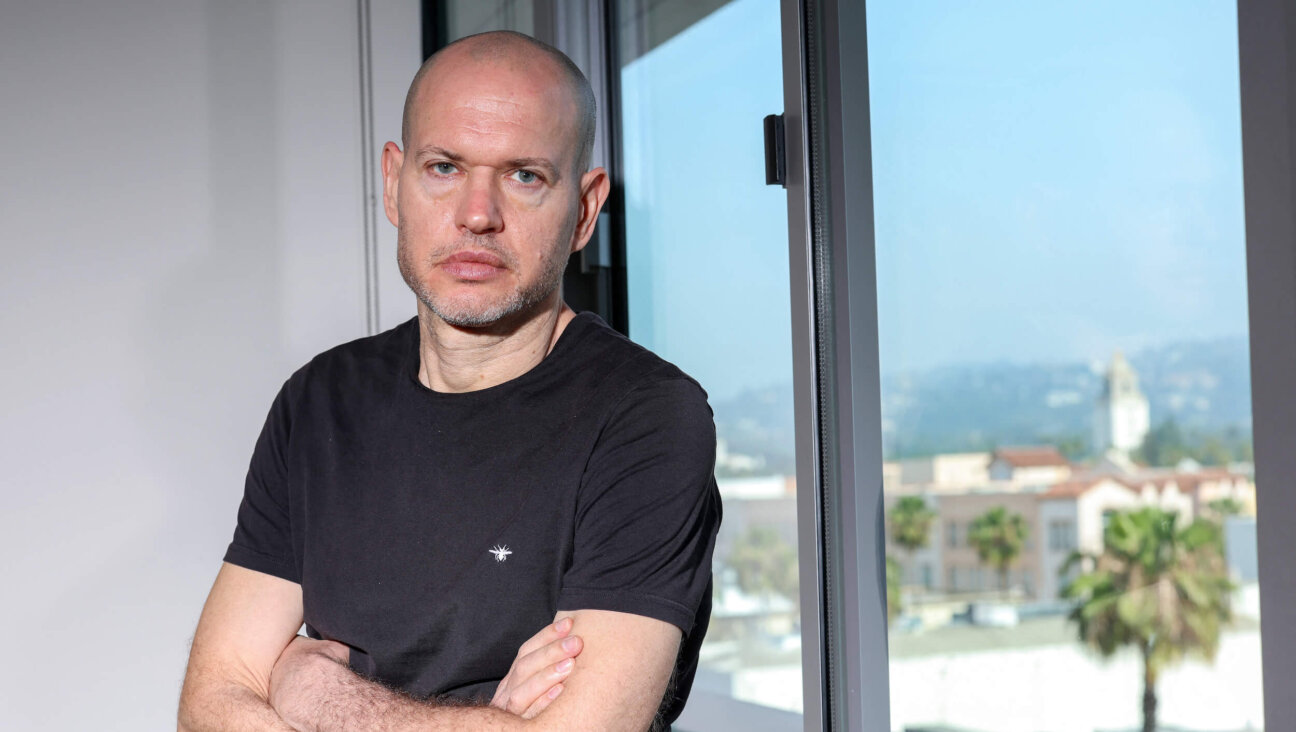
Wearing (Jewish) Heart on Her Sleeve — Or T-Shirt
Graphic by Angelie Zaslavsky

By Anne Cohen April 24, 2014
Anne Grant collects T-shirts. Not just any T-shirts. Jewish T-shirts.
The 23-year-old has roughly 100 of them, purchased through eBay, donated by friends, gathered from bar mitzvahs.
It all started about a year ago, when a friend showed her the Hillel sweatband she had gotten from the University of Pennsylvania. “I thought the object was really fascinating because it seemed to be appropriating from fraternity culture,” she said.

Image by Anne Grant
Slowly but surely, the collection grew, and Grant started to find meaning in the seemingly innocuous items. “I realized that this had potential to be a visual culture project,” she said. And so, Shmattes was born.
This emphasis on cultural Judaism was highlighted in the Pew Research Center’s “Portrait of American Jews,” in October 2013. The “negative” reactions she saw in the American Jewish community spurred Grant to redouble her collection efforts.
“I’m one of those people who identifies as culturally Jewish. It really irked me reading the Pew study and seeing culturally Jewish people getting the shaft from Jewish institutions. I’m of the mind that you can’t throw trips at people in the hopes of molding them into the kind of Jew you want.”
Grant, who says she “wasn’t raised Jewish at all,” actually ended up majoring in Jewish studies at the University of Virginia. She’s now pursuing a PhD at Vanderbilt University focusing on cultural Judaism.

Image by Anne Grant
The T-shirts, she said, are “a means of tracking the ways in which cultural Jews are defining what it means to be Jewish outside the institutional tracks.”
“These are people who are becoming creative and innovative. They feel very Jewish and they’re not very sure why.”
Her favorite shirt is a purple tank top that reads “Purple Drank” in bold pink lettering, with three bottles of Manischewitz replacing Lil’ Wayne’s favorite “Sizzurp.” First runner-up is a design superimposing the Three Stooges on the bodies of Run DMC.
In November of last year, she was contacted by Lucy Partman and Chino Kwan of Yale’s Slifka Center to organize an exhibition, which ended in late March 2014. Towards the end of the summer, if all goes well, they’ll move to the Brown University/RISD Hillel gallery.
The Yale exhibit broke the shirts down into three categories: Cultural appropriation Hillel shirts and Positionality.
Items like the “Purple Drank” shirt, which use a common cultural concept and apply a Jewish inside joke, fall into the cultural appropriation slot.

Image by Anne Grant
Hillel shirts, with their positive slogans and Hebrew translations of university names, deserved their own wall, Grant explained. “They show the hebraization that we see in Jewish institutions,” she said. “To be an American Jew, you need to have some baseline support of Israel.”
The “Positionality” category is a little more obscure. “They’re very self-aware,” Grant said. T-shirts with messages like “I was told there would be Christian girls here,” and “Silent nights are so boring,” fit in here.
“They’re talking a little shit about Christianity and being a minority within a Christian world,” Grant laughed.
Though she hopes to make the collection accessible to as many people as possible, Grant says that it is first and foremost geared towards the college set.
“I wanted this to go to young people first because college students are bombarded with messages about what it means to be Jewish in a “correct” way,” she explained.
“And…it’s a very college article of clothing.”

Did you know that only 2% of Forward readers donate to support our nonprofit newsroom? That 2% make it possible for millions to read the Forward without a paywall or subscription — removing any barriers to the full and fair Jewish story.
But while the Forward is free to read, it isn’t free to produce. Big stories — like deep dives into the antisemitism data, political scoops or reporting trips to college campuses — take months of research and fact-checking. All while we keep you informed of what you need to know each day.
— Rachel Fishman Feddersen, Forward Publisher & CEO
Support our mission to tell the Jewish story fully and fairly.