Sephardic Legend Flory Jagoda Keeps Singing at 90
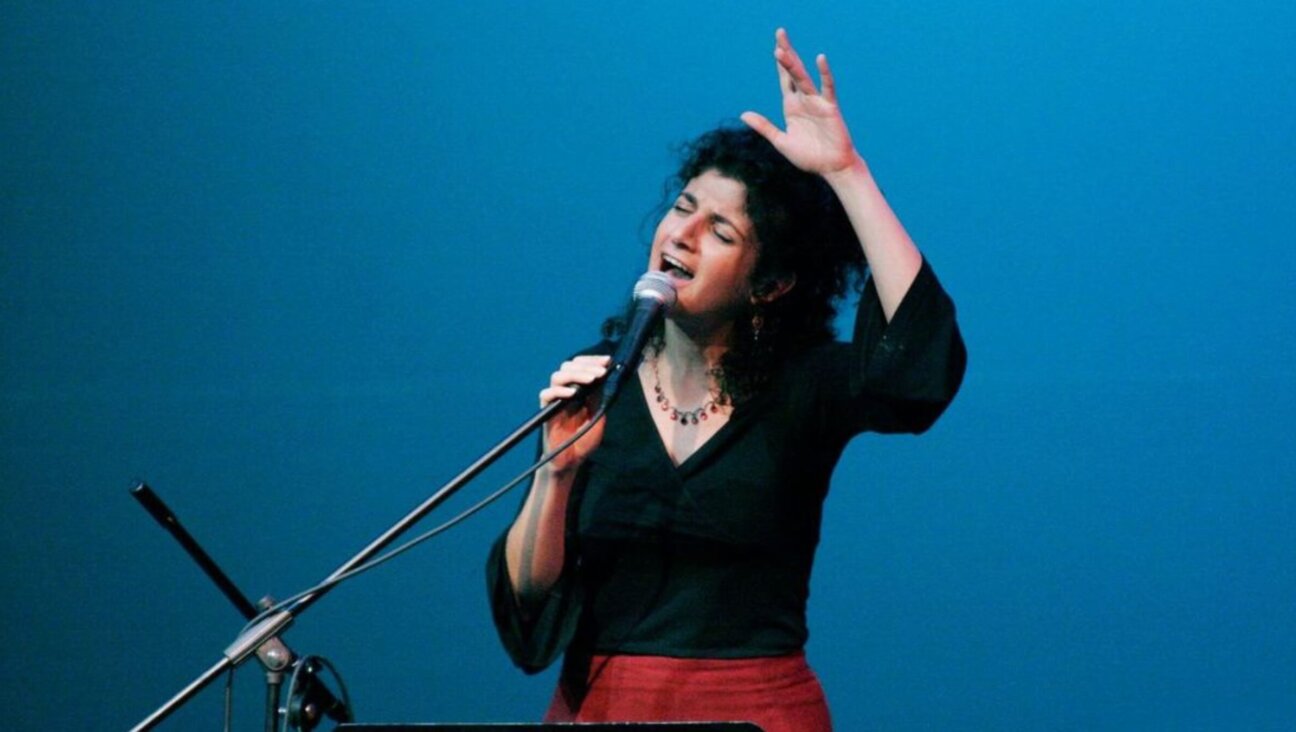
Photo: Tom Pich
Soon after she assumed the makeshift stage during her July 16 performance at the Washington D.C. JCC, Flory Jagoda, 90, lit a candle. “Sephardic women always believed in light, in a candle,” she told the audience of about 125 people. “With these candles,” the Bosnian-born artist sang in Ladino, “We pray to God … to grant us a healthy life.”
A few songs later, however, an accidental thrust of the guitar sent the candle flying, and for a split second before it was clear whether a firefighting team would need to be summoned, the assembly’s collective heart skipped a beat. “Let’s just sing,” said Susan Gaeta, one of the two musicians accompanying Jagoda, defusing the mood.
The candle was encased in a glass box, so catastrophic danger probably wasn’t too likely. And Jagoda, for her part, has seen music do the exact opposite of destroy. “I did save myself with music,” she said, recounting her parents placing her alone on a train out of Croatia in 1941. “Don’t open your mouth,” her father had told her. “Just play your harmonica.” (Throughout the performance, Jagoda used the word “harmonica” to refer to an accordion.)
At 90, Jagoda appears to have a healthy sense of humor about her performances. In response to a false start on one song, where the trio wasn’t in the same key, she told the audience, “You know at my age, I don’t hear good.” Eying her colleague Howard Bass, she said, “He’s going to play beforehand, which is good, because it leaves me a good in.” Without batting an eye, Bass told her, “I’m just playing what you wrote!”
Other gems from the performance — which featured 11 songs that addressed topics ranging from the creation of the world to unrequited love, and Friday nights at Jagoda’s grandmother’s house to holidays with her aunts — included the “old Jewish custom” of “eating a lot of sweets when you are sad.”
And then there was the haunting, yet beautiful song “The Key from Spain” (La Llave De Espana). In 1492, Jagoda explained, the Spanish Jews fleeing the Inquisition locked their doors and brought the keys with them. They truly anticipated returning. (None of this “Fiddler on the Roof” passive aggressively sweeping up for the occupiers-to-be, evidently.) Through every subsequent move in the New World, the refugees-immigrants brought the keys with them and hung them on the wall.
Visiting her aunts on holidays in Bosnia, “Who did not know what kind of story was in the back — so many keys on the wall,” Jagoda said. “Those are the keys from Spain.”
The song, whose lyrics speak of keys that “my forefathers brought … with great pain from their house in Spain,” is indeed sad, Jagoda allowed. “But we are here; we are very happy.”
This is a moment of great uncertainty. Here’s what you can do about it.
We hope you appreciated this article. Before you go, we’d like to ask you to please support the Forward’s independent Jewish news this Passover. All donations are being matched by the Forward Board - up to $100,000.
This is a moment of great uncertainty for the news media, for the Jewish people, and for our sacred democracy. It is a time of confusion and declining trust in public institutions. An era in which we need humans to report facts, conduct investigations that hold power to account, tell stories that matter and share honest discourse on all that divides us.
With no paywall or subscriptions, the Forward is entirely supported by readers like you. Every dollar you give this Passover is invested in the future of the Forward — and telling the American Jewish story fully and fairly.
The Forward doesn’t rely on funding from institutions like governments or your local Jewish federation. There are thousands of readers like you who give us $18 or $36 or $100 each month or year.
Support our mission to tell the Jewish story fully and fairly.