A pitch for the High Holy Days season: Follow the lead of Major League Baseball
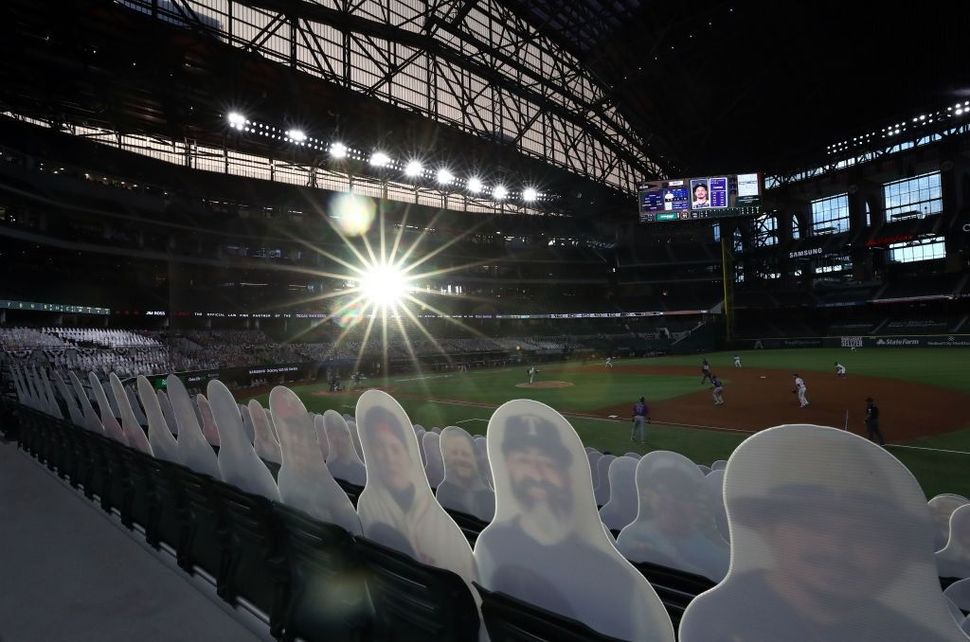
Cardboard cutouts populate the seats during Opening Weekend. Image by Getty Images
I recently received an email from my favorite baseball team advertising fan cutouts as an antidote to empty stadiums. As quick as a fastball, I threw on my best team jersey and cap, snapped a photo and uploaded it to the website. My husband did the same so that we could sit together in cardboard replica at every home game during this strange season.
This wonderful purchase was made all the better because the net proceeds benefit the team’s charitable foundation. A win-win—even before the on-field wins.
In pre-pandemic times, we enjoyed many an inning at the ballpark — including at baseball’s main event, the World Series. Imagine our excitement when the TV camera panned across our section on Opening Day 2020 and, watching from home, we spotted ourselves among the crowd!
Baseball, as it so often does, illuminates life. The beauty of fan cutouts is that they enable spectators to sit in seats they treasured back when congregating was normal. You know where I’m going with this.
Many congregations are commendably planning virtual Rosh Hashanah and Yom Kippur services in response to today’s medical and moral imperative to spatially distance. Allow me to pitch not a ball but an idea: Following baseball’s example, synagogues can fill their appropriately vacant sanctuaries with congregant cutouts at Judaism’s main event, the High Holy Days.
Clergy and lay leaders have always been charged with creating community. The challenge in this somber era of COVID-19 is to re-create community. A robust cutouts program that lets members sit, in a sense, in their beloved houses of worship at the start of 5781 does just that, giving us in imagery what eludes us in reality. As a bonus, these figures neither nod off nor exit early!
Planning committees, here are instructions if you wish to brighten your holiday livestreams with cutouts:
- Name the program: I suggest Prayer Pinch-Hitters or Synagogue Stand-ins or Avodah Avatars or Davening Doubles or Congregational Clones.
- Decide whether to make this initiative a fundraiser. If so, consider donating the proceeds to those affected by the coronavirus.
- Hire a custom cutouts vendor, which you can find online.
- Promote this program as an opportunity for congregants to dress in their holiday best, say “lox and cream cheese” for the camera, and usher in the holy season in style.
- Put the choral proxies in the choir box and the rest of the flock in the regular rows.
- Above all, make sure that every two-dimensional person in the room appears on-screen at least once.
In a year when prudence and sound judgment demand isolation over assembly, imagine the joy and the poignancy of tuning in to a sea of familiar faces populating our sacred spaces. How emotional to pack the pews with these life-size likenesses—reminders of what we had, portraits of what we pray for, placeholders until we meet again.
From Zoom study sessions to apples-and-honey packages to loaner prayer books, temple leaders are working hard to refashion traditions to meet the challenge of worshiping together while apart. A bit stiff but heartwarming all the same, this cardboard cheering section may well rally our spirits and hit our celebration out of the park.
@Jan Zauzmer is a past president of a URJ congregation and a current MLB cutout.

Did you know that only 2% of Forward readers donate to support our nonprofit newsroom? That 2% make it possible for millions to read the Forward without a paywall or subscription — removing any barriers to the full and fair Jewish story.
But while the Forward is free to read, it isn’t free to produce. Big stories — like deep dives into the antisemitism data, political scoops or reporting trips to college campuses — take months of research and fact-checking. All while we keep you informed of what you need to know each day.
— Rachel Fishman Feddersen, Forward Publisher & CEO
Support our mission to tell the Jewish story fully and fairly.