Yiddish non-profit brings together literature, listening parties and language circles in London
‘Jargon’ founders sought a Jewish space that focuses on diaspora and counter-cultural Jewish characters
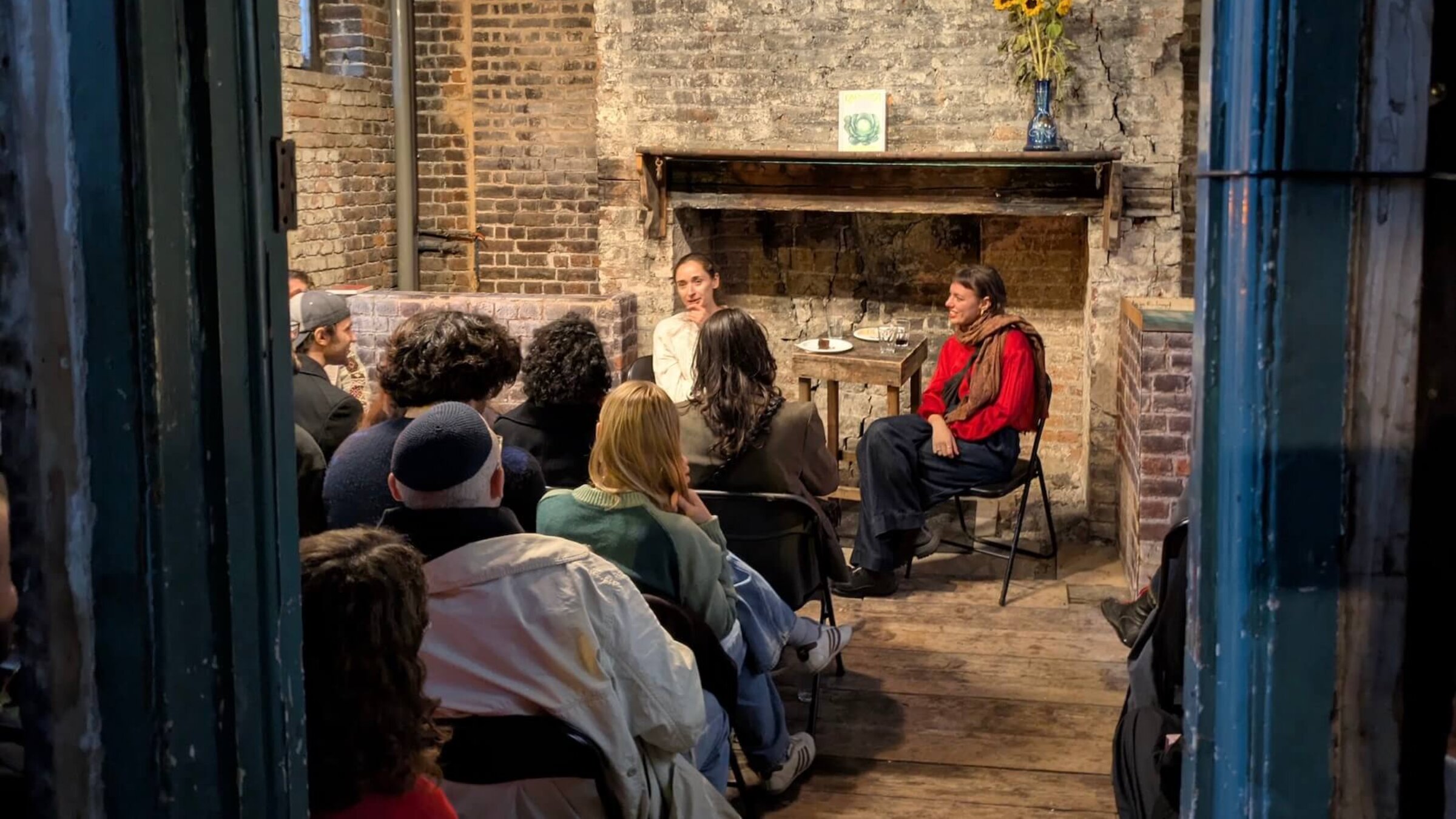
Alissa Timoshkina in conversation with Aleph Ross at a Jargon event, Oct. 5, 2025. Photo by M. Syd Rosen
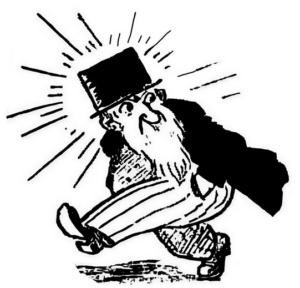
In one of the world’s earliest Yiddish comics, created by Samuel Zagat in 1912, Gimpel the Matchmaker strides ahead while glancing backwards over his shoulder. He’s moving steadily forward, but at the same time, he keeps one eye on the past.
It’s a fitting logo for Jargon, a London-based Yiddish culture organization that was founded last year, dedicated to exploring the past, present and future of the Jewish diaspora. Jargon draws on London’s rich Yiddish history – as well as the overlapping but distinct diaspora communities that have shaped the city for centuries – to imagine a future for Yiddish culture.
Historians Aleph Ross and M. Syd Rosen founded Jargon last year out of a “craving for more Jewish spaces that were platforming things that were about diaspora, that were about Yiddish, and also about more marginal, either esoteric or radical or counter-cultural Jewish characters,” Rosen told me in an interview. He said they had both long felt that these aspects of Jewish culture were “a major part of our sense of what Jewish history was in Britain,” but didn’t receive the attention they deserved in existing Jewish spaces.
Ross and Rosen began learning Yiddish together around five years ago, when Ross realized that she needed to understand Yiddish for a research project on her own great-great-grandfather, the London Yiddish writer Morris Myer. Still, the organizers see Yiddish as one of many aspects of “leaning into those threads of Jewish cultural identity that we felt have maybe gotten lost through processes of assimilation.”
The duo originally imagined Jargon as a bookshop selling Yiddish-language books alongside other Jewish literature, as well as hosting occasional events. In the year since they launched, that original vision has grown into a busy cultural program with pop-up events across London. Jargon hosts a regular shmueskrayz, or Yiddish-language conversation circle, modeled on the Berlin-based Shmues un Vayn group. At the same time, the group aims to “provide points of entry to [Yiddish] culture for different kinds of people,” including those who don’t speak Yiddish at all. With that audience in mind, Ross and Rosen also run a Yiddish-in-translation book club at a library.
“It’s explicitly about bringing attention to these works that are really cult or famous, or infamous, but [that], actually, very few people have read,” Rosen said. At book club meetings, Ross or Rosen sometimes reads a passage of the book out loud in Yiddish to give attendees a taste of the original.
For Jargon’s monthly pop-up events, the organizers often choose topics that touch on multiple different areas of interest – not just Yiddish language and culture. A recent event about the post-war Romani British poet Mark Hyatt, whose boyfriend was the Anglo-American Jewish poet Harry Fainlight, drew readers of both writers’ work as well as people broadly interested in Roma, Jewish, or queer poetry.
Rosen explains that Jargon seeks out this “slightly jumbled alternative read that we’re trying to put on our events, where they’re explicitly not the most obvious way of presenting a cultural product, and as a result they attract quite a weird and varied audience.”
Jargon’s location in London’s East End helps with that goal. Though Jargon is “semi-nomadic,” with events taking place around London, the group’s home base is at House of Annetta, a community space on Brick Lane, in the Shoreditch neighborhood of East London. Historically a center of Jewish immigrants, the neighborhood later became home to a large South Asian community and is now increasingly gentrified.
Being surrounded by multiple diaspora communities creates an opportunity to “think about the connections between these different stories,” Ross told me. In events like the Mark Hyatt talk, Jargon puts Jewish experiences in conversation with the stories of other minority groups in Britain – something the organization plans to do more explicitly in future programming.
At the same time, the area’s Jewish roots make it a fitting home for a Yiddish revival. “It’s so symbolic for people to feel like they can hear Yiddish in the East End again, even if they themselves never heard it,” Rosen said. “It’s got a heymish quality that people have a lot of fondness for.” That said, “we don’t want [the symbolism of the Yiddish language] to be the end point. We want it to be an entry point.”
During a fundraiser and listening party for the album Lider mit Palestine, a collection of new Yiddish songs protesting the war in Gaza, many audience members were encountering Yiddish music for the first time. Providing an accessible entry point to the language through music, the organizers said, made it possible to “advertis[e] Yiddish culture, but in a way that could actually appeal to people that didn’t even know such a thing existed as well.”
In the future, Ross and Rosen want to expand Jargon’s Yiddish-language book offerings. Since many Yiddish books are out of print, they try to find Yiddish literature secondhand or through donations and resell it on a pay-what-you-can basis. As well as broadening access to well-known Yiddish writers, they aim to introduce readers to more obscure works, offering a starting point for a deeper encounter with Yiddish culture. The goal, as Rosen put it, is for Jargon to be “the sort of environment where people say to themselves: ‘You know what, I’m going to read Isaac Bashevis Singer. Oh, and who’s this author that I never heard of next to him?’”
This is a moment of great uncertainty. Here’s what you can do about it.
We hope you appreciated this article. Before you go, we’d like to ask you to please support the Forward’s independent Jewish news. All donations are still being matched by the Forward Board - up to $100,000 until April 24.
This is a moment of great uncertainty for the news media, for the Jewish people, and for our sacred democracy. It is a time of confusion and declining trust in public institutions. An era in which we need humans to report facts, conduct investigations that hold power to account, tell stories that matter and share honest discourse on all that divides us.
With no paywall or subscriptions, the Forward is entirely supported by readers like you. Every dollar you give is invested in the future of the Forward — and telling the American Jewish story fully and fairly.
The Forward doesn’t rely on funding from institutions like governments or your local Jewish federation. There are thousands of readers like you who give us $18 or $36 or $100 each month or year.

Support our mission to tell the Jewish story fully and fairly.