Palestinians Hold Local Elections in West Bank
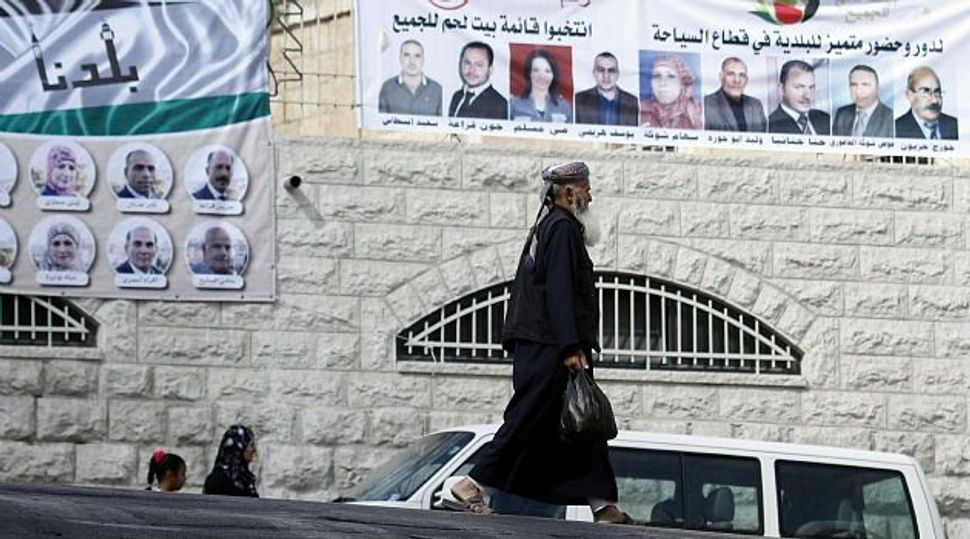
Election Fever: West Bank towns are plastered with posters as Palestinians prepare to vote in local elections. Image by getty images
Palestinians in the West Bank go to the polls on Saturday in long-delayed municipal elections that have already highlighted deep divisions in the occupied territory and stoked complaints about a lack of leadership.
The Oct. 20 ballot will hold up a cracked mirror to a political landscape clouded by financial crises, failure to reconcile the major Palestinian factions and stalemate in peacemaking efforts with Israel.
The powerful Islamist group Hamas is boycotting the election and preventing voting from taking place in the Gaza Strip, leaving the field largely clear for the mainstream Fatah party in the race to take charge of 94 West Bank towns and villages.
But, as has happened so often in the past, President Mahmoud Abbas’s nationalist Fatah movement has failed to present a united face, with party rivals presenting their own candidates.
“The sound basis for any election to take place is a healthy, political atmosphere … which is clearly lacking here,” said Issam Abdeen, a legal consultant at Palestinian Human Rights group al-Haq.
But that doesn’t necessarily mean there is voter apathy.
Streets and roundabouts across the West Bank are plastered with posters of hopeful candidates promising everything from cleaner streets and better transport to jobs and free Wi-Fi.
The familiar old Palestinian slogans calling for liberation and resistance are noticeably absent, as voters focus on their immediate needs at a time of austerity, with cash-strapped authorities struggling to pay public sector salaries.
“This is an exciting opportunity to make changes and see new people enter the local councils,” said Samer Hamdan, working in a coffee shop in Ramallah, the Palestinian administrative capital.
Hamas shot to prominence in the last local vote in 2005, unexpectedly taking control of many municipal councils in both the West Bank and Gaza. It went on the next year to sweep legislative elections, to the shock of the Fatah old guard.
The Islamists seized control of Gaza after a civil war in 2007, splitting the Palestinians both politically and geographically. They have refused to take part in Saturday’s vote, accusing Fatah of harassing their West Bank members.
Israel pulled out of Gaza in 2005, but maintains a tight blockade on the enclave. The Israeli military remains in charge of the West Bank, allowing the Palestinians limited self-rule in certain areas, including the major urban centres.
The continued divide between Hamas and Fatah has proved a source of upset and anger for ordinary Palestinians, who fear it undermines their fight for an independent state.
“I don’t understand how we can have elections in just half the territory,” said Neda Ahmad, a young woman walking through central Ramallah. “I don’t even know who’s running.”
With Hamas not standing, analysts say the best way to measure support for the party will be to look at voter turnout. Last time around, turnout was estimated at some 80 percent, so a sharp fall-off would show Hamas voters had stayed at home.
Whatever the turnout, pro-Western Fatah could still lose what should have been an easy victory.
It is being challenged by an array of independent candidates, including the West Bank’s first all-female political party which is standing in the city of Hebron. It also faces well-known Fatah dissidents, who have put themselves forward after failing to book a berth on the official party lists.
“In this election, a ‘test drive’ for later elections, Fatah has failed to appear unified, and this will weaken the party,” said political analyst Khalil Shaheen.
The decision to hold a municipal election just in the West Bank is a tacit admission that the landlocked territory is, to all intents and purposes, already a distinct entity from Gaza.
However, a decision to hold national votes for a new president or parliament, although already overdue, would effectively seal the separation – a step neither Abbas nor Hamas wants to take at this stage.
That means the forthcoming municipal vote might be the last election the Palestinians can vote in for quite some time.
I’m personally matching all gifts to the Forward, up to $36,000. Can I match your gift now?

Hello, fellow Forward reader! I’m Joel Brown, a Forward reader and supporter for more than 15 years, and currently the chair of the board of directors.
I’m an avid Forward reader because it ticks so many of my essential boxes: excellent journalism, Jewish focus and diverse viewpoints. In today’s political climate, what I most appreciate is the Forward’s independence — made possible by the generosity of its membership.
The Forward is committed to bringing you unbiased, nuanced Jewish news. From my position as board chair, I see an exciting future as we expand our position as the definitive independent voice of contemporary American Judaism.
— Joel Brown, Forward board chair
Support our mission to tell the Jewish story fully and fairly.