Jews didn’t cause Hurricane Milton, but kind of did control the weather in biblical times
As flash floods threaten St. Petersburg, Florida, we consider Noah, the ark and how Jews pray for rain
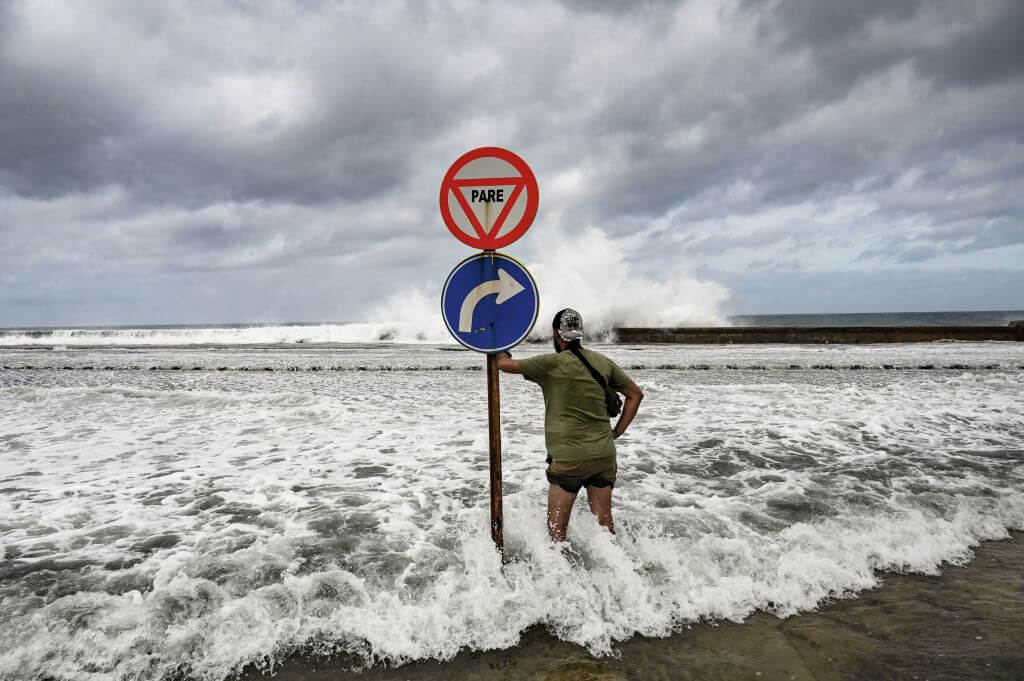
A man looks at waves crashing against the promenade in Havana due to the passage of Hurricane Milton Oct. 9. Photo by Yamil Lage/AFP via Getty Images

By Benyamin Cohen October 9, 2024
Millennia before the seven-day forecast and iPhones that buzzed with weather alerts, Noah could well be described as the world’s first meteorologist.
“Hey, Noah,” God said. “A flood. It’s coming.”
The sixth chapter of Genesis describes how God gave Noah 120 years to build the ark. Yes, you read that right. Sure, a dearth of Home Depots in the ancient world would certainly slow down such a monumental project. I mean, that gopher wood was not going to source itself. But 120 years?
There was a reason for the forecast more than a century into the future. God was having second thoughts about having created humankind; its wicked ways were getting on his nerves. But he couldn’t just wipe them off the face of the earth. Well, I guess he could. Instead, he landed on a compromise of sorts: Tell Noah about the flood and give him 120 years notice.
During that time, we can imagine, people would stroll by Noah’s property and ask him what the heck he was building.
“Hey neighbor! Is that a barn?”
“No,” Noah replied. “It’s an ark. God is angry. A flood is coming. But not tomorrow. Not next week. Sometime in the next millennia. Hey, can you hand me that Allen wrench?”
The long lead time was meant to give the wicked the opportunity to fix the error of their ways. Maybe if they did, God would call off the whole apocalypse thing. “God was trying to give people an opportunity to repent,” Rabbi Elie Cohen, an actuary and my older brother, told me when I dialed him up. “And the best way to repent is if it came from them, if they initiated the process.”
God’s hope was that the curiosity about the big boat being built on Noah’s front lawn would lead people to reevaluate their life choices. In other words, God was putting the weather forecast into the hands of humankind: “Clean up your act and I’ll cancel the flood,” a booming voice could be heard saying. “You idiots control the weather.”
There are other biblical examples of human influence on meteorological events. Take, for instance, the story of Joshua and the Israelites waging a battle against five armies. With the day ending and the battle not yet over, Joshua prayed to God to keep the sun up for a little while longer. And hence, we have the day the sun stood still.
In the Book of Kings, during the third year of an epic drought, the prophet Elijah prayed for divine intervention. “Soon the sky was black with clouds,” the verse states. “A heavy wind brought a terrific rainstorm.”
Do Jews control the weather?
The assumption, of course, is that these biblical characters pray precisely because they do not control weather patterns. God does. Indeed, such prayers are an integral part of Jewish tradition.
On Yom Kippur, my brother told me, God determines how much rain he’ll shower on the world during the coming year. But on Sukkot, the festival that comes a week after Yom Kippur, synagogues around the world begin to recite tefillat hageshem, a special prayer asking for rain. What’s the point if the year’s rainfall has already been determined?
“Yes, the amount of rain is determined on Yom Kippur,” Elie explained. “But on Sukkot, it’s determined when and where that rain will go.” In essence, humankind does have some say in the matter.
To a point. As Hurricane Milton barreled down on the Tampa Bay area, many Jews fled to spend the High Holidays on higher ground.
One Chabad rabbi, however, defied evacuation orders and decided to stay. When a reporter asked the rabbi why, he had a simple response: “God will help us.”
It’s our birthday and we’re still celebrating!
We hope you appreciated this article. Before you go, we’d like to ask you to please support the Forward’s independent Jewish news.
This week we celebrate 129 years of the Forward. We’re proud of our origins as a Yiddish print publication serving Jewish immigrants. And we’re just as proud of what we’ve become today: A trusted source of Jewish news and opinion, available digitally to anyone in the world without paywalls or subscriptions.
We’ve helped five generations of American Jews make sense of the news and the world around them — and we aren’t slowing down any time soon.
As a nonprofit newsroom, reader donations make it possible for us to do this work. Support independent, agenda-free Jewish journalism and our board will match your gift in honor of our birthday!
Support our mission to tell the Jewish story fully and fairly.