American Jews have a Hasan Piker problem. Solving it is going to hurt
Piker’s popularity is a clear sign that we must adjust our tactics for fighting antisemitism — not double down on condemnation
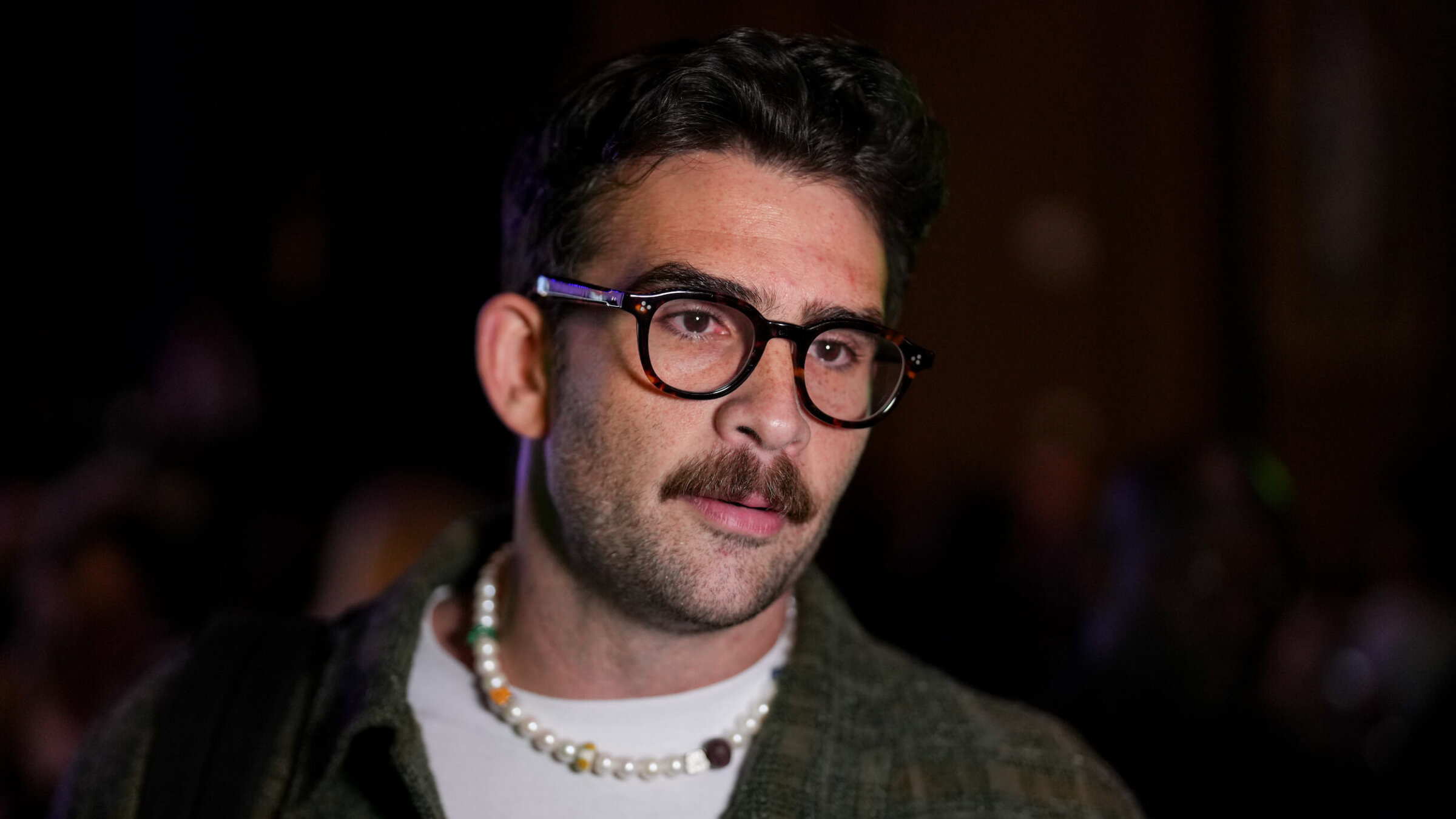
Influencer Hasan Piker during an election night event with now-Mayor Zohran Mamdani in Brooklyn on, Nov. 4, 2025. Photo by Adam Gray/Bloomberg/Getty Images

Contributing Columnist Emily Tamkin April 25, 2026
Years ago, I went to a therapist who practiced Acceptance and Commitment Therapy — popularly known as ACT — which asks patients to interrogate what their values are, and whether their behaviors are aligned with those values. This therapist had me use a little matrix. In one block, I would write down what really mattered to me; it was then my responsibility to figure out the particular behavior or choice that would help me accomplish it.
For a while, I had that matrix pinned to my fridge. I have thought of it again while following the increasingly vocal concerns raised by some Jews about Hasan Piker, the leftist, anti-Zionist Twitch streamer whose presence on the campaign trail with Michigan Democratic Senate candidate Abdul El-Sayed has caused great consternation.
Piker’s profile has been on the rise for some time, and his rhetoric about Israel in particular — which he has accused of advancing “Jewish supremacy” — has drawn allegations of antisemitism. But his appearances alongside El-Sayed, who has said he believes Israel’s government is as evil as Hamas, have brought particular scrutiny. El-Sayed’s opponents have seized on Piker’s presence to, essentially, accusing the candidate of not taking antisemitism seriously enough.
Rep. Haley Stevens said that Piker “is not somebody that you should be campaigning with at a moment when there is clearly a lot of pain and trauma across our state.” State Sen. Mallory McMorrow said Piker is “not entirely different from somebody like Nick Fuentes,” a far-right Holocaust denier. The Anti-Defamation League has accused Piker of denigrating Jewish people, and its leader, Jonathan Greenblatt, has said El-Sayed’s decision to campaign with him reflects “the dangerous normalization of antisemitism in our politics.”
Some of this may be political opportunism. But I do not doubt that there are many American Jews who are sincerely concerned about the normalization of antisemitism, and who are worried that Piker’s increasing prominence plays into that trend. I would ask those American Jews: What is it that really matters to you in this situation, and what are the behaviors and choices that can help you achieve your goals?
A flawed strategy for fighting antisemitism
If pushing back against antisemitism is the top priority for our community, I suspect that writing Piker off as an antisemite with whom engagement simply can’t be countenanced will do more harm than good.
There are plenty of things that Piker has said that I, too, find offensive.
I agree with him that Hamas’s horrific actions on Oct. 7, 2023, including acts of sexual violence, don’t justify the slaughter of Palestinian civilians in Gaza. But I think saying that it “doesn’t matter” whether rape happened amid the Hamas attack, as Piker has, is a cruel and callous way of making that particular point.
And while anti-Zionism is not categorically antisemitism, I think that Piker’s statement that anyone who has exhibited “positive feelings about the state of Israel” should be barred from consideration from any position of import, including “the fucking local dog catcher,” runs the risk of creating a litmus test for Jewish participation in civic life. That’s a concern I hope people running to be elected officials in a pluralistic society take seriously.
But to say that Piker, whose fervent anti-Zionism can cross over into potentially damaging and derisive territory, is akin to Nick Fuentes — a Holocaust denier whose entire worldview is underpinned by the idea that Jews are evil and exploitative — is to make a claim that there is little evidence to support.
This distinction matters. Fuentes’ antisemitism is so extreme and all-encompassing that his fans and followers will never be allies to American Jews. There is little evidence to believe the same is true for Piker. To successfully fight antisemitism, American Jews need a broad base of allies. In that context, Piker’s audience — including nearly 3 million followers on the streaming platform Twitch — is one that it would be a mistake for us to wholly write off.
Many people who follow Piker may agree both with his condemnation of Israel’s government and his condemnation of the deadly attack on a 2025 hostage solidarity walk in Boulder, Colorado. Those people can help in the fight against American antisemitism — but not if we completely refuse to engage with them.
Building alliances on the left
If American Jews’ goal is to discourage antisemitism, and to encourage people to speak thoughtfully and empathetically about Jews, then treating Piker as someone too extreme to engage with risks sending a message that Jews don’t want allies on the left.
This echoes a problem that arose during last year’s New York City mayoral race. Some Jewish groups discounted now-Mayor Zohran Mamdani’s substantial efforts at Jewish outreach, instead focusing wholly on his criticism of Israel. In practice, that choice risked suggesting that there was no reason for Mamdani to bother trying to support New York Jews, because given his stance on Israel, no positive actions he could take would ever be enough.
Thankfully, Mamdani hasn’t stopped making an effort. There’s no guarantee, however, that others on the left will do the same.
There are other ways to approach the ACT matrix on this issue. But in all the ones I can think of, treating Piker as persona non grata seems like a poor strategy for success.
This is true, as well, if concerned American Jews decide that what really matters to them is the opportunity to push back on increasingly negative views of Israel in the United States. Trying to do that by punishing any public figures who associate with Piker is unlikely to pay off. Negative views of Israel have risen since 2022, particularly among Democrats. In that time period, many American Jews have tried to call criticism of Israel antisemitic; the trends have nevertheless continued.
Is blaming or trying to silence or sideline people who speak critically of Israel the thing that’s going to get people to change their minds? That former therapist taught me to think more clearly about the connections between my actions and what I wanted. It was sometimes an uncomfortable experience; change often is. Piker’s popularity is one of the many signs that there is no going back to a past U.S. in which Jews could assume non-Jews (or even other Jews) supported Israel or Zionism. Given that reality, we will need to think about how to bring ourselves closer to the country we want to live in — without ignoring the practical realities of the country we have now.
I’m personally matching all gifts to the Forward, up to $36,000. Can I match your gift now?

Hello, fellow Forward reader! I’m Joel Brown, a Forward reader and supporter for more than 15 years, and currently the chair of the board of directors.
I’m an avid Forward reader because it ticks so many of my essential boxes: excellent journalism, Jewish focus and diverse viewpoints. In today’s political climate, what I most appreciate is the Forward’s independence — made possible by the generosity of its membership.
The Forward is committed to bringing you unbiased, nuanced Jewish news. From my position as board chair, I see an exciting future as we expand our position as the definitive independent voice of contemporary American Judaism.
— Joel Brown, Forward board chair
Support our mission to tell the Jewish story fully and fairly.