In the race for Jerry Nadler’s seat, much talk on Israel but little disagreement
In Manhattan’s heavily Jewish 12th Congressional District, Alex Bores, Micah Lasher and Jack Schlossberg all largely support Israel, even as Gaza and military aid divide Democrats elsewhere
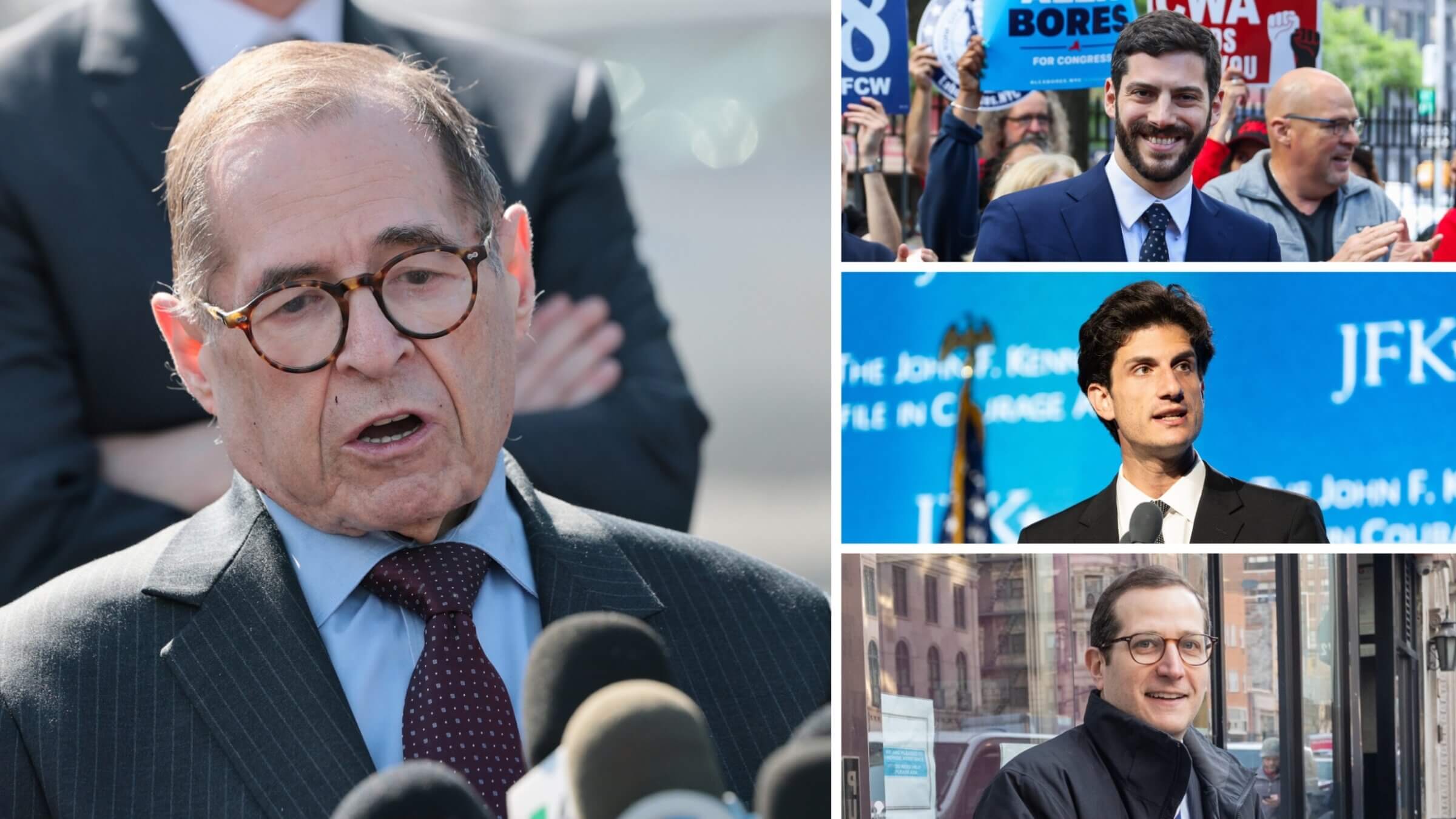
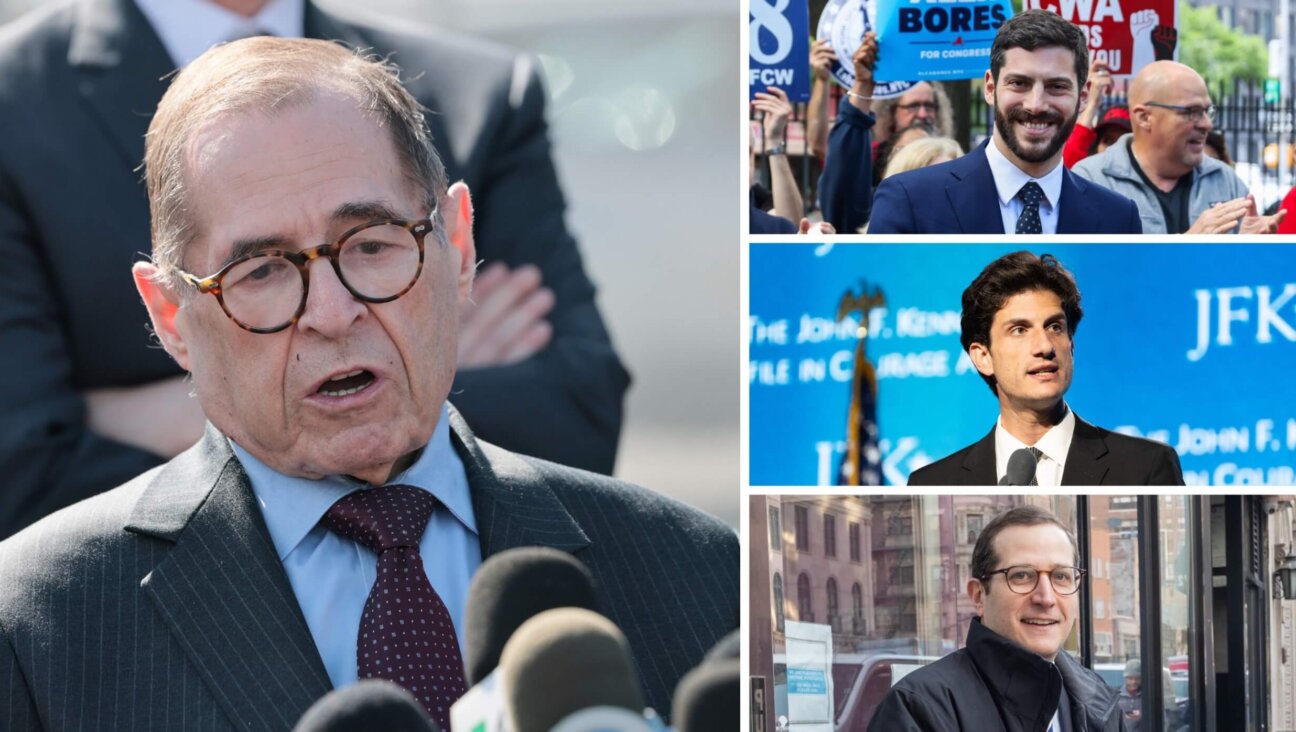
Collage photo of Rep. Jerry Nadler and the leading candidates to succeed him: Alex Bores, Jack Schlossberg and Micah Lasher Photo by Michael M. Santiago/Getty Images, Michael Nagle/Bloomberg via Getty Images, Mel Musto/Bloomberg via Getty Images and Lev Radin/Pacific Press/LightRocket via Getty Images

By Jacob Kornbluh June 5, 2026
With U.S. aid to Israel and the wars in Gaza and Lebanon pressing for voters in many Democratic primaries, the race to succeed Rep. Jerrold Nadler in Manhattan stands out for the relative consensus among the leading candidates on Israel.
Nadler, who is retiring after 33 years in the House, represents a heavily Jewish district and served as the leading voice in Congress for liberal Jews, making the choice of his successor a significant one nationally.
During a televised debate on Thursday between top contenders, New York Assemblymembers Alex Bores and Micah Lasher, political scion Jack Schlossberg and attorney Goergie Conway spent more time sparring over super PAC money, artificial intelligence and Donald Trump than on the Middle East conflict.
The three largely shared a broad agreement on support for Israel. None embraced the characterisation of Israel’s military campaign in Gaza as a genocide. They all touted support for a two-state solution and backed continued U.S. funding for Israel’s Iron Dome missile defense system.
The contrast with other competitive Democratic primaries was striking. In congressional races in New York City and some others nationally, debates have been dominated by contentious exchanges over military aid to Israel, accusations of genocide and the growing influence of anti-AIPAC politics within the party. Earlier this week, Israel consumed a significant portion of the televised debate between Rep. Dan Goldman and former New York City Comptroller Brad Lander in a neighboring congressional district.
In another neighboring district, former Columbia University Gaza War encampment activist Daraliza Avila Chevalier is challenging Rep. Adriano Espaillat with his support for Israel front and center. And in a TV debate this week in the race to replace retiring Rep. Nydia Velazquez in Brooklyn, democratic socialist Assemblymember Claire Valdez — who like Lander and Avilla Chevalier has been endorsed by Mayor Zohran Mamdani — called Israel’s actions in Gaza “U.S.-funded genocide.”
The relative consensus in Nadler’s district reflects the politics of the district they hope to represent. Jewish voters make up an estimated 30% of the Democratic primary electorate, which stretches across Manhattan’s Upper East and Upper West sides.. When Nadler ran for reelection in 2022 after redistricting forced him to go head to head with Rep. Carolyn Maloney, he campaigned on the need to preserve Jewish representation from New York City in Congress.
The candidates themselves have close ties to the Jewish community. Lasher, Nadler’s endorsed successor, is Jewish. Schlossberg, a grandson of President John F. Kennedy, was raised Catholic by his mother, Caroline Kennedy, but identifies as Jewish. Bores’ wife, Darya Moldavskaya, is Jewish, and the couple are raising their son Jewish.
Another factor distinguishing the race from other Democratic primaries is the district’s political makeup.
In last year’s Democratic mayoral primary, New York City Mayor Zohran Mamdani, an outspoken critic of Israel who rose to power by embracing pro-Palestinian activism, won handily in the Goldman and Espaillat districts, but the 12th District split almost evenly between Mamdani and former Gov. Andrew Cuomo. The candidates also took different approaches to Mamdani. Lasher and Bores did not endorse Mamdani until after he secured the Democratic nomination, mirroring Nadler’s own cautious approach. By contrast, Schlossberg endorsed Mamdani in the primary and has generally been the most critical in the field of Israeli government policies.
Mamdani, who resides in Gracie Mansion in the district, has said he won’t endorse in the race, but intends to cast a ballot. In Thursday’s debate, the candidates gave Mamdani A- and B grades.
Polling suggests the race remains highly competitive. A recent Emerson College survey showed Lasher with a slim advantage over Bores, while Schlossberg and Conway trailed behind. But most significantly, 32% of likely voters had yet to make up their minds.
In an online poll of 700 debate viewers by host PIX11, 42% said Bores won the debate, compared with 33% for Lasher and 24% for Schlossberg.
The leading candidates
Micah Lasher, 44, enters the race with perhaps the deepest roots in New York politics. A longtime Democratic operative and protégé of Nadler, Lasher has assembled support from many of the district’s traditional political leaders.
Lasher started his public career as a special assistant to Nadler in 2007. He previously worked for former New York State Attorney General Eric Schneiderman, New York City Mayor Michael Bloomberg and Gov. Kathy Hochul. At 17, he was an informal adviser to then-Assemblymember Scott Stringer, who is also Jewish. He is serving his first term in the State Assembly.
Growing up in the Upper West Side, Lasher first gained attention as a magician.
His campaign reflects continuity with the brand of liberal Zionism long represented by Nadler, co-chair of the Congressional Jewish Caucus: support for Israel’s security, opposition to Benjamin Netanyahu’s government and a commitment to a two-state solution.
Alex Bores, 35, has emerged as the progressive coalition-builder trying to bridge fierce Israel critics and mainstream Jewish voters. He attracted support from organizations aligned with the Democratic Party’s left flank, such as the Bernie Sanders-aligned Our Revolution, New York Progressive Action Network and PSC-CUNY, despite describing himself as a Zionist supporter of Israel.
Bores, a former Palantir data scientist, also serves in the state Assembly. His congressional campaign has become a focal point of a major political proxy war over the regulation of AI.
Some Jewish leaders have expressed concern over how Bores would align with the groups who backed him in Congress, as tensions between progressive activists and Zionist organizations continue to grow. Bores also faced scrutiny over social media posts of his father, William, some equating between Nazis and Zionists. Bores told Jewish Insider he disagrees with his father’s views.
Jack Schlossberg, 33, has become the race’s most recognizable figure because of his family name and social media presence. He has touted the younger generation’s voice wrestling publicly with questions of Jewish identity and Israel.
Raised Catholic but identifying as Jewish through his father, Schlossberg frequently references his Jewish heritage when discussing Israel and antisemitism. At the same time, he has adopted positions that place him to the left of many Jewish organizations, particularly his support for halting transfers of offensive weapons to Israel.
Schlossberg repeatedly shares that contrast on X as he challenges his rivals on Israel policy.
The online influencer turned political candidate made Jewish security a central pillar of his campaign. He said that if elected, he would immediately introduce legislation to nearly double federal funding for security upgrades at synagogues and other Jewish institutions.
Their views on U.S. military assistance for Israel
At Thursday’s debate, as previously, the leading candidates voiced support for funding Israel’s Iron Dome missile defense system amid growing calls for ending all U.S. aid to Israel.
Arms sales and aid for offensive weapons represented the clearest divide among the candidates.
Lasher said he’d support certain conditions on military aid in accordance with the Leahy laws, which enable the State Department to prohibit military aid to foreign countries when there is credible evidence that they have committed gross human rights violations.
Bores said he’d “strengthen those laws significantly” so they apply equally to Israel, Saudi Arabia and Egypt.
Schlossberg, however, said he would support Democratic efforts to block transfers of 1,000-pound bombs and oppose the sale of bulldozers that could be used for demolitions in Gaza or the occupied West Bank. He went on to accuse his rivals of lacking the “courage” to challenge the status quo.
“The Leahy laws give Donald Trump and Marco Rubio full discretion over what constitutes a humanitarian crime,” Schlossberg said. “I’m not comfortable passing the buck to them, and I think the candidates on this stage should be strong enough and have enough courage to actually answer the question.”
The war in Gaza
All three candidates voiced criticism of Israel’s handling of the war in Gaza, citing the dire humanitarian situation and the civilian death toll. However, when asked whether Israel’s actions in Gaza constitute genocide, they declined to use the term.
Lasher maintained that the debate over definitions often “does more to divide people of good faith than it does to find common ground. He called the killing of tens of thousands of people in Gaza “horrific,” while emphasizing the need to recognize the loss of civilian life.
Bores similarly said he’s “not comfortable” using that word “because of the high intent threshold that is required as part of it.” He said that while there are ongoing international investigations, the United States should focus on ending atrocities and expanding humanitarian aid.
Schlossberg also stopped short of calling the war genocide, though he delivered the sharpest criticism of Israel’s military conduct. “Israel had every right to defend itself following Oct. 7, but what has happened since then has gone above and beyond,” Schlossberg said. He added that the more important question was what policymakers would do next, pointing to his position on halting offensive weapon transfers.
Conway, a former Never-Trump Republican who is running on a platform to impeach President Donald Trump, said that while Israel ”did too much” in the name of self-defense, I don’t think it meets the threshold of genocide … and I don’t believe that we should abandon Israel as an ally.”
The debate followed a candidate forum Wednesday at which the candidates spoke at greater length about their attachment to Israel, support for a settlement between Israel and the Palestinians, and their opposition to Netanyahu.
I’m personally matching all gifts to the Forward, up to $36,000. Can I match your gift now?

Hello, fellow Forward reader! I’m Joel Brown, a Forward reader and supporter for more than 15 years, and currently the chair of the board of directors.
I’m an avid Forward reader because it ticks so many of my essential boxes: excellent journalism, Jewish focus and diverse viewpoints. In today’s political climate, what I most appreciate is the Forward’s independence — made possible by the generosity of its membership.
The Forward is committed to bringing you unbiased, nuanced Jewish news. From my position as board chair, I see an exciting future as we expand our position as the definitive independent voice of contemporary American Judaism.
— Joel Brown, Forward board chair
Support our mission to tell the Jewish story fully and fairly.