I come from a long line of Jewish Bundists. Now, Molly Crabapple is part of our family.
For some, Crabapple’s ‘Here Where We Live Is Our Country’ is history; for this writer and her grandparents, it’s an heirloom.
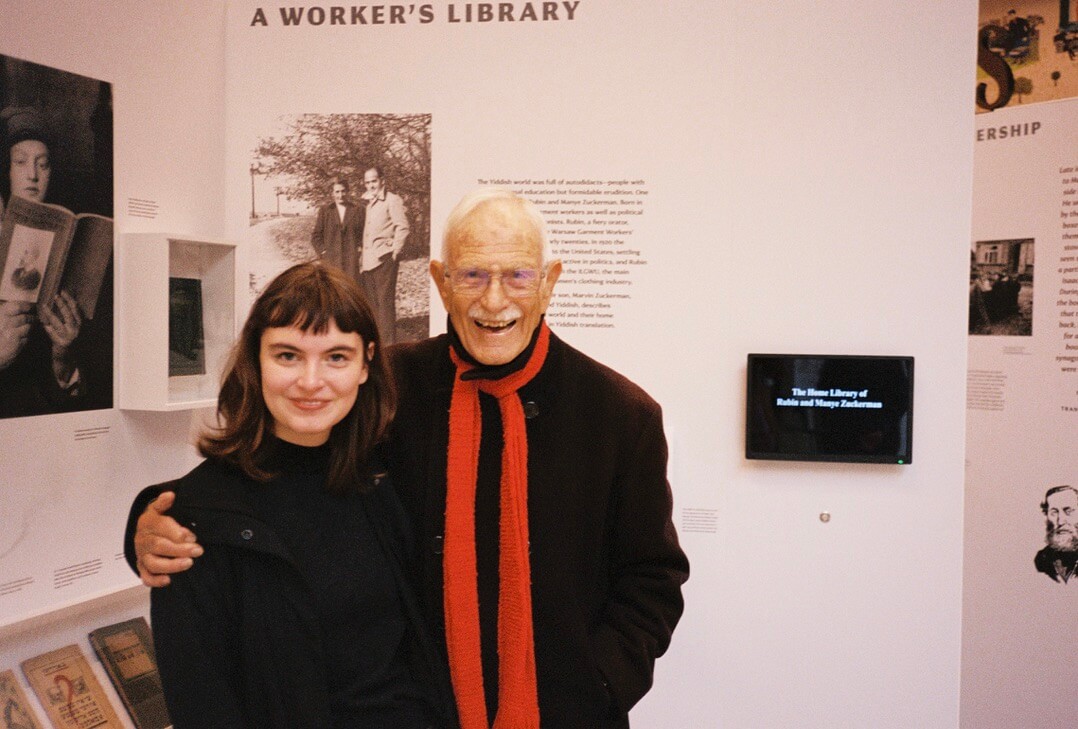
The author, Ruby Elliott Zuckerman, and her grandfather, Marvin Zuckerman. Courtesy of Ruby Elliott Zuckerman
My grandparents live in a small apartment in Santa Monica. It has white walls and wood floors and is full of light. The living room window faces the street, and my grandma, Kathy, likes to poke her head out and talk to her neighbors, many of whom moved here after the Palisades fire, just like them.
To me, the Palisades house where my grandparents lived for 60 years always felt frozen in time. While opulent mansions sprung up on their street, their house served as a reminder of the days when a humble community college English professor (my grandpa, Marvin) could buy property in those idyllic, quiet, near-enough-to-smell-the-ocean streets. It was filled with books and family photographs. The living room mantle was covered in beach glass, sea-shells and surf paraphernalia, reminders of Kathy’s 1950s Malibu surf career that was immortalized in my great-grandfather’s novel Gidget, which inspired a series of books, a movie and a TV show.
Marvin’s office was filled with hundreds of Yiddish books with multi-colored spines and black-and-white photos, some of which showed his Bundist father in Polish prisons. As a child, I would scan the spines of fat history books with frightening titles like The War Against the Jews 1933-1945 and Never Say Die! Printed out and pinned to the wall was a quote by Marek Edelman, the Bundist second commander of the Warsaw Ghetto Uprising: “To be a Jew means always being with the oppressed & never the oppressors!”
The Bund was a socialist Jewish political party, at one point the most popular in pre-Holocaust Eastern Europe. The party was founded on the premise of doikayt, or hereness, the belief that Jews deserved to live in freedom and dignity wherever they happened to be. In practice, this meant that the Bund ran a complex network of schools, self-defense squads, athletic clubs, literary journals, unions and local courts, designed to celebrate Jewish life and protect Jews from ever-surging antisemitic hostility. Knowing that my great-grandfather and namesake, Rubin Zuckerman, was a Bundist meant knowing that he was secular, proudly Jewish, believed firmly in egalitarian values, and was critical about the founding of Israel.
During the pandemic, I would sit in Marvin and Kathy’s overgrown garden, six feet away next to a rusted exercise bike. I would practice my Yiddish by reading aloud postcards sent from some young woman Marvin thought was the greatest — Molly Crabapple.
Molly began interviewing Marvin for her new book, Here Where We Live Is Our Country: The Story of the Jewish Bund, seven years ago. She has a resume that would make anyone’s head spin. Her art is in the permanent collection of the Museum of Modern Art and her journalistic output has covered Occupy Wall Street, Syrian rebels, and Guantanamo Bay. She’s won two Emmys and was nominated for a National Book Award.
Marvin told me about her with glowing eyes, and I responded with the type of disinterest reserved for recommendations from elder family members. OK, yes, there’s this young woman, she cares about the Bund, she makes art. But I too was a young woman who cared about the Bund and made art, and the narcissism of small differences precluded any real enthusiasm.
In 2026, with my grandparents’ Palisades sanctuary in ashes, I came to their house with a galley copy of Molly’s book. I had received it in the mail a few days earlier, and was quickly stripped of any skeptical haughtiness. Molly was describing a world, an ideology and a sensibility I knew so dearly and intimately from Marvin and Kathy. I had never seen this world so well described, neatly explaining concepts I have failed to adequately convey to even my closest friends.
I was eager to show Marvin the book, hear what Molly had gotten right or wrong, and share in the strange melancholic joy that comes from jewels of truth surviving over time, even as the physical, lived experience is washed away. With our personal archive up in smoke — the letters written by my great-grandparents, the stray notes, the marginalia in books toted from Poland to the Bronx to the Palisades — Molly’s book had a lot to live up to.
We sat on the couch and Marvin licked his finger to flip through the first pages. He went down the opening “Cast of Characters,” which outlines major players in Bundist history.
“Rafael Abramovich — I met him,” he said. “Meyer London — my father was in a picture with him.”
At 93, Marvin struggles to read without reading glasses and a dentist-grade clip-on magnifying glass. I read the introduction aloud to him and he recognized himself as the “octogenarian Yiddish scholar” who sang “partisan hymns” to Molly.
I continued to read aloud — about Molly’s own connection to her Bundist great-grandfather, her experience with leftist organizing, the overwhelming outpouring of support when she wrote about the Bund for the New York Review of Books, and her travels to the former Pale of Settlement, Ukraine and Gaza.
Despite my best intentions, my voice broke when I read this line: “The Bundists built alternate worlds of beauty, of courage, and of hope, which allowed their people to persevere even in the midst of an apocalypse. Their ideas are still vital today.”
I turned to Marvin and he was weeping as well.
“It’s true,” he said, “they were beautiful, beautiful people.”
“Are you two crying?” Kathy called in disbelief from the kitchen.
In Santa Monica, my grandpa’s office is inside of a closet. When I first got the news that the Palisades house had burned down, I emailed David Mazower, the curator at the Yiddish Book Center. I wanted to know if he could help me replace Marvin’s Yiddish books. Over the course of several months, he generously mailed nearly 100 books to us. They have strangers’ names written on their inside covers.
Feteshizing books
Family history embeds itself in your psyche through roundabout means. Marvin picked me up from school every Wednesday from the time I was in kindergarten until I graduated high school. He would buy me ice cream and listen to my favorite CD’s — The Beatles or Simon & Garfunkel, which sounded brand new to him since he stopped listening to popular music after Benny Goodman and prefers classical to anything else. He was my caring friend, who prioritized my own curiosity over anything else. Words like Bund, Yiddish, democratic socialism, Poland, the Holocaust, Zionism entered my subconsciousness, but I didn’t recognize the particular bent of Judaism I was born into until my later teens, when I started to seek out my own community.
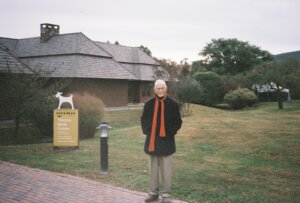
Marvin urged me to attend the Yiddish Book Center’s Great Jewish Books program for high school students in 2015. Stepping inside their shtetl-inspired wooden building deep in lush Western Massachusetts was the first time my Yiddishist, Bundist history had a context. I recognized a Jewishness based in literature. A Jewishness based in solidarity and multiculturalism, without borders or armies. Today, my great-grandparents, Manye & Rubin, are featured in the permanent exhibit curated by David Mazower. Their picture stands above a bookshelf with Yiddish translations of Darwin, Marx and George Brandes’ literary criticism, and a full set of Guy de Maupassant and Jack London. Next to the books is a video of Marvin, describing how his parents, although they had no formal education and were garment workers, read all the time. When I tell friends that my great-grandparents are in an exhibition, they ask what they achieved.
“They liked to read,” I say, with my heart full of pride. Their values speak to me as loud as any accomplishment.
“Secular Yiddish literature and the Bund grew together,” Molly writes in her book, “until Bundists became the literature’s greatest champions.”
“Jews fetishized books,” Molly writes elsewhere, describing the “gluttony” for knowledge most working class Eastern European Jews nourished.
Marvin is often critical of any work describing his history, but as we read the first 30 pages of Here Where We Live Is Our Country aloud, he had little to say other than brief exclamations of excitement and agreement. Molly’s writing style is full of delicious and evocative details that allow us to fully inhabit this vanished world. As we read about how Polish borders were drawn and re-drawn, Marvin told me about how he would fill out forms for his parents when he was a child.
“The forms would ask when were you born,” he said, “well, they didn’t really know. OK. Then, the forms ask where you were born. They would shrug and look at each other, saying, ‘Poland? Russia? Was it Russia then? Was it Poland?’
“Then the form would ask, what is your profession. They would say ‘operator.’ They meant sewing machine operator, but as a boy, I just thought, what’s wrong with these people? They don’t know when they were born, they don’t know where they were born, and they’re telling me ‘operator’ is a real job?”
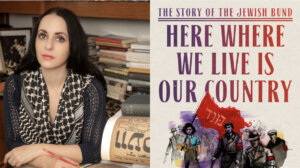
Molly and I share the same generational gap from our Bundist great-grandfathers. Both of us have parents who are not Jewish. And we are both women. Her perspective about female psychology, sexuality and experience allowed me to relate to Bundist history from a new axis. She writes about women who lost their virginity or had sex with multiple men in one day while surviving in the Warsaw Ghetto. She brings Pati Kremer to the forefront over her better known husband, the official founder of the Bund, Arkady Kremer, starting with Pati’s abandonment of her bourgeois upbringing and ending with a visit to her unmarked mass grave in Poland. Molly articulates the pull that many women, including myself, feel to “[subsume themself] in the domestic sphere that takes so many women out of historical record, while sometimes compensating them with private joys”
Women in Here Where We Live Is Our Country crush on their “family maid with sapphic fervor,” have long noses that “a male comrade mentioned unkindly in his memoirs,” make men their projects, sustain relationships with incarcerated men, or sometimes, “never married… had no lovers… just worked for the Bund.” She describes Sophia Dubnova’s efforts to disseminate birth control and lecture series about a woman’s right to orgasm. A non-Jewish Polish Socialist ally woman hides a message in her lipstick case. Abortion happens inside the Warsaw Ghetto, where many women were unwilling to risk bringing a life into such terrifying circumstances. It’s thrilling to hear these subjects written about so candidly, with no sense of shame or secrecy. I realize that in some ways, only a woman from my generation can do this.
A family affair
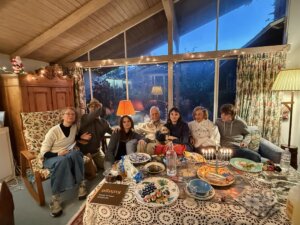
This past New Year’s Day, my parents and siblings crowded into Marvin and Kathy’s cramped living room. We ate the pastries Kathy had carefully assembled until the atmosphere abruptly shifted from friendly to tense. My father, a sociology professor, admitted he was planning on going to an academic conference in Israel. Although all of our family leans heavily left, my father feels a more profound connection to Israel. He lived there and worked on a kibbutz for several years.
My dad and I fell into the kind of argument many children have had with their parents since Oct. 7th, 2023. Despite fully knowing our shared values, we couldn’t help accusing the other of representing extremes: My dad must believe war crimes and genocide are legitimate means of self defense; I must believe Jews don’t deserve their own country. Marvin intervened thoughtfully, trying to bring our commonality to the forefront. Repeatedly, he referenced the Bund.
The Bund’s story is able to sidestep so many claustrophobic tropes around Zionism. Their devotion to Jewish safety and cultural autonomy leaves no room for accusations of antisemitism. If nothing else, they prove a point that bears urgent repeating for Jews and non-Jews alike — there has never been a singular Jewish consensus on the necessity of our own ethnostate. Like the Warsaw Ghetto fighters Molly resurrects in her book, like my own family, Jews have always argued about the best way forward.
I take enormous comfort reading Bundist leader Henryk Erlich’s 1933 speech, one that Marvin shared with me a few years ago when I was full of desperation about the atrocities unfolding in Gaza. Reprinted in Molly’s book, his words are clear as ever: “Our nationalism is just as ugly, just as harmful, and has the same inclination to fascist debauchery as the nationalisms of all nations.”
A strange sense of ownership
A few days after finishing Molly’s book, I met her at Canyon Coffee, and the two of us sat on the sidewalk while the east side creatives meandered by.
“I feel this strange sense of ownership over your book,” I said.
“You should,” said Molly, “without your grandfather’s encouragement, I would have never been able to finish it.”
I was overwhelmed by a new feeling. Here we were, chatting about the hectic nature of her upcoming book tour and the stress I’ve been feeling as a bridesmaid for my friend getting married next month. Against all odds, the movement that united our great-grandparents created a thread strong enough to find us sitting together. I felt that Molly was family.
Did you know that only 2% of Forward readers donate to support our nonprofit newsroom? That 2% make it possible for millions to read the Forward without a paywall or subscription — removing any barriers to the full and fair Jewish story.
But while the Forward is free to read, it isn’t free to produce. Big stories — like deep dives into the antisemitism data, political scoops or reporting trips to college campuses — take months of research and fact-checking. All while we keep you informed of what you need to know each day.
— Rachel Fishman Feddersen, Forward Publisher & CEO
Support our mission to tell the Jewish story fully and fairly.