On the small island of St. Eustatius, the Jewish community turned the tide of the American Revolution
‘The First Salute’ exhibit at the Weitzman Museum in Philly sheds light on the Jewish history of St. Eustatius and its impact on America
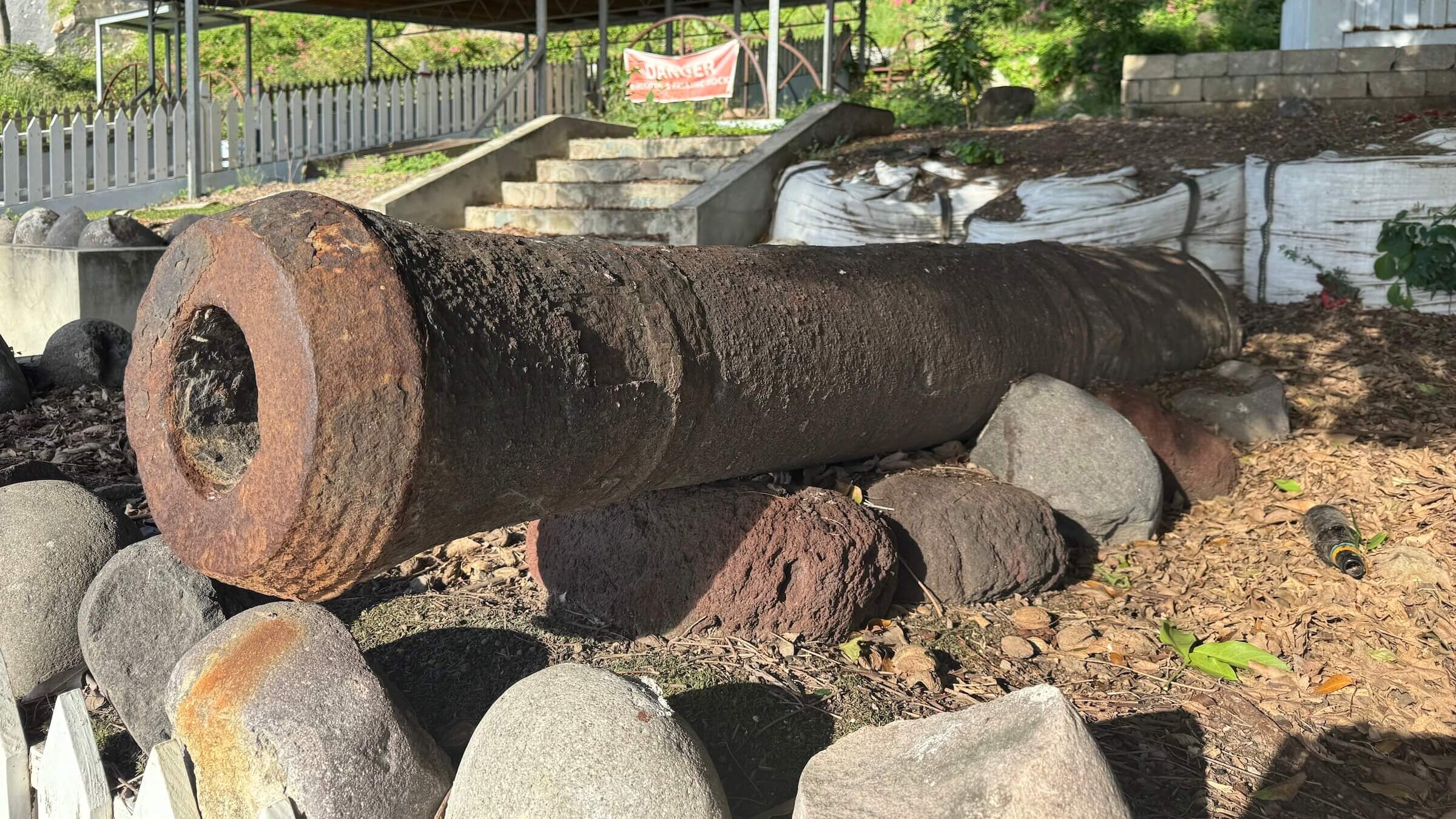
An 18th Century Cannon from St. Eustatius, which was transported to the Weitzman for the ‘First Salute’ Courtesy of The Public Entity of St. Eustatius

By Olivia Haynie April 23, 2026 · Updated April 24, 2026
Even if you’re someone with the most prolific knowledge of Jewish American history, you may not have heard of the small Caribbean island of St. Eustatius. But its Jewish community played an important role in the American Revolution.
The First Salute, a new exhibit at the Weitzman National Museum of American Jewish History in Philadelphia, highlights the important role Jews across the Americas, especially in St, Eustatius, played in the American Revolution.
“When we talk about American Jewish history, most people’s brains immediately go to Ellis Island and the Statue of Liberty and the turn of the 20th century,” Josh Perelman, a senior advisor at the museum, said in an interview. “However, in the 18th century, there were Jewish communities in North America, in the Caribbean, in South America.”
“Until at least the 19th century, the Caribbean communities were the dominant communities,” Perelman said. “They were the more established, more wealthy, more prominent.”
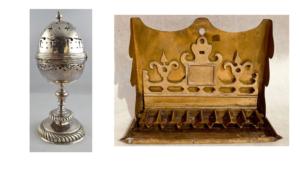
Curaçao. The Hanukkah lamp (right) may be the only surviving Jewish ritual object from St. Eustatius. It was later brought to St. Thomas. Both are on loan to the Weitzman for ‘The First Salute.’ Courtesy of he Mikvé Israel - Emanuel Congregation in cooperation with the Jewish Museum Curaçao/the Hebrew Congregation of St. Thomas
Jews began living in St. Eustatius in the 17th century, primarily those of Iberian descent who had escaped the Spanish and Portuguese Inquisitions that lasted from around the middle of the 15th century to the 19th century. As a Dutch colony, St. Eustatius provided Jews with more independence and freedom to worship than they would have had under other European powers. The population grew and, by 1739, had become large enough to establish a synagogue, Honen Dalim. By the Revolutionary period, approximately 30% of the European population in St. Eustatius were Jews.
Turning the Tide of the Revolution
One of the most prominent ports in the Atlantic at the time, St. Eustatius was also an ideal pace for Jewish merchants to conduct business. Jewish commercial networks developed across Europe, the Caribbean, South America, and North America bound together by a shared faith, ethnic background, and sometimes by marriage. The exhibit, which contains artifacts and documents from early Jewish communities in America, explains that, using this intricate network, Jewish merchants sent gunpowder and other military supplies to American forces, disguising the shipments as tea.
Historian Jonathan Sarna explained at the exhibit’s press opening that Jews were excited by the founding father’s commitments to religious freedom, which was inscribed in the Declaration of Independence.
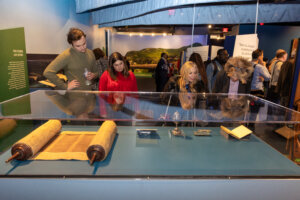
Although few Americans are taught about the Caribbean’s role in their American Revolution, the area played a central role in the conflict. On Nov. 16, 1776, St. Eustatius became the first international entity to officially recognize the United States of America when the governor greeted the American warship Andrew Doria in the St. Eustatius harbor with a cannon salute.
“The Revolution was an international event that touched people all through the Atlantic world,” Perelman said. “Without the Caribbean, without allies in Europe, and without courage on this continent, the Revolution would have never succeeded.”
In 1781, the British Army captured St. Eustatius and almost instantly, the Jewish population was persecuted. Royal Navy Admiral George Rodney imprisoned more than 100 Jewish men, and, less than 24 hours later, deported nearly a third of them to St. Kitts, an island in the West Indies. He had the homes of Jewish merchants ransacked for personal possessions, and dug up fresh graves at the Jewish cemetery, thinking they contained treasure. The Jews who weren’t deported immigrated to other places and by the early 19th century, the island’s Jewish community had virtually disappeared.
Rodney was so distracted with his antisemitic campaign that his troops failed to stop a French ship headed to join George Washington at Yorktown, costing the British the famous battle that turned the tides of the war.
Keeping History Alive
The First Salute, which was timed to coincide with America’s 250th anniversary, contains numerous artifacts from across the Americas including a cannon from St. Eustatius (it’s unknown if it’s the one that fired the first salute), a spice box from South America, pottery shards from the site of Honen Dalim, and Rodney’s list of St. Eustatians and their belongings, including the Jews he stole from.
Current St. Eustatius governor Alida Francis and other officials from the island attended the exhibit’s press opening and participated in a 13 “cannon” salute with confetti alongside the historians and staff at the Weitzman involved with bringing the exhibit to life. A man playing the role of George Washington oversaw the ceremony.
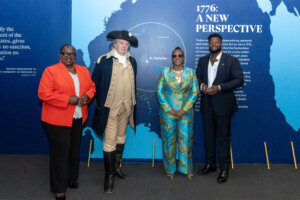
“The Jewish community of St. Eustatius did not stand in the margins of history,” Francis said in her remarks. “They helped to move it.”
Raimie Richardson, St. Eustatius’ State Heritage Inspector, who helped coordinate bringing artifacts to the exhibit, told me that the synagogue, which now exists only as a set of windowless walls, and the Jewish cemetery are routinely cleaned and cared for.
“We treat history as if it’s still part of our cultural heritage, even though the descendant community is no longer here,” Richardson said, noting that the Jews in the exhibit are not just abstract historical figures. “They were all Statian-born, just like me today. So we do not see them as part of a global nomadic Jewish community, but we see them also as Statians.”
Perelman thinks there’s a lesson for everyone to learn from the exhibit, underscoring the risk the Jewish community took to support a fledgling rebellion.
“In the very complicated world we live in today, what would you risk?” Perelman said. “What choices might you make for an unknown but better world?”
The exhibit The First Salute will be at the Weitzman until April 2027.
Correction: The original version of this article incorrectly named the State Heritage Inspector. His name is Raimie Richardson, not Raimie Ritchson.
Did you know that only 2% of Forward readers donate to support our nonprofit newsroom? That 2% make it possible for millions to read the Forward without a paywall or subscription — removing any barriers to the full and fair Jewish story.
But while the Forward is free to read, it isn’t free to produce. Big stories — like deep dives into the antisemitism data, political scoops or reporting trips to college campuses — take months of research and fact-checking. All while we keep you informed of what you need to know each day.
— Rachel Fishman Feddersen, Forward Publisher & CEO
Support our mission to tell the Jewish story fully and fairly.