The PBS series ‘Black and Jewish America’ gets it right — except the Black and Jewish part
The documentary traces years of alliance and rupture — but its false binary perpetuates stereotypes
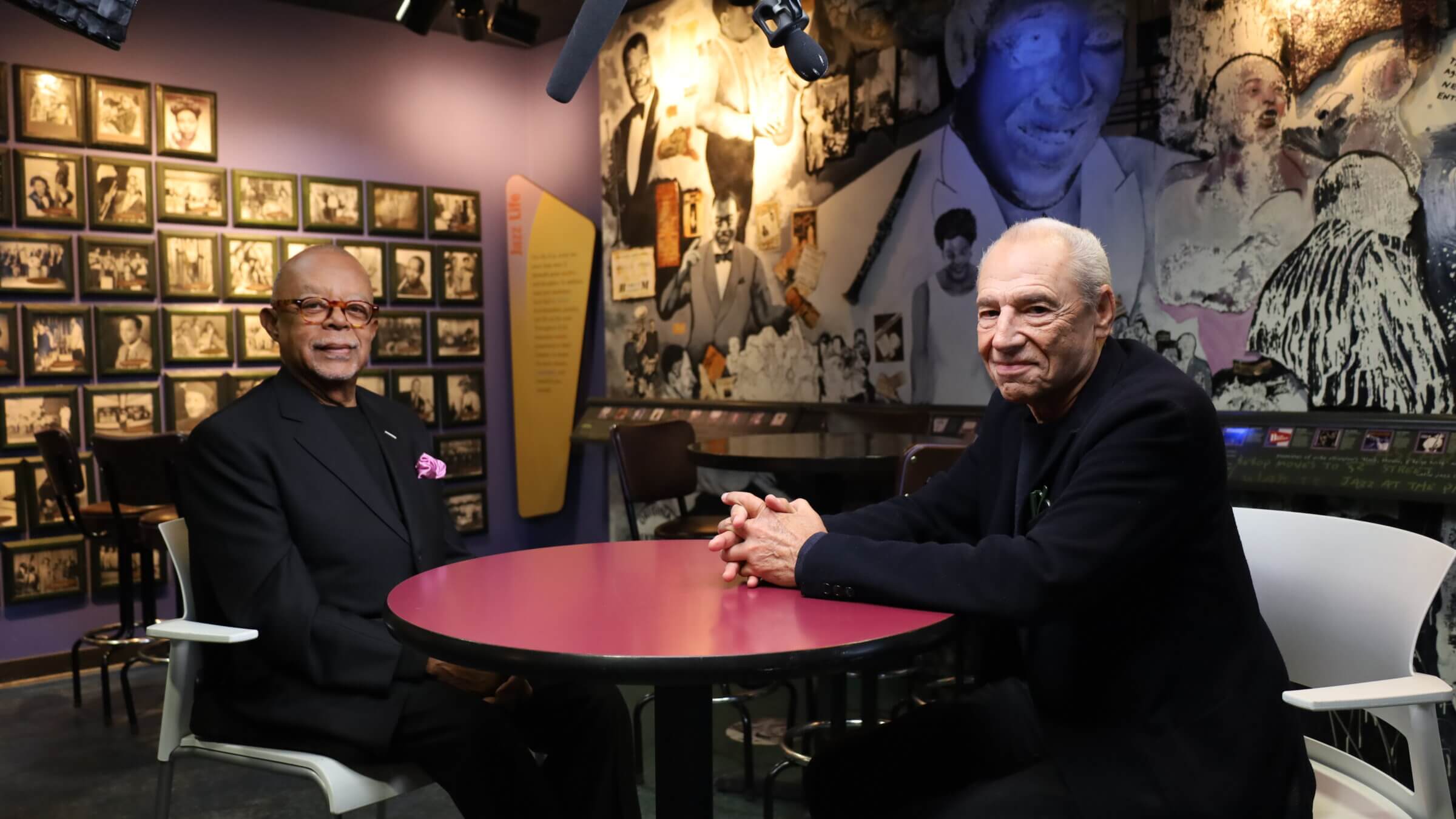
Henry Louis Gates Jr. and jazz artist Ben Sidran. Courtesy of PBS
By Robin Washington February 9, 2026
The opening scene in the first of four episodes of the PBS series Black and Jewish America: An Interwoven History captures a truly wonderful event: a Passover Seder led by culinary genius Michael Twitty that also includes his fellow rock-star Jews of Color Jamaica Kincaid and Rabbi Angela Buchdahl, among others. Rabbi Shais Rishon regales the group with a brief accounting of his Black and Jewish ancestry going back to the 1780s — an origin story that would seem to offer a natural entry point into the history of Black and Jewish life in America, at least through the 20th century.
Except we never hear from him again — or any other Jew of Color seated at that table.
What we do get in the four-hour series presented by Harvard historian and Finding Your Roots host Henry Louis Gates Jr. is a reductive depiction of the histories of Blacks and Jews as two separate groups. That’s despite the incessant reminder that I, and countless other Jews of Color, including those seated at that Seder table, have been making for decades: “Blacks and Jews” is a misnomer. The two are not mutually exclusive. Jews can be Black and Blacks can be Jews — and you cannot talk about the relationship between the two without acknowledging those who inhabit that intersection and have been influencing each group’s attitudes about the other for millennia.
Someone who has lived in both of those spaces all his life is University of Connecticut philosophy professor Lewis Gordon, who describes the binary as endemic in academia.
“They’re really invested in an ongoing stereotypical discourse, in which Blacks are represented by Christians and Jews are represented by whites,” he said. “Ultimately, they’re always talking about it as ‘Blacks and Jews,’ even when Black Jews are in the room.”
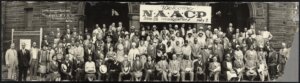
To be sure, there are other Black Jews in the program’s interview rooms, including Rabbi Capers Funnye of Chicago’s Beth Shalom B’nai Zaken Ethiopian Hebrew Congregation. But Funnye is one of many luminaries asked to comment on facts, incidents, or dynamics specific to one or both of the communities, rather than on the history of his own: a historically rich congregation that has served as a bridge between largely Black Israelite groups and predominantly white Jewish denominations.
And Funnye aside, Israelites aren’t mentioned at all, even as Israelite communities have crossed paths with mainstream Jewish congregations around the country for more than 150 years — a history the producers told me they were aware of but didn’t have the time or space to address.
“The Hebrew Israelite community is so complicated in and of itself that it felt almost like we could only bite off just the smallest piece of it,” co-producer Sara Wolitzky told me over Zoom. “We didn’t want to get that wrong, because it’s such a complicated set of experiences in its own right.”
That may be, but that’s like saying Jerusalem is claimed by both Jews and Palestinians; let’s talk about Tokyo instead.
As for that binary discussion, the series is competently told and offers deep dives into areas not widely covered in other Blacks-and-Jews works. In particular, it recognizes that Black and Jewish allyship wasn’t always a one-way street, in which more privileged Jews came to the aid of downtrodden Blacks. In the early 20th century, it notes, Black newspapers editorialized against pogroms in Europe and against the rise of Nazism.
The vein continues with the recording of Billie Holiday’s anti-lynching standard, “Strange Fruit,” though in a curious understatement it describes its Jewish songwriter Abel Meeropol — writing as Lewis Allan — as a schoolteacher, rather than as the fiercely progressive adoptive father of the sons of Ethel and Julius Rosenberg who also wrote lyrics for Paul Robeson.
A lesser-known story the series does allow room to breathe is that of the other Brown v. Board of Education: Esther Brown, a Jewish housewife in Merriam, Kansas, whose successful school-desegregation efforts in partnership with African American parents helped lay the groundwork for the landmark 1954 Supreme Court case — named, as it happens, for a different Brown.
To each of these peaks of progress and partnership are valleys of dispute and discontent. Jewish support of Black entertainers was often accompanied by economic exploitation; Jews fighting against restrictive covenants were undermined by others building whites-only Levittowns.
The alliance reached its zenith, of course, in the Civil Rights Movement, though the program largely confines that story to the 1960s, omitting crucial Black-Jewish collaborations that preceded it — including that of the Rev. Martin Luther King Jr. and his Jewish adviser and fundraiser, Stanley Levison. And while it briefly mentions one Black Jewish civil-rights leader, Student Nonviolent Coordinating Committee chairman Chuck McDew, he’s described as a “Jew by choice” — a moniker not used in reference to Jews in the program void of melanin.
At least he’s included. Sammy Davis Jr., who was also intensely involved in the movement, is nowhere to be found.
“Sammy Davis was a convert, right?” Wolitzky said, suddenly imposing a standard that apparently wasn’t a problem when talking about McDew, whose Judaism very much informed his decision to become a movement leader. “When you’re talking about Black Jews or Jews of African descent, there are so many different versions of that. Highlighting only one example like a Sammy Davis Jr. can misrepresent that.”
I’m sorry. You can laugh at, laugh with, or make one-eyed–Black–Jewish–Nixon-loving jokes all you want about Sammy, but you can hardly deny he was a major force in bringing awareness to the entire world — let alone to Blacks and Jews — that a person could be both, and proud of it. There is no way to deny his existence shaped the attitudes of both Blacks and Jews about the other.
Following the movement came the inevitable breakup, with Civil Rights morphing into Black Power and white activists expelled. A particular flare-up is highlighted in New York’s Ocean Hill–Brownsville school dispute between largely Jewish teachers and Black parents. Yet again, a key figure in that conflict who would later become a Black Jewish darling of mainstream Judaism is missing: Julius Lester, who during the dispute was accused of stoking antisemitic flames on his radio show before his Conservative conversion two decades later.
The series finally does return to Black Jews in the final episode, briefly, to recount Israel’s airlift of Ethiopian Jews in the 1980s, an act presented as if a more than 2,000-year-old community had suddenly been discovered. That segues into the revelation that there are Black Jews in America, and that it is suddenly acceptable to be one — a conversation that is quickly swallowed up by euphoria over the biracial phenomenon of Barack Obama.
If it sounds like I’ve been incessantly harping on where are the Black Jews?, co-producer Phil Bertelsen expressed exactly that.
“Do you have any questions beyond that?” he asked.
I did. I was curious about the mechanics of the production, and whether or not he and Wolitzky had documented how many times they showed the alliance holding hands versus reaching for each other’s throats.
“I didn’t count them,” he said.
Viewers don’t have to either; we get the point. It’s “I love you,” “I never want to see you again!” “I love you…” and on and on. And in that, the series is instructive. What’s missing is a strong summation that countless others who have written about the perpetual Black-Jewish makeup-and-breakup ritual have noted: If the two communities didn’t truly care for each other, they wouldn’t be talking about each other so much.
That’s something nearly every Black Jew I’ve ever met would tell you — including the ones at the Seder table. It’s too bad they didn’t get the chance.
This is a moment of great uncertainty. Here’s what you can do about it.
We hope you appreciated this article. Before you go, we’d like to ask you to please support the Forward’s independent Jewish news this Passover. All donations are being matched by the Forward Board - up to $100,000.
This is a moment of great uncertainty for the news media, for the Jewish people, and for our sacred democracy. It is a time of confusion and declining trust in public institutions. An era in which we need humans to report facts, conduct investigations that hold power to account, tell stories that matter and share honest discourse on all that divides us.
With no paywall or subscriptions, the Forward is entirely supported by readers like you. Every dollar you give this Passover is invested in the future of the Forward — and telling the American Jewish story fully and fairly.
The Forward doesn’t rely on funding from institutions like governments or your local Jewish federation. There are thousands of readers like you who give us $18 or $36 or $100 each month or year.
Support our mission to tell the Jewish story fully and fairly.