How an Amish Mennonite school in Arkansas went viral with a song by an Orthodox Jew
The choir director of the Calvary Bible School says that ‘Tatty, My King’ shows the surprising affinities between Jews and Mennonites
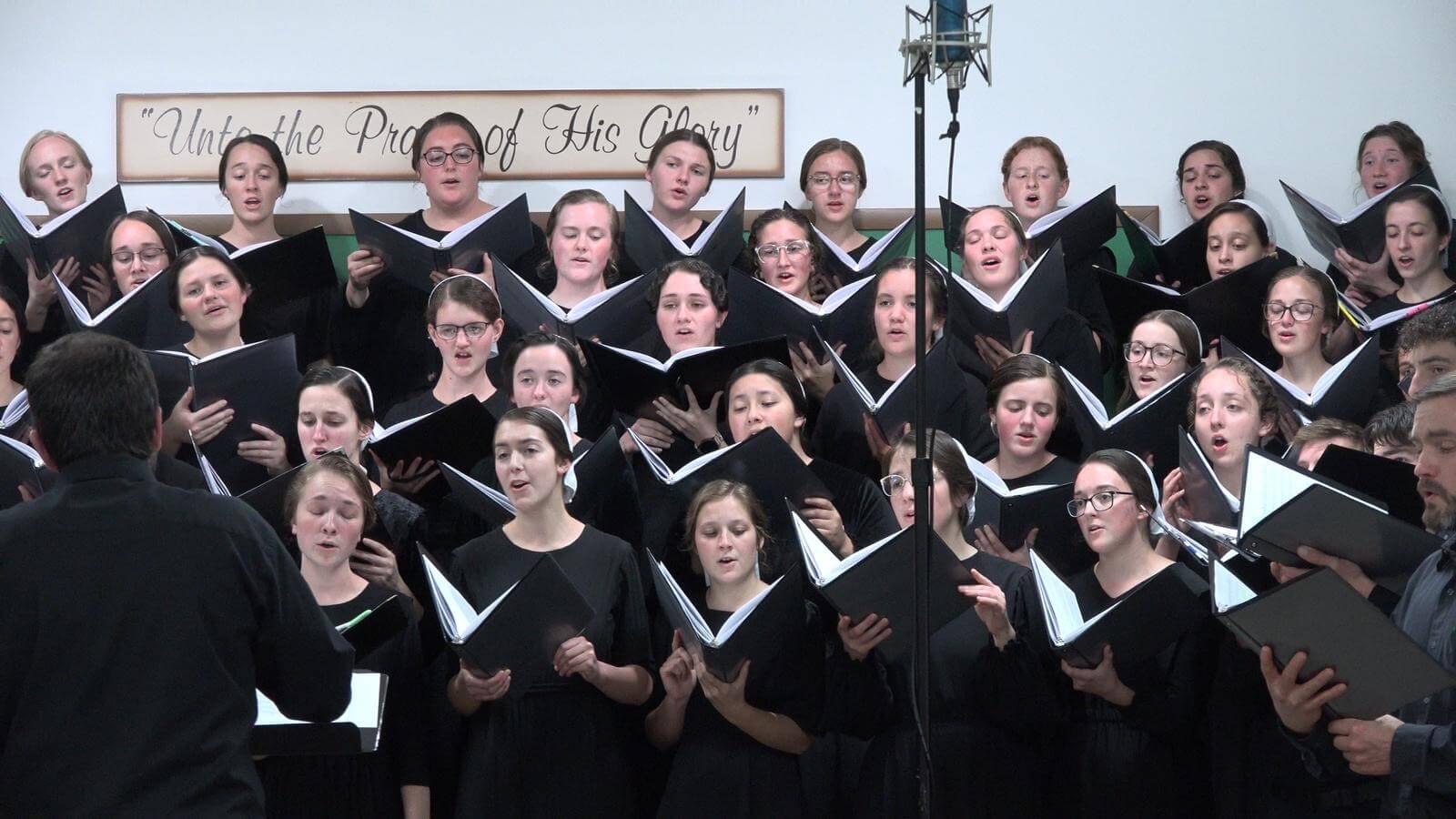
The a cappella choir of Amish Mennonite students from Calvary Bible School in Calico Rock, Arkansas. Courtesy of Gabriel Jantzi
Jewish social media was buzzing last month over a video of a choir singing the popular 2018 song “Tatty, My King,” composed by Dovid Edell, a former student of an Orthodox high school for boys in Waterbury, Connecticut. Normally, another rendition of a popular Jewish song wouldn’t cause such a stir, but the singers in this case weren’t the typical yeshiva grads of the Maccabeats; they were a co-ed a cappella choir of Amish Mennonite students from the tiny Calvary Bible School in Calico Rock, Arkansas.
Jewish viewers mostly expressed delight — “the YouTube algorithm is probably going crazy right now — frum people watching Calvary bible school,” one commenter put it, topping it off with a typed happy face — with only the occasional disgruntled remark about kol isha, the religious prohibition against men hearing women sing.
Curious about this rather unlikely collaboration, I called up Gabriel Jantzi, a self-described “amateur” musician who directed the choir, to ask about his introduction to Edell’s tune, how the project unfolded, and the choir’s surprising moment of minor fame in the Orthodox world.
Can you tell me a little bit about your background?
I’m 41 years old. I went to university for medicine, but I also really liked music. So I studied music, but I didn’t even minor in it, and I ended up as a veterinarian. [In the ensuing years] I have directed church choirs, and I directed my university choir for a year, and so that has been part of my life for the last 25 years. But it’s not like I have a master’s degree in choral composition or conducting.
I am a full-time farm and country vet in Ontario, Canada, and that’s what I do. This is a slow season in January and February, so it’s very convenient to take off time and do something that I really care about. So I’m also a pastor in a local conservative Mennonite church. I take great pleasure and derive a lot of energy out of working with young people who are interested in following God.
What’s your relationship to the Calvary Bible School?
I was a student there 20 years ago. Probably since its inception in the ’70s, it’s been a destination for Beachy Amish Mennonite youth between the ages of 18 and 20 who want to dedicate time to study how to live a life that’s pleasing to God.
There are a lot of different names for all the different stripes of Mennonite. I grew up in the Amish Mennonite tradition. I got married, I moved a little bit. I ended up in a tiny bit different stripe. But at least in our communities, it’s not a big issue for me to go back to that tradition and say, here I am, what can I bring and what can I offer? So technically I’m not exactly the same stripe as the school, but I grew up in that stripe, if that makes sense.
I think the concept of moving a little bit along denominational lines, or even to sort of different expressions of one’s faith, would be quite familiar to many Jews.
I think that there are striking similarities between our communities here.
I think a lot of people understand who the Amish are and they understand who Mennonites are, but can you explain what an “Amish Mennonite” is? I know these boundaries can be fluid.
The Beachy Amish Mennonites care about traditions; we’re not throwing them out just because we want to move forward in a certain progressive way. Yet we are much more open to technology than what we call the Old Order Amish or Old Order Mennonite groups. When we use the term “Old Order,” we’re referring specifically to those groups that have said, “We’re going to welcome technology up until the 1800s or the early 1900s, and we’re going to maintain the horse-and-buggy style of life and so on.” [But Amish Mennonites] said, “No, we’re not actually against technology, we’re just hesitant to adopt everything new without testing it.” We care about probably many of the same traditional values that [Old Order groups] would, such as community and our church. And also just like they do, we put a great emphasis on our religion being a very practical religion. So it’s lived out in such a way that you can look at us and say, oh, they must have some reasons behind living a certain way.

How did you first come across this song, and what made you want to arrange it?
Anabaptists have a strong tradition of a cappella music, men and women singing together without the aid of instruments. We care very much about that: Every time we get together for a worship service, that’s how we sing.
We came across an a cappella cover of this song by Benny Friedman on Spotify and that really resonated with us. Not me personally, but some of these kids [in the choir] would actually be from a congregation that’s set limitations that you’re not even supposed to listen to instrumental music, so they could listen to this song.
And so they brought it to me last year at the Bible school and said, “Do you know this song?” And I said, “No, I’ve never heard of it.” I listened to it a bunch more and I realized why they liked it. It talks about some very universal questions that any kid who’s grown up in a tradition with God will have: Where are you? I’m told I need to come talk to you, but I don’t really want to. And as my relationship with God matures, it kind of develops into this realization that actually He’s been covering my back all this time and I never realized, so I really do want to stay on God’s team. Whether you’re an Orthodox Jew or you’re a conservative Mennonite, either way, as your relationship with God matures, those words really resonate and that progression really comes through in the song. So I thought, and my wife thought as well, that I should lead this song next year for these kids.
I have often taken music and arranged it to fit an a cappella group, and for some reason I just was not filled with any profound inspiration on how to do that for this song. So I asked a friend of mine named Wendell Glick [to arrange it.] He is a professional musician, he’s got a Ph.D. in composition, he does this for a living. He’s also from [an Anabaptist] background, and led this choir for seven years before I did. So he knows this choir, which means he knows how to write music that stretches them just the right amount so that they do a good job of it. I really want to praise him for that.
He did a great job.
It worked for us. We’re only together for two and a half weeks, and we’re not professional musicians. Also, this choir is mandatory. That means 60% of the kids want to be there, 20% are OK with it, and 20% don’t like singing and they still have to be there. Actually, you can see [in the video recording] some of them are really feeling it and others are zoned out. And that’s OK!
For the first week [of practicing], we didn’t really like it. We’ve been very tainted by mainstream Christianity’s Protestant music that came in the 1850s, [whereas] this song has just a touch of minor key. It comes from a different culture, not quite what our mental ear hears. It took us a bit of time to get into it, but by the second week this was without a doubt the favorite song of my repertoire. Then at our local or in-house concerts, the audience just absolutely loved it. And when I say that, it’s not like we got a standing ovation; to us the highest compliment is when somebody says, “It made me worship God.” And those are the compliments we began hearing.
Did you ever have any interactions with Dovid Edell, who wrote the song?
Yes, I did. When I take a song, I make sure it’s licensed for use. I understand [Edell] had to get permission or talk with some rabbis to see whether it would be appropriate. And so he talked to the rabbis and then he called me up and I spoke to him about who wanted to sing it and I explained that the youth are all Christian. He was very nice about it and he said, “Just let them know that this was my conversation with God. It’s a personal song.” And I said, “That’s the basis on which it resonates with us as well.” He was gracious and let us use it.
Then when I was actually working with the students, I also communicated back to Dovid because he said, basically, “I have a few messages I want you to directly convey to the students.” Which made it very personal. Gen Z loves to have some personal connection, right? When they perform a song, they love to have some personal connection to the composer. And that just made it for them. That was amazing.
Did you get any negative reactions?
I’m assuming — and I say this with respect because we also understand some of the traditions from the Torah — that some people found it offensive, that it’s a mix. Forgive me if I’m mispronouncing it, but I had never come across the kol isha idea so I was a bit sheepish that I walked into something without doing my research very well.
One of the things I care about is that people worry about pronunciation when they sing another language. One of my negatives is I did not ask Dovid how to pronounce “tatty.” I just kind of ran with it. In the future, I would probably be a little more careful about asking the original composer whether he wanted a certain emphasis and a pronunciation of certain words.
Did you realize how popular the video had become in the Orthodox world?
The lovely thing is the conductor is not mentioned in that video and you just see his back. So fortunately, from my viewpoint, very few people know who I am. If there’s any publicity here, I’m glad that the school gets it, because the school is blatantly about the glory of God. And to use a phrase that Dovid would have said, he just wants to spread light. So I want that to be the focus.
We read the comments, and I think I’d have two words to describe our reaction: first is delight, and second, we’re honored. We blatantly are Christians, not Jews, so we come at this and say this is a part of our maturity process to learn more about God’s son. But that being said, the song itself doesn’t speak whatsoever about the Messiah; it only talks about the relationship with God. And to us, it 110% resonated, just like it did for your community, so we are grateful that we could participate.
We care a lot about this school, but we understand it’s very arcane. All of 83 students were there this past term. Not many people know about it. So it was quite a thing that another community is interested in what we’re doing. But we also acknowledge that the song that we are singing is from that community. So yeah, it was kind of a good circle.
Did you have much familiarity with Jews and Judaism before this? Have you learned more about it through this experience?
Yes, we would have some familiarity. I hope I’m not coming across as cocky, but because we study Judaism, I think we actually have a bit more familiarity with Judaism than I think from what I read in the comments than they’d ever have with us. There are a lot of comments that were like, “Where did you get this song?” Well, guys, you put it on Spotify! But if you assume we’re all Old Order Amish that drive horse and buggy and don’t have internet, then I can understand those questions. So I think we have some knowledge, although I had no idea about things like kol isha. Also, it was a surprise to all of us how much our performance of your song resonated with your community. I’m still not sure why.
I can think of two possibilities. One is that it’s just a very beautiful rendition, so it’s hard to imagine not being moved by it. But I also think Jews are often happily surprised to see a group of non-Jews embrace or respect a piece of Jewish culture, particularly Orthodox culture. A lot of the time, people anticipate negativity.
Well, that’s very nice of you to say. Those words really make me feel fuzzy and warm inside. We have great respect for your culture. We think God brought the Messiah through your people. I realize that differs from the understanding of many people who wrote comments, but we have profound appreciation and love for your people.
We understand that we are the white Christians and Christians have had thousands and thousands of years of fighting with the Jews. So I know it’s hard to say, “Well, we’re not like that.” But I think I can speak for all Anabaptists and say we would strongly differentiate ourselves and say, no, one of our fundamental professions or distinctions is this idea of love for all man. In fact, we won’t even go to war because we love people. Again, it comes back to we are honored that you let us use it. We were tickled pink and I’ll be keeping my eyes open for other songs that I think could be used.
This is a moment of great uncertainty. Here’s what you can do about it.
We hope you appreciated this article. Before you go, we’d like to ask you to please support the Forward’s independent Jewish news this Passover. All donations are being matched by the Forward Board - up to $100,000.
This is a moment of great uncertainty for the news media, for the Jewish people, and for our sacred democracy. It is a time of confusion and declining trust in public institutions. An era in which we need humans to report facts, conduct investigations that hold power to account, tell stories that matter and share honest discourse on all that divides us.
With no paywall or subscriptions, the Forward is entirely supported by readers like you. Every dollar you give this Passover is invested in the future of the Forward — and telling the American Jewish story fully and fairly.
The Forward doesn’t rely on funding from institutions like governments or your local Jewish federation. There are thousands of readers like you who give us $18 or $36 or $100 each month or year.
Support our mission to tell the Jewish story fully and fairly.