Dear internet: Having Jews in movies isn’t ‘Zionist propaganda’
Viewers of new films, and old, are missing the plot on the Jewish story
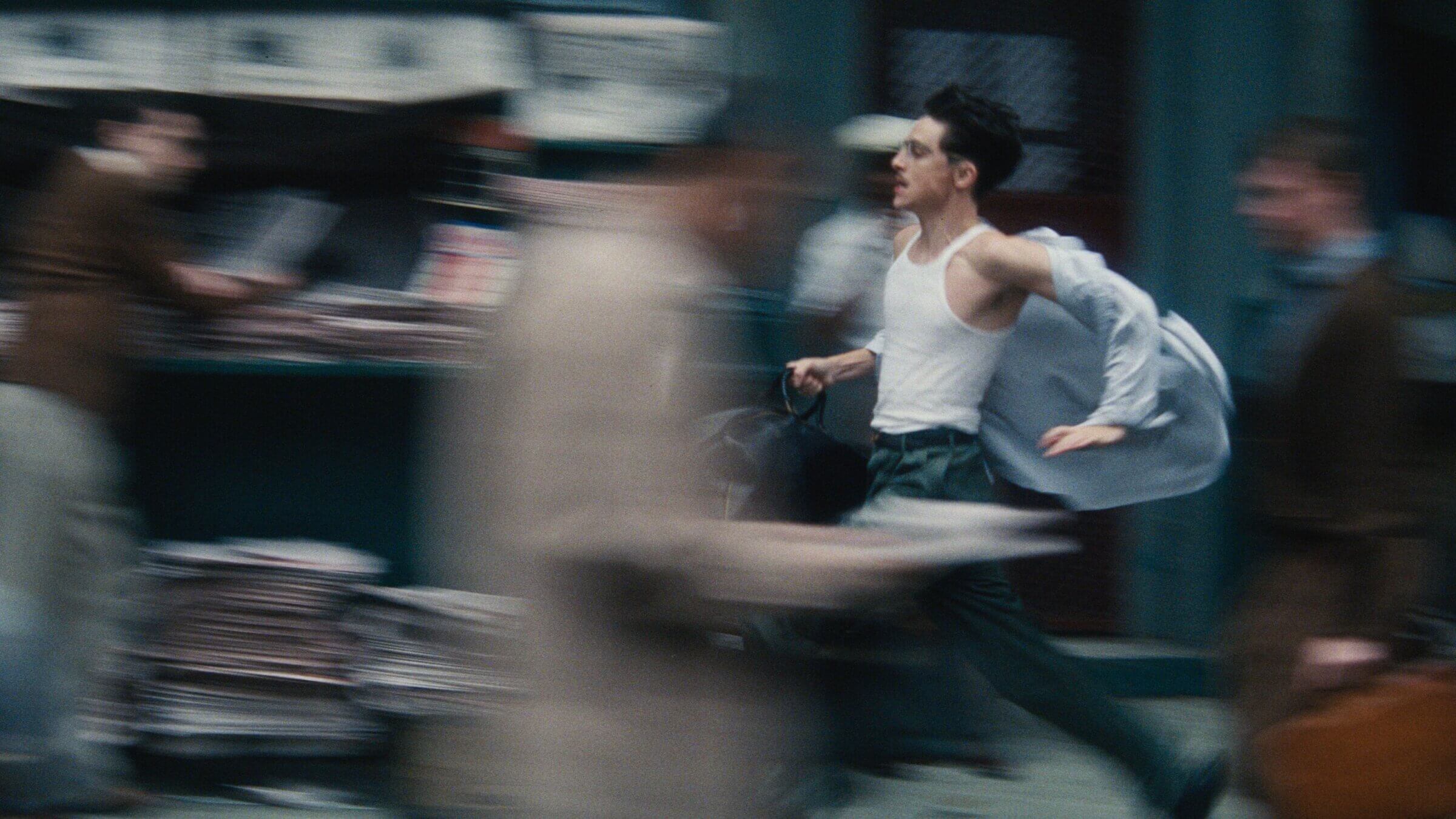
Timothée Chalamet plays Jewish ping-pong player Marty Mauser in Marty Supreme. Courtesy of A24

By PJ Grisar February 20, 2026
There’s a joke in Blazing Saddles, about an event that took place several thousand years ago, that maybe hasn’t aged so well.
It’s in the scene where Harvey Korman’s conniving Attorney General Hedley Lamarr brainstorms plans to clear away the town of Rock Ridge. Lamarr’s lackey Taggart, played by Slim Pickens, makes a modest proposal: “We’ll kill the firstborn male child in every household.”
Lamarr considers the idea, before dismissing it. “Too Jewish,” he says.
When I heard that quip in a recent rewatch with my girlfriend (her first time), I saw a new reason why you couldn’t make the film today: Modern audiences, particularly those amateur critics itching to sound off online, seem to have more fluency in blood libels about Jews than the Passover narrative Mel Brooks and Co. were riffing on. For those who think the Epstein files contain damning proof of elites eating babies, “too Jewish” might seem like an admission. For the many more who look upon Zion as the source of the world’s ills, a misreading of the gag would likely go viral.
True, Blazing Saddles was made in 1974, well before the recent carnage in Gaza. But I could imagine the rejoinders — “Israel has been killing kids since 1948!”
I put the “too Jewish” joke out of mind for a bit. I decided I was overstating just how wrong people on the internet could be. And then I encountered a post on X. It was responding to a screenshot from Marty Supreme, where the title character presents his mother with a chunk of the pyramids. “We built that,” he says.
“This is Zionist propaganda,” an eagle-eyed netizen wrote, to the tune of nearly 96,000 likes, 11,000 reposts and 7 million views. The self-professed “archeology (sic) major” took the occasion to correct this humorous expression of the collosal self-regard of an antihero ping-pong hustler with proof that this particular Wonder of the World was the work of well-respected Egyptian craftsmen and so (somehow) invalidates the Jewish national project.
Someone else said the film, which nowhere mentions Israel, was Zionist. A Letterboxd review is terse in its description: “if the spiritually Israeli term was a movie.”
This failure to grasp Jewish references that have their own ontology — or the desire to graft more recent ones onto them — is becoming a theme.
Last year, The Brutalist, was mired in a debate about whether or not its subplot about the newly formed Jewish state was an endorsement or indictment of national ambitions in the Levant. (In entering this particular fray, most missed the point: Recent survivors of the Holocaust discussed and argued about Israel, some moved there, others didn’t and a film can present this reality without offering a judgment either way.)
When I see these takes, I beat my chest as if performing viddui over the death of media literacy.
As a critic for a Jewish publication, whose remit is to read deeply into even the most tenuous of Jewish subtexts, this pains me. Not because I myself have offended (though perhaps I have), but because I take the work seriously and try my hardest not to impose on art something that just isn’t there. I’m reminded of Freud’s famous remark: “Sometimes a cigar is a phallic metaphor for Jewish domination on stolen Palestinian land.”
Sorry, that wasn’t it at all, was it?
What the terminally online crowd often mean to say when they shout “Zionist propaganda” is “there are Jews in this!” It’s not a great way to interpret art, and it undermines the legitimacy of the argument that anti-Zionism is not antisemitism. But a film need not even have Jews in it for some to claim it’s really about Israel.
My colleagues and I have written about how Dune, Superman, and Zootopia 2 have been seized by the internet as part of the monomyth of Israeli villainy. When people make these connections, they may believe they’re thinking deeply, but they’re really just reaching for the nearest headline or playing to their own biases.
This insistence on Israel as the ultimate Big Bad reminds me of a remark made by Denise Gough, an actor in the Star Wars series Andor (another property said to be about Israel-Palestine, even though the creator Tony Gilroy mentioned numerous historical inspirations, most directly the Wannsee Conference). In an interview, Gough said a fan sent her a Star Wars analogy, which she said she only half understood.
The fan argued that just as the Death Star, a planet-destroying weapon, has an Achilles’ heel in its exhaust port, that when fired at explodes the whole thing, the conflicts of the world have a focal point in Palestine from which the architecture of oppression can be demolished.
“If we can free Palestine,” Gough concluded, “it explodes everything.” “Everything,” here, being unrelated atrocities in Sudan, Congo and Nigeria.
Let’s leave aside the fact that Gough, an actor in a Star Wars property, is somehow unfamiliar with the most iconic scene in the franchise, and what that level of research might connote for her understanding of the dynamics of the Middle East.
What she is really demonstrating, when she mentions other countries rocked by violence, is something much scarier: how the conspiratorial, magical thinking that all wrongs lead back to Israel — and that everything is a metaphor for it — echoes tropes of Jewish control and is ultimately an excuse for an exclusive fixation. Turn off the targeting computer that acknowledges complexity. Use the force, Denise! Get rid of the Zionist entity, every other crisis will sort itself out!
And so, I worry that Jewish stories — or even jokes — will stop being seen outside of a context of Israel’s actions and that metaphors and allegory will lose their elasticity, all looping back to a unified theory of evil Jews. Not for everyone, but for enough people to make a difference.
The Jewish story is textured, complex and anything but unified. Marty Supreme, The Brutalist and Blazing Saddles, each make this case. Those who see only one narrative not only miss the plot, they miss out on what good art does best.
This is a moment of great uncertainty. Here’s what you can do about it.
We hope you appreciated this article. Before you go, we’d like to ask you to please support the Forward’s independent Jewish news this Passover. All donations are being matched by the Forward Board - up to $100,000.
This is a moment of great uncertainty for the news media, for the Jewish people, and for our sacred democracy. It is a time of confusion and declining trust in public institutions. An era in which we need humans to report facts, conduct investigations that hold power to account, tell stories that matter and share honest discourse on all that divides us.
With no paywall or subscriptions, the Forward is entirely supported by readers like you. Every dollar you give this Passover is invested in the future of the Forward — and telling the American Jewish story fully and fairly.
The Forward doesn’t rely on funding from institutions like governments or your local Jewish federation. There are thousands of readers like you who give us $18 or $36 or $100 each month or year.
Support our mission to tell the Jewish story fully and fairly.