Did Jew Who Triggered Kristallnacht Survive Nazi Era After All?
Graphic by Angelie Zaslavsky
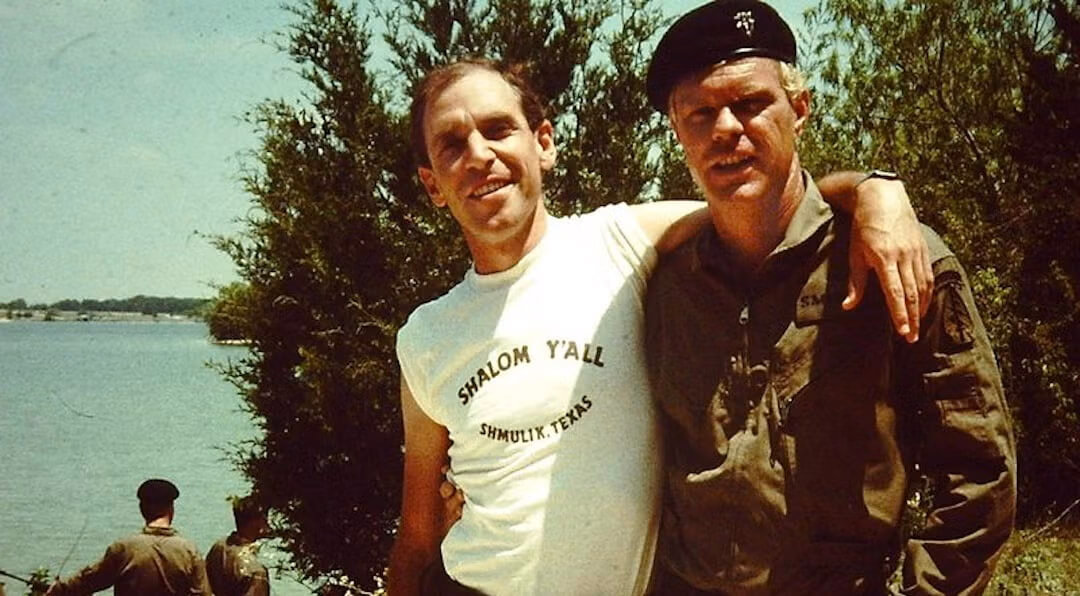
— A photo found in Vienna suggests that Herschel Grynszpan, whose murder of a German diplomat in 1938 was used as a pretext to launch the Kristallnacht pogrom 78 years ago this week, may have survived World War II.
It was previously believed that Grynszpan, a Jew of Polish background who was 17 when he shot Ernst vom Rath in Paris on Nov. 7, 1938, had either been executed or died of an illness between 1942 and 1945 while held in a German prison. Von Rath died of his wounds two days after the shooting.
Christa Prokisch, archive director at the Vienna Jewish Museum, found a photo in which a man who strongly resembles Grynszpan is seen in a postwar displaced persons camp. The photo shows displaced persons demonstrating in 1946 against the British decision to bar Jewish immigration to Palestine.
Prokisch showed the photo to the German journalist Achim Fuhrer, author of a biography of Grynszpan, who agreed that the person in the unposed photo was probably Grynszpan. He told Focus magazine that Grynszpan’s exact fate remains unknown.
Grynszpan had said after his arrest that he was prompted by Germany’s deportation of his parents and 12,000 other Jews of Polish origin in August 1938.
Fuhrer told Focus magazine that if he survived, Grynszpan may have feared being tried for his murder of vom Rath or being associated with Kristallnacht, “The Night of Broken Glass.”
On the nights of Nov. 9 and 10, 1938, mobs in Germany, Austria and the Sudetenland attacked Jews, their homes and institutions. Nearly 100 Jews were murdered and hundreds injured, and some 30,000 were arrested and placed in concentration camps. At least 1,000 synagogues were destroyed.
It’s our birthday and we’re still celebrating!
We hope you appreciated this article. Before you go, we’d like to ask you to please support the Forward’s independent Jewish news.
This week we celebrate 129 years of the Forward. We’re proud of our origins as a Yiddish print publication serving Jewish immigrants. And we’re just as proud of what we’ve become today: A trusted source of Jewish news and opinion, available digitally to anyone in the world without paywalls or subscriptions.
We’ve helped five generations of American Jews make sense of the news and the world around them — and we aren’t slowing down any time soon.
As a nonprofit newsroom, reader donations make it possible for us to do this work. Support independent, agenda-free Jewish journalism and our board will match your gift in honor of our birthday!
Support our mission to tell the Jewish story fully and fairly.