Remembering Siskel and Ebert’s great debate: Mel Brooks or Woody Allen?
In 1980 the critics sparred over whose films were better — it’s an eerie watch in 2026
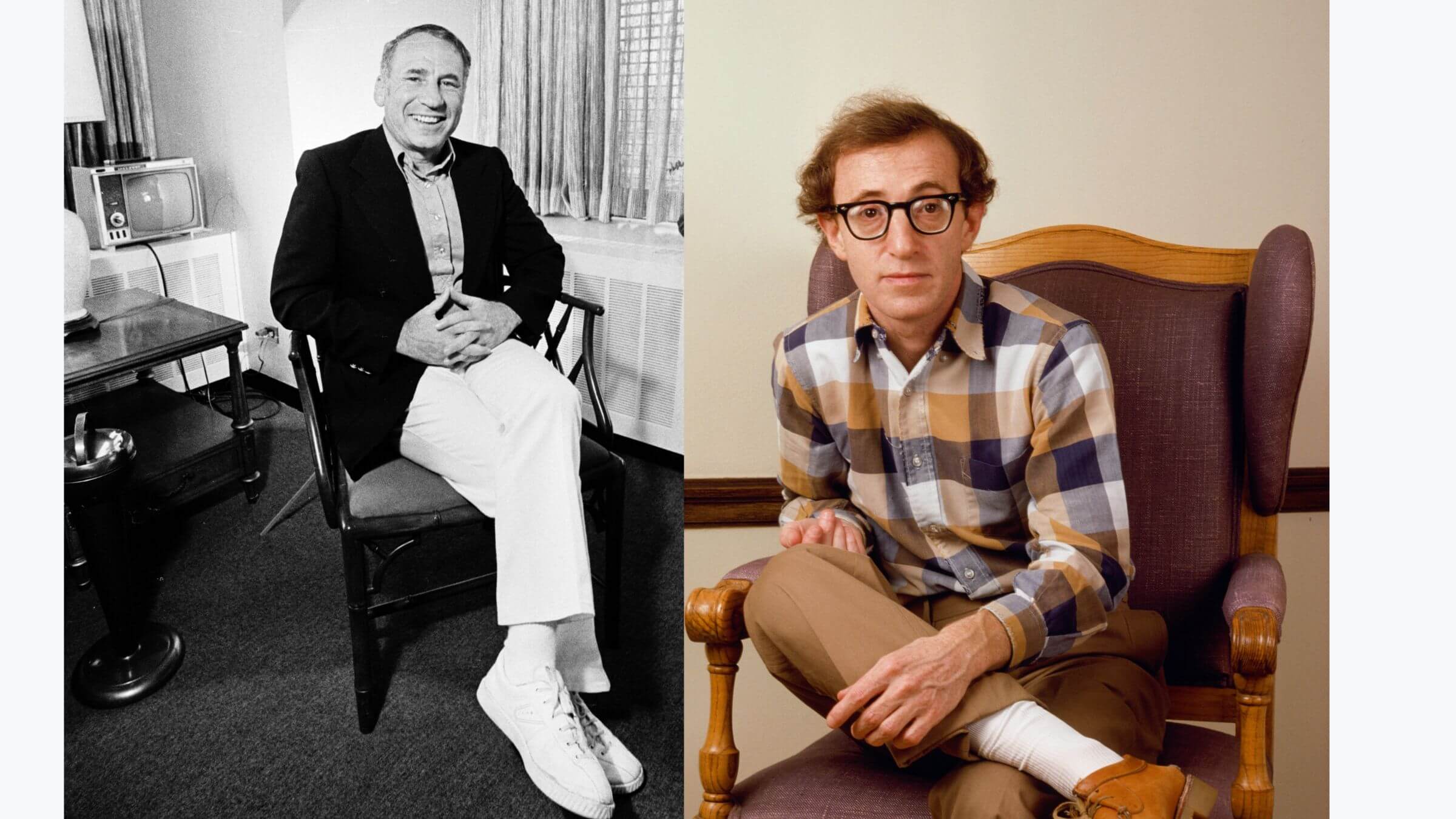
Mel Brooks and Woody Allen, two titans of film comedy, were compared on an episode of Sneak Previews. Photo by Jack Mitchell/Getty Images/Nancy R. Schiff/Getty Images

By PJ Grisar April 17, 2026
Of the great debates in film history, a few dominate. How much of Citizen Kane did Orson Welles really write? Is the auteur a film’s true author? And, the one that will never be resolved, can we separate the art from the artist?
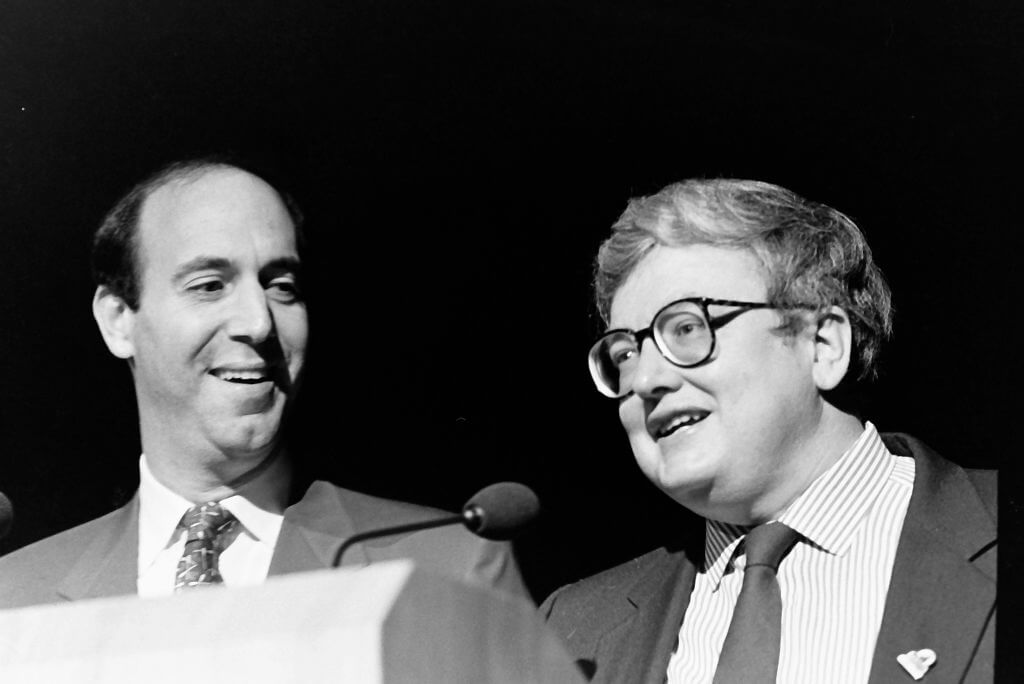
In 1980, Gene Siskel and Roger Ebert devoted an episode of their PBS review series Sneak Previews to the following question: Who’s funnier, Mel Brooks or Woody Allen?
The camps fall out as one might expect. Ebert, the Pulitzer Prize-winning critic for the Chicago Sun Times, whose work spoke to the everyman, preferred Brooks.
“Mel Brooks satirizes old movies, he plays off of our own shared sense of movie history because we know these cliches and stereotypes as well as he does,” Ebert, who died in 2013, argued. “That’s part of the fun, we’re in on the joke.”
He laid out his evidence in the form of his favorite gags: A man punches a horse (Blazing Saddles); Gene Wilder gets smooshed in a revolving book case (Young Frankenstein); and Burt Reynolds is lathered up by Brooks, Marty Feldman and Dom DeLuise (Silent Movie).
Siskel, the stuffier, Ivy-educated writer for the Chicago Tribune, championed Allen’s films, praising the filmmaker’s perennial theme of “his difficulty, every man’s difficulty, in establishing a long-lasting relationship with a woman.” (Siskel died in 1999, the year of Sweet and Lowdown, Allen’s jazz-inflected riff on La Strada.)
He made the case that Allen’s oeuvre, from Take the Money and Run through to Annie Hall, showed a personal and artistic evolution. “Watch how he grows more competent as a lover, and as a filmmaker.”
It’s a kind of odd proposition for considering comedy, and, depending on your views of Allen, may give you pause today.
Yes, Virgil Starkwell’s reliance on voiceover to express his feelings for a love interest is different from Love and Death’s Boris, who is different from Alvy Singer and his assertive request that Annie Hall kiss him now to “get it over with and then we’ll go eat.”
The scenes Siskel curates by way of argument are not the funniest moments, but taken together they signal what is most unsettling in some of the films. That is to say, they are uncomfortable, or to borrow a term from Claire Dederer, “urpy,” because Allen casts himself as a mostly hapless lover, who only aspires to possess, in the words of his later character from Manhattan, where these problematic glimmers become plot, the “coiled sexual power of a jungle cat.”
1980 was an inflection point in the careers of both Brooks and Allen. Brooks, following the rave response to Blazing Saddles and Young Frankenstein, had more measured — if not quite tepid — notices for Silent Movie and his Hitchcock sendup, High Anxiety.
Allen’s previous two films were Interiors, his attempt at a serious picture in the mode of Ingmar Bergman, and Manhattan.
Both Ebert and Siskel saw “danger signs” ahead in these artists’ filmographies.
Siskel thought Brooks was repeating himself and straying to a more niche mode of parody.
He was right, and after High Anxiety, Brooks could be said to have officially entered his flop era with History of the World Part I. Siskel also diagnosed a generally-agreed-upon development in the work to come: Brooks giving himself starring roles, and the proportional decline in quality corresponding to his screentime.
But it’s Ebert’s view of Allen that seems most prescient, however unwittingly.
Ebert likens Brooks and Allen to Buster Keaton and Charlie Chaplin. In Keaton he sees a man who remained true to himself and the persona he sought to perfect — this, one infers, is analogous to Brooks. In Chaplin, come The Great Dictator, there was a “creeping seriousness.”
I have to say, I stopped listening after “creep,” aware, as I am, that Chaplin, at age 54, married Oona O’Neill, a month after her 18th birthday.
Manhattan, and later Allen’s relationship with his now wife Soon-Yi Previn, echoes such an age gap. But Ebert’s issue with Manhattan, and he is not alone in this indulgence, isn’t with the film’s tacit approval of Isaac Davis’ relationship with a 17-year-old (played by a 16-year-old), it’s with its pretensions.
Out is Alvy Singer’s relatable, late-night campaign against a spider in his ex-girlfriend’s bathroom. In is black-and-white film stock and Isaac’s defense of Bergman as “the only genius in cinema today.”
“You can see Woody Allen there slipping away from his all-purpose comic persona that he developed in those other movies and into a character who might be a lot closer to life, but he’s also a lot less funny,” Ebert said.
Ebert’s forecast was astute. As Allen became ever more a caricature of himself, there have been both bright spots — Hannah and Her Sisters, Zelig — and diminishing returns — the run from, say, 2009 to the present, where actors including Larry David and Wallace Shawn have served as his surrogate.
Running through the discussion is a subtext of Jewish particularism. Allen’s voice is so personal, so dialed in to New York neuroses, that his departure to WASPs in Interiors sounded a symphony of false notes. In contrast is Mel Brooks, who brands his comedy not as Jewish, but “New York humor,” and whose main inspiration has always been the wider province of popular culture.
That Siskel, a Jew with a snobbish streak, should favor Allen and Ebert, a Catholic and the real film lover of the pair, Brooks, perhaps says it all.
But baked into everything is the unspoken question of legacy — who would fare better in the long-term. In a way it’s a tossup. So many of Brooks’ references were locked in place and time, even as they parodied older films. A young viewer today may need footnotes to get the joke behind the profusion of Johnsons (Howard, Olsen and Van) in Rock Ridge.
In this formulation, Allen skews (mostly) evergreen. Except when he doesn’t because of where the culture, and his reputation, is now.
For their closing arguments, Ebert and Siskel each selected a scene from their preferred filmmaker. One of them holds up today.
Ebert brought a scene from The Producers, where Leo Bloom has a meltdown over Max Bialystock’s suggestion they break the law. While this timid CPA is hyperventilating, Bialystock crosses the room to get him a glass of water — and douses him with it. Leo: “I’m hysterical and I’m wet.”
It’s timeless.
Siskel’s pick is from Annie Hall. It’s when Alvy Singer recalls his second-grade classroom.
“In 1942,” he says, “I had already discovered women,” a curious word choice for what follows. Alvy, 6, kisses a classmate (definitively a girl).
The girl cries out for the teacher, who scolds Alvy for his precocious sex drive. “6-year-old-boys don’t have girls on their minds.”
In comes the adult Alvy, cramped in a child-sized desk, to insist he had no latency period. He then gets the child actors to report on where they are a few decades later. The boys name their careers, and in one case, addictions. One girl, in glasses and a Peter Pan collar, simply says “I’m into leather.”
Is it funny? Such things are subjective, in the end. Given what we know now of Allen, the allegations of sexual abuse against him by his daughter Dylan Farrow (which he denies) and his proven and unrepentant association with Jeffrey Epstein, it’s harder to watch.
Without knowing it, Siskel chose the exact wrong clip.
As for Brooks, the baggage, and the ambition, may seem lesser, but in fact point to something unimpeachable.
“I think what Mel Brooks wants, when he walks past a theater that has one of his movies playing into it, is the sound of laughter coming from inside,” Ebert said. “That’s what I want when I go to a Brooks movie is to laugh. I can defend his career on that basis. That he wants to amuse me, that’s enough. I’m satisfied.”
To that, I say, Dayenu.

Did you know that only 2% of Forward readers donate to support our nonprofit newsroom? That 2% make it possible for millions to read the Forward without a paywall or subscription — removing any barriers to the full and fair Jewish story.
But while the Forward is free to read, it isn’t free to produce. Big stories — like deep dives into the antisemitism data, political scoops or reporting trips to college campuses — take months of research and fact-checking. All while we keep you informed of what you need to know each day.
— Rachel Fishman Feddersen, Forward Publisher & CEO
Support our mission to tell the Jewish story fully and fairly.