As Mel Brooks turns 99, his wisdom matters more than ever
And its greatest outlet might be ‘The 2000 Year Old Man’
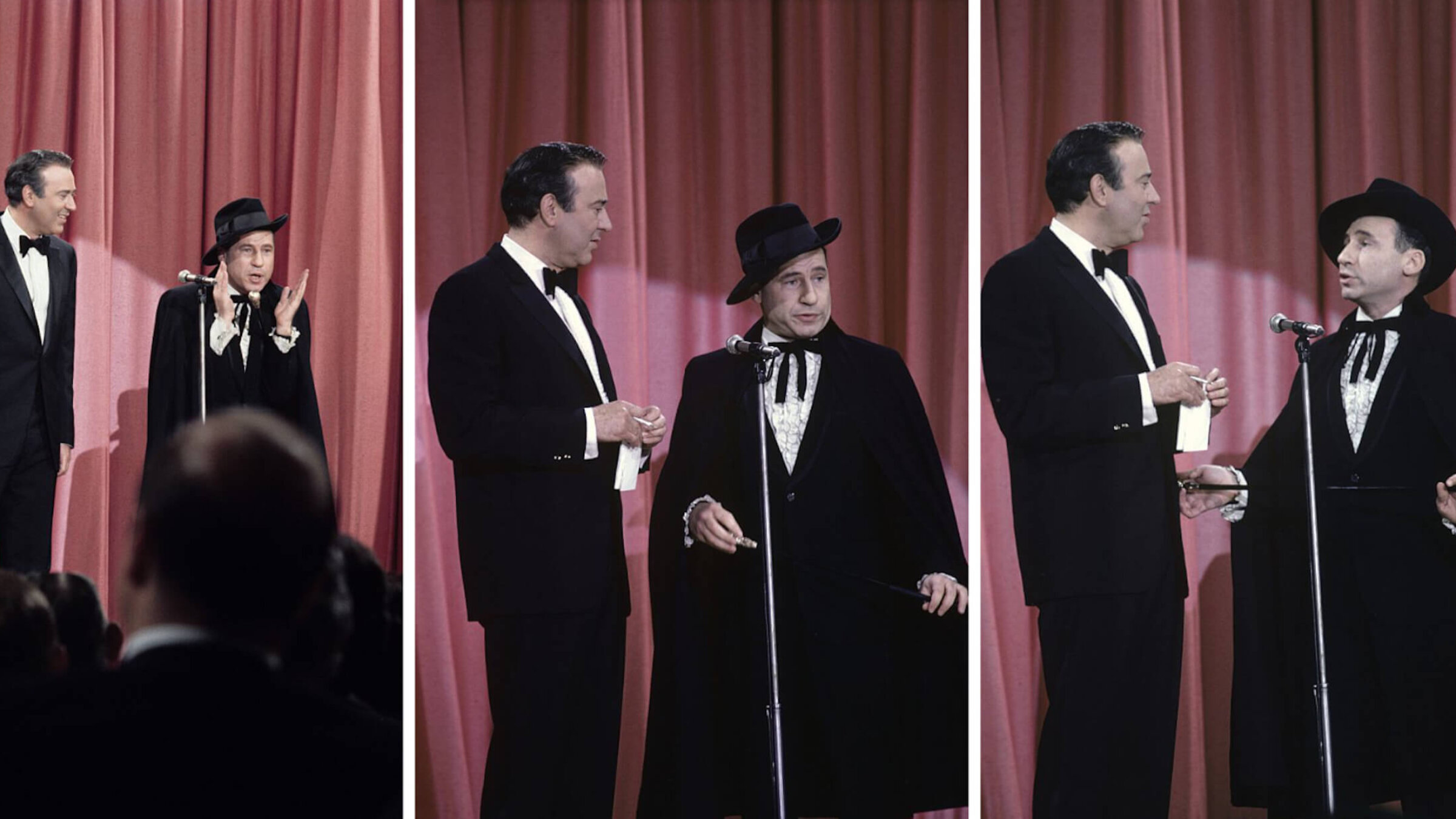
Carl Reiner and Mel Brooks, performing The 2000 Year Old Man in Los Angeles, California in 1967. Photo by Martin Mills/Getty Images

By Talya Zax June 27, 2025
My late grandpa was a taciturn man, not prone to sharing details about his life. So when I used to ask him what it was like to be a psychologist — he worked until he was 92 — he would always give the same answer: a paraphrase of a sketch from Mel Brooks’ and Carl Reiner’s The 2000 Year Old Man:
“Clients come to me and say, doc, something’s wrong, I can’t stop cutting paper. So I tell them: Don’t cut paper!”
There’s an ancestral quality to the routine, which I first heard as a teenager, when my dad would play CDs of it during road trips in the family minivan. That quality isn’t just due to the fact that the titular gerontological miracle, played by Brooks, claims to have more than 42,000 children, none of whom ever come to visit. It has, instead, something to do with the way in which Brooks, who turns 99 on Saturday, gives voice to a very Jewish kind of ancient wisdom: cockeyed and often unhelpful — “I’d rather eat a rotten nectarine than a fine plum, whaddyathinkofthat” — but reliably excellent at establishing a sense of proportion.
Brooks makes it easy to believe that a certain recognizable type of Jew could easily have seen all of modern history unfold, and come away blithely unimpressed. Robin Hood? “He stole from everybody and kept everything.” Joan of Arc? “Ah, what a cutie.”
I’ve been thinking a lot about that sense of proportionality, recently. As the Forward’s opinion editor, my inbox often reflects a feeling — coming from across the political spectrum — that the state of the world could not be more dire. I get it. The post-World War II international order is fragile; the Middle East is mired in war; the climate is changing; the future of the United States seems, for many different reasons, uncertain.
But feeling constant desperation doesn’t necessarily help things get better. When I succumb to that habit — when I begin to see every single news item as an emergency — I increasingly hear my grandpa’s voice, telling me not to cut paper. It doesn’t mean there are no emergencies. It just means, respectfully, get over yourself.
The 2000 Year Old Man comes from a time during which — in markedly different ways from today — the stakes of human existence, and Jewish existence, seemed uncomfortably high. Brooks and Reiner — who plays the straight man, interviewing Brooks about the many wonders he’s seen — began crafting the routine in the 1950s, publicly debuted it in the ’60s and eventually turned into a set of hit records and, in 1975, a television special.
In 2009, revisiting the routine’s glory days, Reiner told The New York Times that when the duo first came up with it, they agreed, “we can’t do it for anybody but Jews and non-antisemitic friends.”
“The Eastern European Jewish accent Mel did was persona non grata in 1950,” he said. “The war had been over for five years, the Jews had been maligned enough.”
By the time the television special came out, the Cold War was at its height; the Vietnam War had killed thousands of American soldiers and millions of Vietnamese civilians; and Watergate was remaking American politics. The specific traumas had changed; the fact that the world is traumatizing had not.
And yet there was Brooks, in that special, solemnly informing Reiner that he credited his longevity to one simple habit: “I never, ever touch fried food.” The 2000-year-old man exists, stubbornly, in a world in which no problem is so gigantic that it cannot be overcome by a healthful diet. (And, he later adds, a determination to never run for a bus.) He survives not because of his wits or his strength, but because he watches his waistline and lets history gently glide right by him.
Of course, this may be only partially reasonable advice for how to actually, practically live. But it’s reassuring to encounter someone so radically free from the burdens that characterize the lives of those afraid of what the world has in store. It’s a reminder that no matter how much we worry about it, history is going to pass us by, too, and eventually leave us behind, with our concerns making little if any mark on its progress.
In the TV special, Brooks patiently explains to Reiner that pretty much every joyful human behavior is rooted in fear — including singing, dancing, and falling in love. He doesn’t put it quite this way, but it’s clear that one thing his long life has taught him is that things never work out quite the way you might predict. You check a foe for weapons, and then, boom, you’re dancing the Charleston together. You ask one woman to watch your back for a while, to see if there’s an animal behind you, and suddenly, you’ve invented marriage.
Most of us won’t have multiple millennia through which to develop such matter-of-fact sagacity. But it’s a joy that Brooks and Reiner gave us a sense of what it might be like if we did. As the former turns 99 — about 4.95% of the 2000-year-old man’s lifespan, for reference — it’s worth revisiting, and enjoying, the fruits of their labor. After all: “Fruit is good,” the 2000-year-old man once wisely said. “Fruit kept me going for 140 years.”
Did you know that only 2% of Forward readers donate to support our nonprofit newsroom? That 2% make it possible for millions to read the Forward without a paywall or subscription — removing any barriers to the full and fair Jewish story.
But while the Forward is free to read, it isn’t free to produce. Big stories — like deep dives into the antisemitism data, political scoops or reporting trips to college campuses — take months of research and fact-checking. All while we keep you informed of what you need to know each day.
— Rachel Fishman Feddersen, Forward Publisher & CEO
Support our mission to tell the Jewish story fully and fairly.