These states want to ban the term ‘West Bank’ and replace it with ‘Judea and Samaria’
A legislative push seeks to mandate state officials use the biblical name for the territory
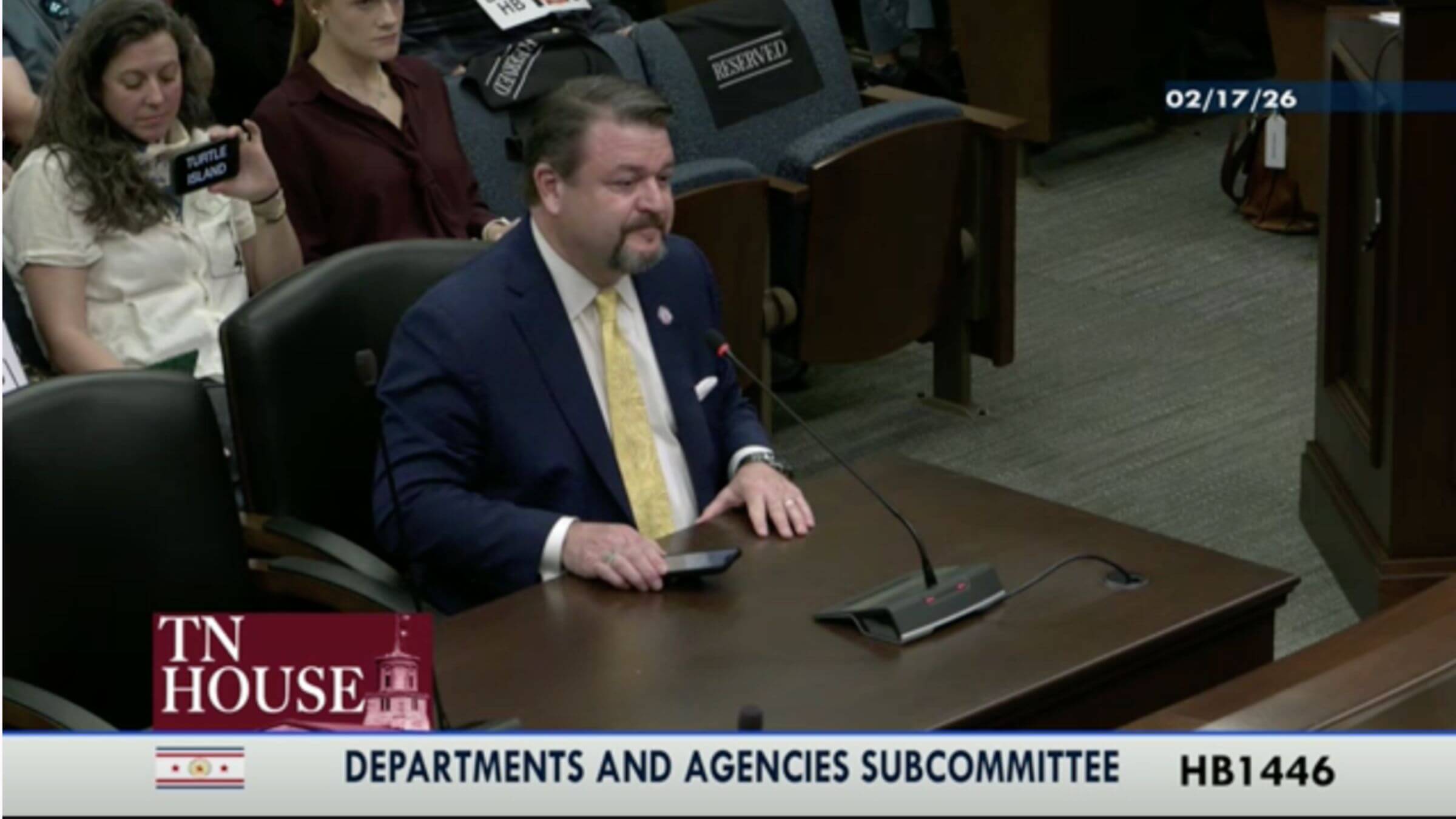
Jason Rapert, founder of the National Association of Christian Lawmakers, testifies before the Tennessee state house. Screenshot of Tennessee General Assembly

By Hannah Feuer April 22, 2026
When it comes to discourse surrounding the Israeli–Palestinian conflict, fights over word choice can be as charged as fights over the facts themselves. Is it “occupied territories” or “disputed territories”? A “security fence” or an “apartheid wall”? “Terrorist” or “militant”?
These terms often signal a speaker’s allegiances — and which historical narrative they accept as true.
Now, that semantic divide is moving from rhetoric into law.
Tennessee passed a bill last week banning the use of “West Bank” in official state documents, instead favoring the biblical names, “Judea and Samaria.” Gov. Bill Lee is expected to sign the bill into law, applying the mandate to state educational materials including textbooks and course descriptions, according to state Sen. Mark Pody, a co-sponsor of the bill.
“The use of the term ‘West Bank’ is a deliberate attempt to erase the Jewish identity of Judea and Samaria,” the bill reads, “and to obscure the deep historical, religious, and legal connections of the Jewish people to the land.”
The measure is part of a broader push by Republicans to recognize Israel’s claim to land widely considered unlawfully occupied under international law. Last year, House Republicans launched the “Friends of Judea and Samaria Caucus,” a group of Christian lawmakers who promote Israeli sovereignty over the West Bank. Meanwhile, Arkansas Sen. Tom Cotton introduced a federal bill — with the unwieldy title “Retiring the Egregious Confusion Over the Genuine Name of Israel’s Zone of Influence by Necessitating Government-use of Judea and Samaria Act,” an acronym for “recognizing” — though the bill never made it out of committee.
Now, states are taking on the fight. Jason Rapert, founder of the National Association of Christian Lawmakers and a former Arkansas state senator, has said he is working to pass similar bills nationwide, with 15 states expressing interest so far. Among the states that introduced such legislation this year: Alabama, Arizona, Florida, Oklahoma, Utah and West Virginia.
The flurry of bills comes as violence against Palestinians in the West Bank intensifies and Prime Minister Benjamin Netanyahu has accelerated the expansion of settlements, entrenching Israeli control of the region and further dimming prospects for a future Palestinian state.
That reality is now colliding with U.S. state politics, as legislators argue over the legitimacy of Israeli and Palestinian claims to the land — and how far state law should go in shaping that debate.
Each term is “loaded with political context, loaded with real significance for a dispute where people are dying,” said state Senator Jeff Yarbro, a Democrat, who testified against the bill during the Tennessee legislature’s deliberations. “We are compelling [the] use of one of those political terms. That’s a choice. It is mandated political speech, effectively.”
The bill’s origins
Yossi Dagan, head of the Shomron Regional Council, which oversees Israeli settlements in the West Bank, has spent years building support among American evangelicals to formally recognize “Judea and Samaria.”

“The lie about the ‘West Bank’ or ‘occupied territory’ must end,” Dagan said at a conference of conservative state legislatures in Indianapolis last July. “We must put the truth on the table: Judea and Samaria are the heart of Israel.”
Dagan has close ties with U.S. ambassador to Israel Mike Huckabee, and has hosted him for multiple visits to “Samaria” as part of a broader effort to bring American officials to the region.
Sen. Pody said he was inspired to cosponsor Tennessee’s bill after taking such a trip last year with Huckabee.
“They were talking about a bill that had passed that was very similar out of Arkansas, and how that was really inspiring to the people over there [in Israel],” Pody told the Forward. “And so after we left, we knew that we wanted to do something like that in Tennessee.”
The Tennessee bill mirrors model legislation promoted by the National Association of Christian Lawmakers and leans heavily on biblical justification, stating that “the return of the Jewish people to Judea and Samaria in modern times constitutes the fulfillment of numerous biblical prophecies” — referring to the Christian Zionist idea that the Jewish state is a precursor to Jesus’ return.
“Eighty percent of the Bible stories that we read occurred in Judea Samaria,” Rapert told the Tennessee legislature. “Can you imagine someone not wanting to call Tennessee, ‘Tennessee’?”
Rapert did not respond to a request for comment.
In addition to biblical reasoning, advocates for the name “Judea and Samaria” often point out that the region was not known as the “West Bank” until relatively recently. The name was popularized after Jordan annexed the territory in 1950, a move the Arab League condemned as illegal at the time. Israel took control of the territory in the 1967 War and has administered it since, with varying degrees of Palestinian self-rule in some areas.
“The more traditional things that we’ve had, that have been around for centuries, is something that I think we’re going to be more comfortable with using,” Pody said. “The West Bank has been more recent terminology.”
Today, the U.S. State Department — which uses the term “West Bank” — estimates that roughly 3 million Palestinians live in the region, alongside an estimated 465,400 Israeli settlers, according to the Israeli Central Bureau of Statistics, which does not include Israelis who live in East Jerusalem in their tally.
Many Palestinians view the West Bank as core to any future Palestinian state, while Netanyahu has said “Judea and Samaria” is part of Israel’s “ancestral homeland.”
‘Co-opting Judaism’
Asked by a state representative about who opposes his bill, Rapert said those who resist using the term “Judea and Samaria” are typically “folks that support Hamas.”
But efforts to ban the term “West Bank” in official documents have drawn pushback from a broad range of voices — including some Jewish leaders who say they were never consulted on the matter.
“This is not something that has been on the agenda of the Jewish community whatsoever,” Civia Tamarkin, president of the National Council of Jewish Women Arizona, told the Arizona Mirror. She added that Arizona’s resolution on the topic amounted to “co-opting Judaism and antisemitism for a Christian nationalist agenda.”

Maeera Shreiber, a rabbi and English professor at the University of Utah, voiced similar concerns about Utah’s bill, which did not make it out of committee. She said the effort appeared rooted in “a kind of sympathy for the Jewish community,” but failed to account for the diversity of views Jews hold. As a professor at a public university, she also worried about how such language mandates could shape course materials.
“If we replace it with Judea and Samaria, it really obscures the presence of Palestinian claims to the land as well,” Shreiber told the Forward. “These things happen out of misinformed, misguided goodwill, and people often don’t understand the long, dark reach.”
In Tennessee, critics raised similar concerns about erasing Palestinian identity. Anwar Irafat, an imam in Memphis who grew up in Gaza and the West Bank, said the bill ignored the millions of Palestinians who live on the land.
“I’m here because this bill tells me and my family that we do not exist,” Irafat told lawmakers during their deliberations.
State Sen. Charlane Oliver, a Democrat who voted against the measure, questioned why lawmakers were focused on the issue at all, raising concerns about the separation of church and state.
“This is not a congregation,” Oliver said on the Senate floor. “We are not here to debate scripture.”

Did you know that only 2% of Forward readers donate to support our nonprofit newsroom? That 2% make it possible for millions to read the Forward without a paywall or subscription — removing any barriers to the full and fair Jewish story.
But while the Forward is free to read, it isn’t free to produce. Big stories — like deep dives into the antisemitism data, political scoops or reporting trips to college campuses — take months of research and fact-checking. All while we keep you informed of what you need to know each day.
— Rachel Fishman Feddersen, Forward Publisher & CEO
Support our mission to tell the Jewish story fully and fairly.