Citing risk to Elie Wiesel’s ‘Night,’ Iowa judge blocks key parts of state book ban law
Iowa’s Republican governor signed the bill into law last year along with other culture-war legislation targeting transgender athletes and student pronouns in schools
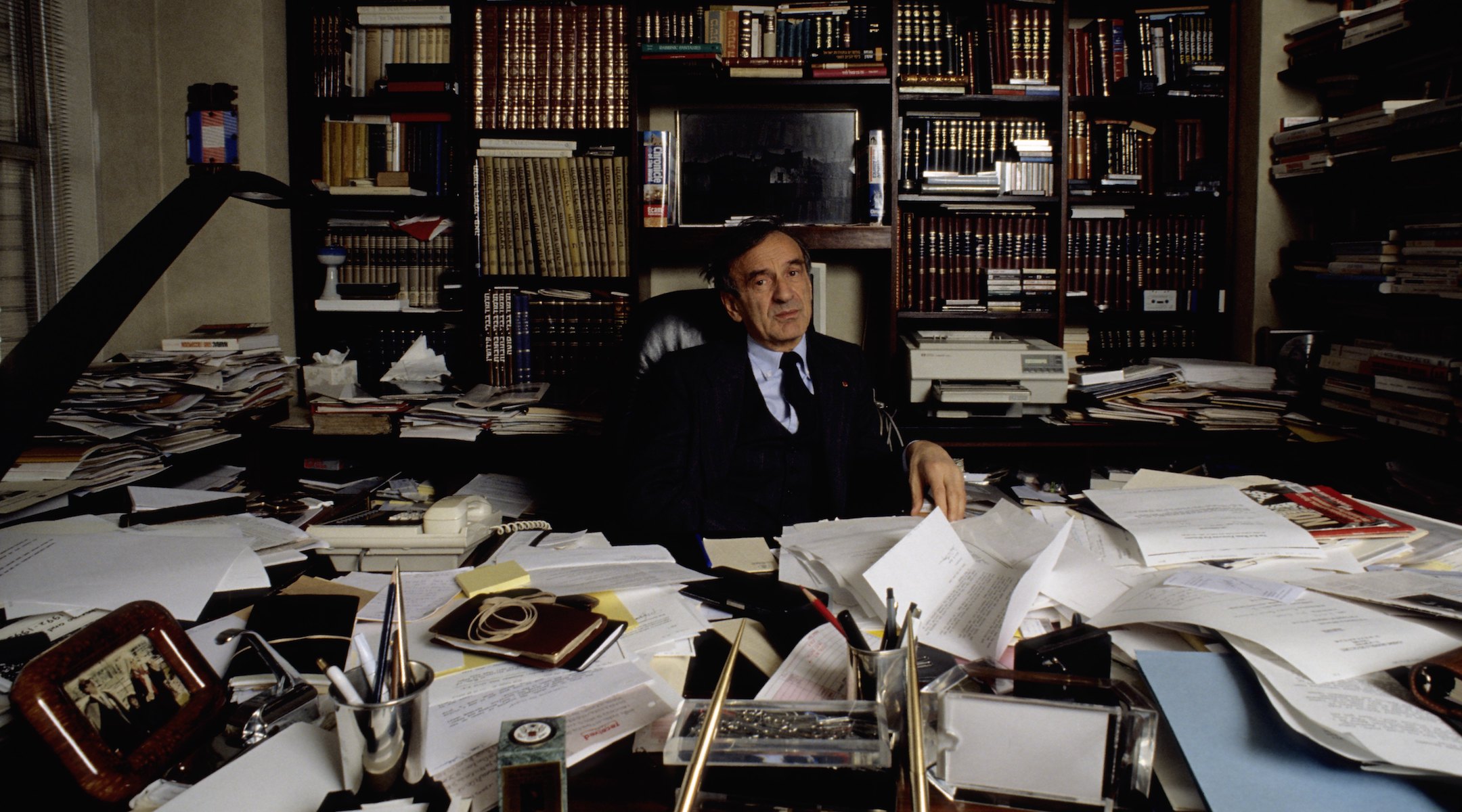
Political activist and writer Elie Wiesel on November 3, 1980 in New York, New York. (Santi Visalli/Getty Images)
(JTA) – A federal judge in Iowa has blocked much of a state law forbidding school libraries from stocking books depicting “sex acts,” in part because he said it was keeping a classic Holocaust memoir off shelves.
U.S. District Court Judge Stephen Locher granted a preliminary injunction against the law, Iowa Senate File 496, on Friday, just before a Jan. 1 deadline for schools to begin enforcing it. The “staggeringly broad” law, he wrote in his opinion, would prevent public schools from stocking “non-fiction history books about the Holocaust.” He pointed specifically to Elie Wiesel’s “Night” as an example of a book that could be caught in the dragnet.
Lochner had previously brought up “Night” during oral arguments about the Iowa law. At a Dec. 22 hearing, he grilled a state attorney about which kinds of books the state had the authority to pull from schools. Asked if Wiesel’s memoir could be pulled along with World War II history title “The Rape of Nanking,” the attorney responded that it could, the Des Moines Register reported at the time.
At that hearing, Locher called the law “one of the most bizarre laws I’ve ever read in my life.”
The injunction is temporary while Lochner considers the law and challenges against it more fully. Still, it represents a major blow to efforts by conservative legislators in Iowa to import a national effort to purge school libraries of books they consider inappropriate. The effort has focused on books about race and sexuality but has also led to books dealing with Judaism and the Holocaust being challenged or removed.
“Night” previously entered the book-ban debate when a Pennsylvania district forced a librarian to take down a poster featuring a Wiesel quote.
In Iowa, months-old local reports and Locher’s opinion indicated that “Night” was at one time removed from at least one Iowa public school district, although a regularly updated database of pulled books maintained by the Des Moines Register no longer lists the title.
Other Jewish books have also been affected by the law. “Maus,” Art Spiegelman’s graphic Holocaust memoir, was on the chopping block in at least one district along with Judy Blume’s “Are You There, God? It’s Me, Margaret,” before the school reversed course and put them back on shelves. According to the Des Moines Register, “Maus” remains banned at another Iowa district: Alta-Aurelia, in a rural northwest region of the state.
Iowa’s Republican governor, Kim Reynolds, signed SF 496 into law last year along with other culture-war legislation targeting transgender athletes and student pronouns in schools.
Locher’s ruling said that most parts of the law, including the provisions requiring schools to ban all books depicting a “sex act” and prohibiting instruction on gender identity and sexual orientation through the sixth grade, could not go into effect.
Two separate lawsuits challenging the law’s constitutionality will remain active in the meantime: One of them was brought by Penguin Random House and four bestselling authors, including Jodi Picoult, while the other was brought by LGBTQ students.
Challenges to similar laws are also winding through courts in Texas and Florida.
This article originally appeared on JTA.org.
Did you know that only 2% of Forward readers donate to support our nonprofit newsroom? That 2% make it possible for millions to read the Forward without a paywall or subscription — removing any barriers to the full and fair Jewish story.
But while the Forward is free to read, it isn’t free to produce. Big stories — like deep dives into the antisemitism data, political scoops or reporting trips to college campuses — take months of research and fact-checking. All while we keep you informed of what you need to know each day.
— Rachel Fishman Feddersen, Forward Publisher & CEO
Support our mission to tell the Jewish story fully and fairly.