Marvelous day for a moon dance? Eclipse parties, talks and trips at JCCs, synagogues
Rabbi says watching together will be ‘something joyous and celebratory’
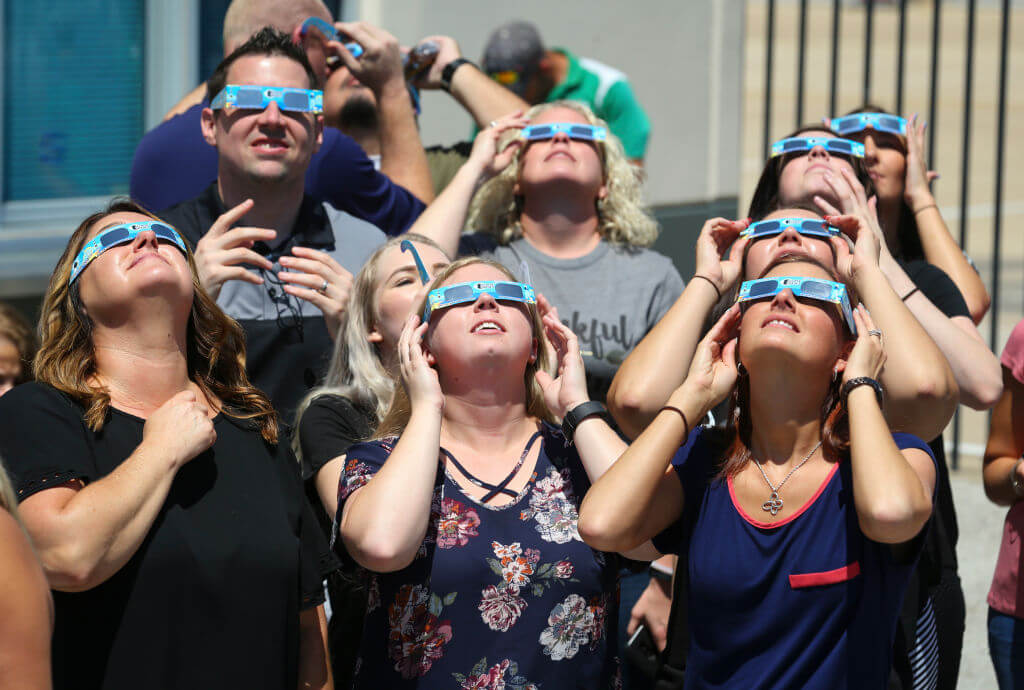
Watching the 2017 solar eclipse in Fort Worth, Texas. Photo by Richard Rodriguez/Getty Images
By Beth Harpaz April 1, 2024
A “silent-disco moon dance party,” field trips and talks by experts are among the activities planned by synagogues and JCCs around the country for Monday’s solar eclipse.
The moon dance, in which guests can move and groove together via headphones while listening to their choice of playlists, is being offered by a Jewish Community Center in Rochester, New York. The center’s other activities include a reading of Goodnight Moon, an eclipse puzzle and a craft table where you can decorate your eclipse glasses or build a rocket ship from straw.
Rochester is among many destinations that will experience total darkness when the moon crosses in front of the sun Monday afternoon. That darkness will last anywhere from a few seconds to 4 ½ minutes, depending on where the destination lies in the path of totality that will stretch across North America from Northern Maine to Mexico.
Temple Beth-El of Northern Westchester, in Chappaqua, New York, is not in the path of totality, but Rabbi Jonathan Jaffe came up with the idea of organizing a trip for synagogue members to a place that will experience total darkness. So they’ll be heading to Syracuse, 240 miles away in upstate New York, to experience the phenomenon there.
On the way up, Jaffe will lead a discussion about what the eclipse means in Jewish text and commentary. After all, darkness “is one of the 10 plagues and we’re on the eve of Passover,” Jaffe said in a phone call. “It’s seen as an ominous sign in a lot of rabbinic texts.”
It’s also just a great opportunity to bring people together. “We thought, let’s do something joyous and celebratory. We’re in deep need of it,” he said, adding that it appeals to every age group: “We’ve got empty nesters coming but also parents who are pulling their kids out of school.”
They’ll be hosted by a local synagogue, Temple Adath Yeshurun, where they can park the bus and use bathrooms. “So it’s another great example of this idea of peoplehood,” Jaffe said.
A JCC in Akron, Ohio, is advertising “Eclipsin’ at the J,” with food trucks, a “Moon Walk” bounce house, crafts, games and space-themed snacks and drinks. Meanwhile Beth Abraham Synagogue in Dayton, Ohio, is hosting an “Eclipse Spectacular,” with a kosher deli lunch and a talk by a member of a local astronomical society prior to the main event.
In Dallas, one of the cities where the eclipse will last the longest, Temple Emanu-El has dubbed itself “Totality Temple,” for a picnic and watch party. Rabbi Debra Robbins will offer a “teaching” called “A Jewish Spiritual Approach to a Solar Eclipse.” The event will conclude with a closing circle of gratitude and blessing.
The JCC in Indianapolis is also hosting a watch party called “Eclipse Day at the J.” “We love any reason to gather our community together,” said spokesperson Hanna Fogel, “so the eclipse is a perfect way to do that.”
Correction: An earlier version of this story misspelled the name of a Dallas synagogue. It is Temple Emanu-El.
It’s our birthday and we’re still celebrating!
We hope you appreciated this article. Before you go, we’d like to ask you to please support the Forward’s independent Jewish news.
This week we celebrate 129 years of the Forward. We’re proud of our origins as a Yiddish print publication serving Jewish immigrants. And we’re just as proud of what we’ve become today: A trusted source of Jewish news and opinion, available digitally to anyone in the world without paywalls or subscriptions.
We’ve helped five generations of American Jews make sense of the news and the world around them — and we aren’t slowing down any time soon.
As a nonprofit newsroom, reader donations make it possible for us to do this work. Support independent, agenda-free Jewish journalism and our board will match your gift in honor of our birthday!
Support our mission to tell the Jewish story fully and fairly.