German Holocaust reparations increase again this year, but plateau expected as survivors perish
The rising tally is driven by health care costs, not direct payments to survivors
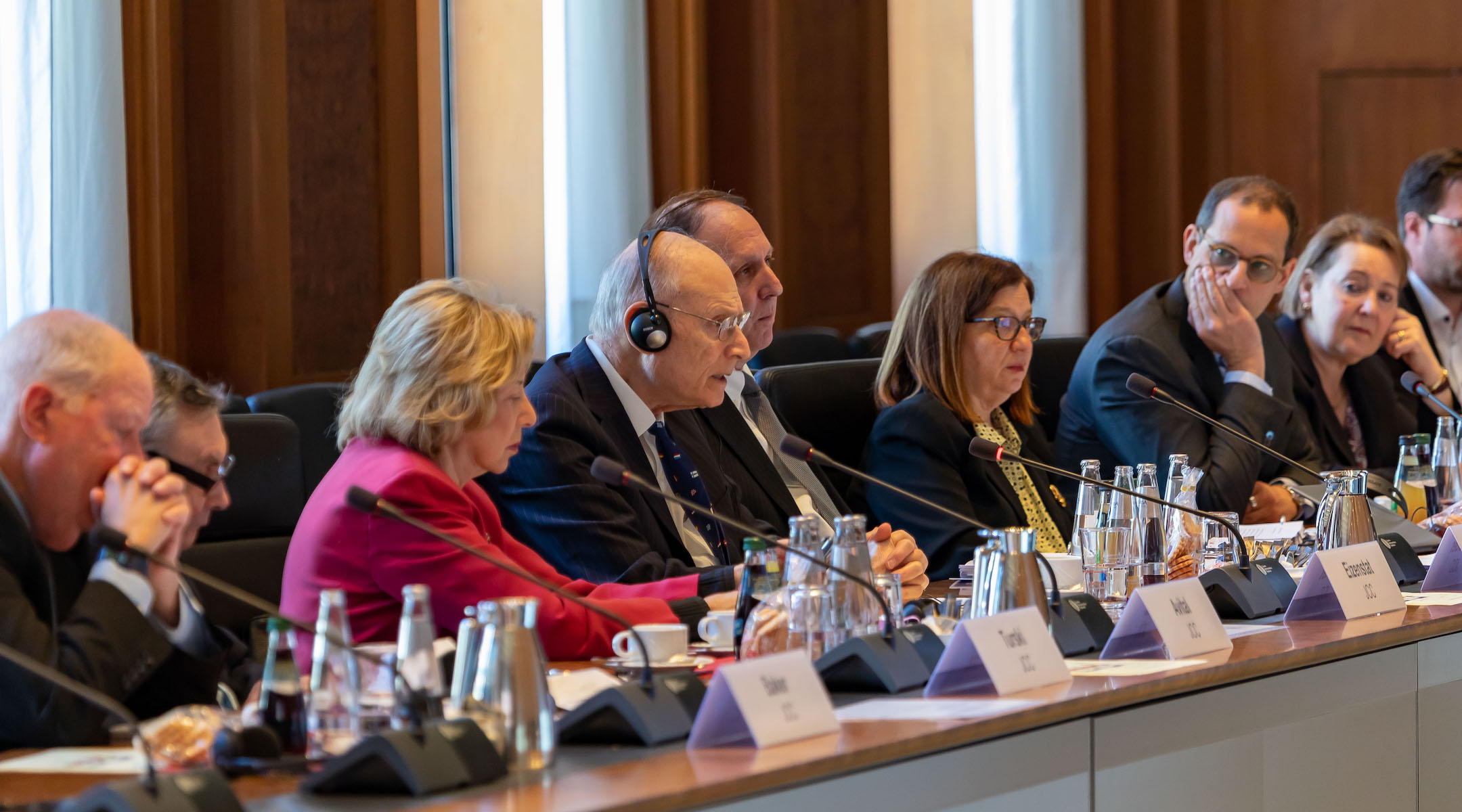
Claims Conference delegation for negotiations with the German government on behalf of Holocaust survivors in Berlin, Germany, May 8, 2023. (Courtesy of Claims Conference)
The German government has agreed to allocate $1.5 billion in Holocaust reparations this year, setting a new record for how much the country is spending to support survivors.
The increase from a total of $1.4 billion last year is due to a rise in the amount the government is paying to reimburse survivors’ medical expenses. But the sum paid directly to survivors has once again declined, reflecting the accelerating deaths of survivors.
And the growth in the total package is expected to end soon as the number of living survivors plummets, according to the Conference on Jewish Material Claims Against Germany, known as the Claims Conference, the group that negotiates reparations with the German government.
Earlier this year, the group said it had conducted a thorough review of remaining survivors, including those who have not received reparations through its efforts, and found that about 245,000 were alive, with the median age being 85.
“We have negotiated a huge increase because survivors need more help. More survivors are coming forward and they are getting older and more disabled,” Gregg Schneider, the Claims Conference’s executive vice president, wrote in an email. “However, sadly, we project these needs plateauing as the cruelty of mortality rates cannot be stopped. By 2026, the needs will level off.”
The $1.5 billion set aside this year is broken into three categories: $500 million in direct reparations, a decrease from last year; $972 million to support the care needs of an increasingly elderly cohort of survivors; and $40 million for Holocaust education.
The Claims Conference negotiated support for Holocaust education for the first time in 2022. That figure has quadrupled and the organization now says it has negotiated further increases in the amount allocated for Holocaust education through 2028. It expects that number to grow as other reparations spending falls.
“We recognize that the day when all of our firsthand witnesses are no longer with us is closing in,” Schneider said. “This gives more urgency to our work, not just negotiations, but Holocaust education and social campaigns that capture the testimony of survivors in a format that reaches younger generations more thoroughly.”
Efforts to overhaul Holocaust education, which has historically centered on first-person testimonies by survivors, are taking a range of new forms, including, increasingly, through virtual reality and AI-generated content.
This article originally appeared on JTA.org.
I’m personally matching all gifts to the Forward, up to $36,000. Can I match your gift now?

Hello, fellow Forward reader! I’m Joel Brown, a Forward reader and supporter for more than 15 years, and currently the chair of the board of directors.
I’m an avid Forward reader because it ticks so many of my essential boxes: excellent journalism, Jewish focus and diverse viewpoints. In today’s political climate, what I most appreciate is the Forward’s independence — made possible by the generosity of its membership.
The Forward is committed to bringing you unbiased, nuanced Jewish news. From my position as board chair, I see an exciting future as we expand our position as the definitive independent voice of contemporary American Judaism.
— Joel Brown, Forward board chair
Support our mission to tell the Jewish story fully and fairly.