Orthodox groups ask Supreme Court to hear case of Ohio man barred from hosting home prayer services
After opening his home to a group of men for Shabbat services, Daniel Grand was told he needed a permit to continue
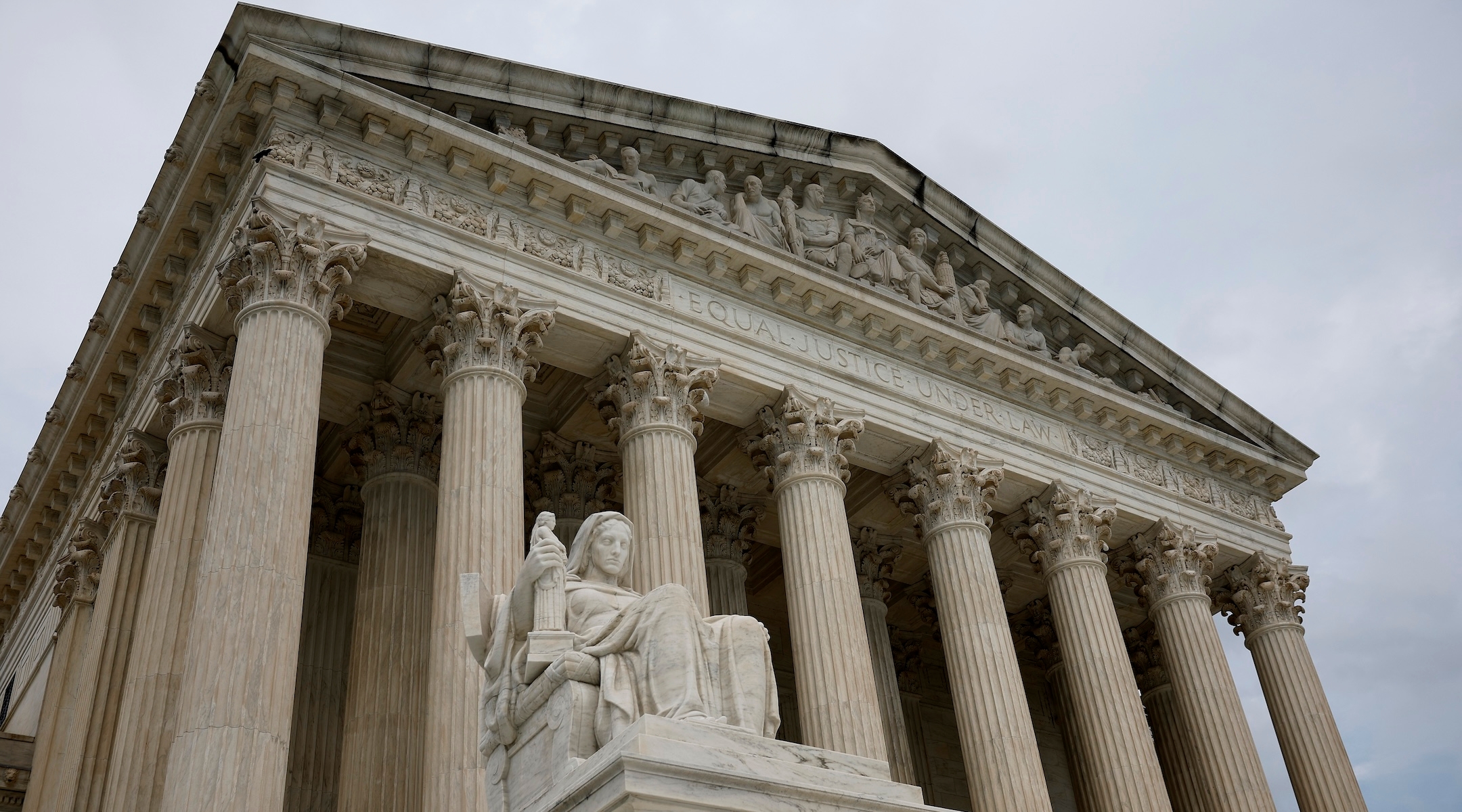
The U.S. Supreme Court in Washington, D.C., is pictured on July 30, 2024. Photo by Kevin Dietsch/Getty Images
(JTA) — Orthodox Jewish groups urged the Supreme Court to take up the case of an Orthodox Jewish man ordered by officials in University Heights, Ohio, to stop hosting prayer services in his home without a permit.
The amicus brief, which was filed Friday by the National Jewish Advocacy Center alongside the Orthodox Union and the National Council of Young Israel, comes years after Daniel Grand, a resident of the suburb of Cleveland, invited a group of Jewish men to his home for Shabbat services starting in January 2021.
At the time, University Heights, citing zoning laws, issued a cease-and-desist order blocking Grand from using his home for prayer.
Grand initially applied for a special use permit to use his home as “a place of religious assembly” in 2021, but later withdrew the application, saying he did not “wish to operate a house of worship as is defined under the zoning ordinance.”
According to the NJAC, the former mayor of University Heights, Michael Dylan Brennan, then encouraged Grand’s “neighbors to watch his home and report any sign of Jewish worship to the authorities.”
“What happened to Daniel Grand is not an isolated incident,” Rabbi Mark Goldfeder, the CEO of NJAC, said in a statement. “It is the latest chapter in a long and documented history of municipalities using zoning laws to suppress Orthodox Jewish religious practice.”
The city’s current mayor, Michele Weiss, who was elected last fall, told JTA that there was currently one residence in the city that had obtained a special permit to host worship gatherings and that another was currently in the middle of applying for one.
“My perspective is that everyone has a right to worship in their home with a small group of people (a minyan) without city involvement, just like a book club might do,” Weiss, who is the first female Orthodox Jewish mayor in the United States, wrote in an email to JTA. “If a congregation wants to worship in a residence with a proper congregation then each city should have a way forward through their planning commission.”
In September 2022, Grand filed a lawsuit against the city and Brennan, alleging that the former mayor was motivated by “animus against Orthodox Jews.” He maintained that the actions blocking him from conducting services in his home were part of a “systematic campaign” to prevent the Orthodox community from growing in University Heights, according to the Cleveland Jewish News.
In January, Weiss told JTA that University Heights’ Jewish community had grown a “tremendous amount” in recent years, and was the “largest Orthodox contingency of residents in the state of Ohio.”
Brennan, who was twice censured by the city council for “inappropriate language,” had previously faced criticism from the city’s Jewish community during his tenure. In November 2024, he drew backlash for criticizing voters in a heavily Jewish neighborhood who supported Donald Trump, and in April 2025, he accused the volunteer-run Jewish ambulance service Hatzalah of “jeopardizing public safety.”
In October 2024, the U.S. District Court of Northern Ohio ruled in favor of University Heights, and the Ohio 6th District Court of Appeals later upheld the ruling in November 2025.
A petition for Supreme Court review is currently pending, and a decision on whether it will be heard is expected in the coming months, according to NJAC.
“This case deserves Supreme Court review because, across the country, Jewish religious practice has repeatedly been constrained through the neutral application of rules in ways that disproportionately burden visible Jewish life,” David Benger, the litigation counsel at NJAC, said in a statement.

Hello, fellow Forward reader! I’m Joel Brown, a Forward reader and supporter for more than 15 years, and currently the chair of the board of directors.
I’m an avid Forward reader because it ticks so many of my essential boxes: excellent journalism, Jewish focus and diverse viewpoints. In today’s political climate, what I most appreciate is the Forward’s independence — made possible by the generosity of its membership.
The Forward is committed to bringing you unbiased, nuanced Jewish news. From my position as board chair, I see an exciting future as we expand our position as the definitive independent voice of contemporary American Judaism.
That’s why I’m paying it Forward, by matching $36,000 of reader gifts. It’s an investment in the Forward’s newsroom, to continue telling the American Jewish story with truth and independence.
— Joel Brown, Forward board chair
Support our mission to tell the Jewish story fully and fairly.