At Harvard antisemitism conference, Trump official defends ‘list of Jews’ legal strategy in Penn case
EEOC Chair Andrea Lucas said “there is no other way to protect victims.”
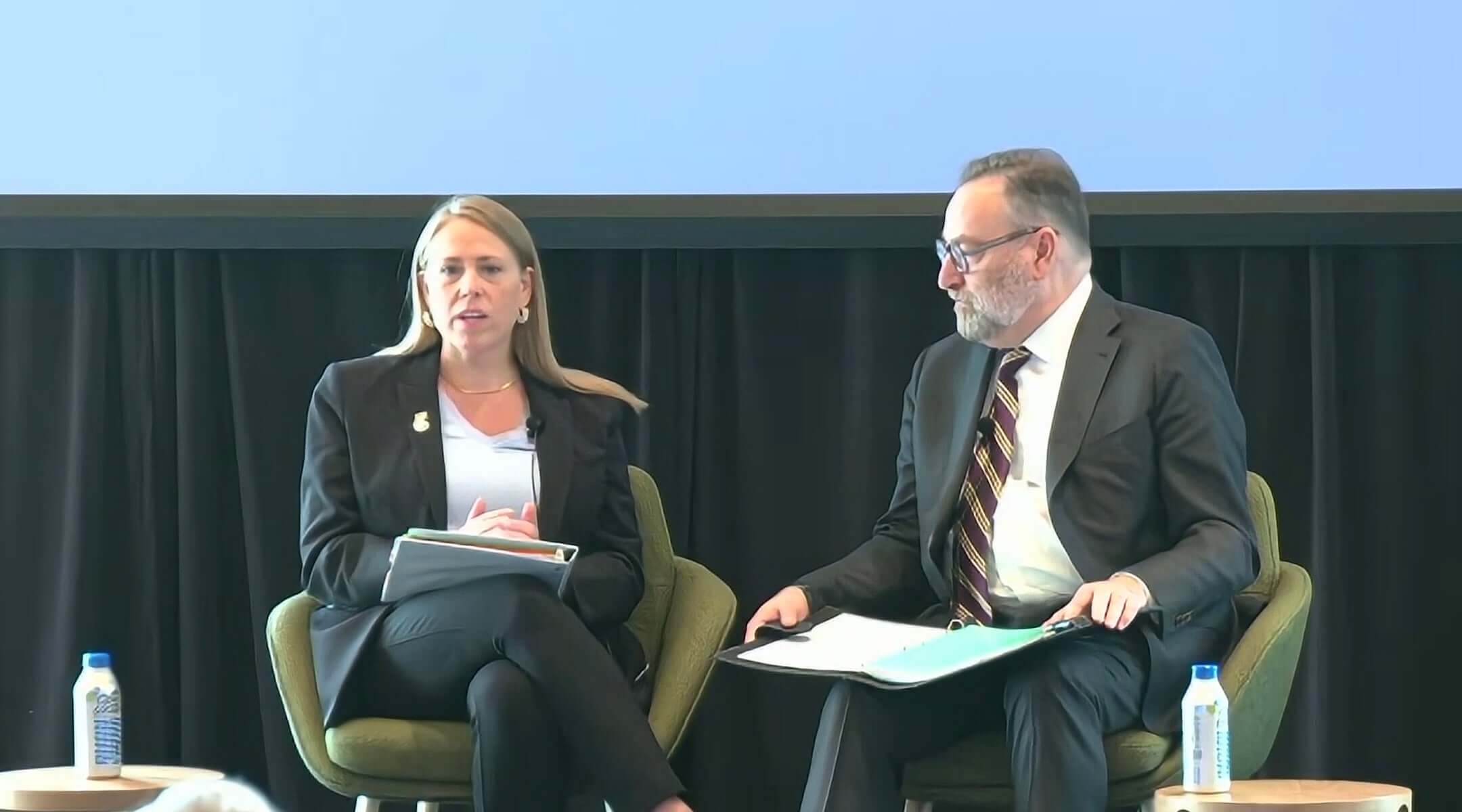
(L-r) Andrea Lucas, chair of the federal Equal Employment Opportunity Commission, speaks with Brandeis Center founder Kenneth Marcus at an antisemitism conference held at Harvard University in Cambridge, Massachusetts, April 16, 2026. (Screenshot)
(JTA) — The Trump administration official behind a controversial antisemitism probe at the University of Pennsylvania told an audience of Jewish leaders that her office’s demand for a list of Jews from the university was necessary for her to identify “potential victims.”
“There is no other way to protect victims of harassment or discrimination unless you collect information about them,” Andrea Lucas, chair of the U.S. Equal Employment Opportunity Commission, said at a conference on antisemitism and the law held at Harvard University.
As part of its investigation into antisemitism at Penn, the EEOC has demanded the Ivy League university produce a list of Jewish faculty, staff and students, along with personal identifying information. The school opposed the subpoena, saying the demand “raises serious privacy and First Amendment concerns,” but an Obama-appointed judge recently ruled that the Trump administration was within their rights to ask for such a list.
Penn has appealed the case and this week asked for a stay on the court order, which would otherwise require them to produce the list by May 1.
The case has drawn fierce opposition from Penn’s Jewish community, including its Hillel chapter, and beyond. Free-speech groups have also spoken out against the demand, though some Jewish groups have argued it is reasonable.
Lucas, who is not Jewish, said she couldn’t comment specifically on the Penn case due to ongoing litigation. Her representative did not respond to requests for an interview with the Jewish Telegraphic Agency following her talk.
But in broad terms she defended her office’s approach to antisemitism cases, claiming that for class-action employment harassment cases, any eventual payout would be dependent on having specific names of victims.
“At some point, either the government will know information about individuals related to their religion or we will not be able to enforce the laws on their behalf. I understand the sensitivities around this issue,” she told the crowd. “But fundamentally the Jewish community does have to decide: Do you want to have civil rights enforcement in this space?”
The conference was put on by the Brandeis Center for Human Rights Under Law, a legal group that frequently defends Jewish and pro-Israel college students. It was held at Harvard as part of the terms of a different antisemitism settlement between Harvard and the Brandeis Center, related to the university’s handling of pro-Palestinian activism after Oct. 7.
Attendees were a mix of representatives from umbrella Jewish groups, including Hillel International’s lead counsel; sympathetic Jewish university faculty; and strongly pro-Israel advocacy groups including the Lawfare Project and American Friends of Likud. William Daroff, the head of the Conference of Presidents of Major American Jewish Organizations, also spoke on a panel.
Lucas said she had to obtain information about “somebody’s affiliation with a religious organization” in order to determine potential payouts from any religious discrimination settlement her office might negotiate. She also claimed the list would give her a fuller picture of the victims.
“I have reason to believe there are victims there, but I may not know all of them. So there’s going to be information gathering,” she said, adding that the EEOC would do the same for Black complainants alleging discrimination.
The Brandeis Center’s founder Kenneth Marcus, himself a former Trump official, interviewed the chair onstage and praised her leadership of the office.
“I think that she has been a transformative chair of the EEOC, one of the most consequential civil rights enforcement officials that we have,” Marcus said of Lucas, who was nominated to the commission by Trump in 2020 and appointed as chair in 2025. The EEOC’s Penn case dates back to 2023, prior to Trump’s second term in office.
Not everybody in the audience agreed with Lucas’s arguments. Mark Rotenberg, general counsel of Hillel International, told JTA that Hillel echoed its Penn chapter’s concerns about the list.
“The government has many ways in which to ascertain the scope of the problem of antisemitism in higher education without forcing the universities themselves to create and disclose lists of Jews,” Rotenberg said shortly before appearing on another panel at the conference.
He added, “The idea that this topic, compiling lists of Jews, is just like compiling lists of women or something like that misses the important historical context in which Jews experience horrifying examples of being singled out by the government. And the Jewish experience with that is something that we believe the enforcement officials need to take into account when they choose the tools they use to deal with the terrible problem of campus antisemitism.”
Rotenberg said he wasn’t the only one in the room who differed with the EEOC chair on the issue. “I think people in the room were trying to be courteous to her and didn’t want to engage in an open debate with her on the merits of that,” he said.
Lucas did not directly address broader concerns from Jewish groups that “collection of Jews’ private information carries echoes of the very patterns that made Jewish communities vulnerable for centuries,” as Penn Hillel said earlier this year. Instead, she addressed perceived privacy issues.
“I can assure you, though, that we understand the concerns and we take our confidentiality duties very, very seriously,” she said.
The EEOC is also pursuing an antisemitism probe against the University of California. The agency’s work is separate from other federal campus antisemitism probes at the Department of Education and other agencies.
Under Lucas, the EEOC has been more aggressive in pursuing antisemitic workplace discrimination cases — a cause the chair said she felt compelled to because of her interest in religious liberty.
“For me, religious liberty is a core thing the EEOC needs to be focusing on,” she said. “And combatting antisemitism is, of course, an integral part of defending religious liberty.”

Hello, fellow Forward reader! I’m Joel Brown, a Forward reader and supporter for more than 15 years, and currently the chair of the board of directors.
I’m an avid Forward reader because it ticks so many of my essential boxes: excellent journalism, Jewish focus and diverse viewpoints. In today’s political climate, what I most appreciate is the Forward’s independence — made possible by the generosity of its membership.
The Forward is committed to bringing you unbiased, nuanced Jewish news. From my position as board chair, I see an exciting future as we expand our position as the definitive independent voice of contemporary American Judaism.
That’s why I’m paying it Forward, by matching $36,000 of reader gifts. It’s an investment in the Forward’s newsroom, to continue telling the American Jewish story with truth and independence.
— Joel Brown, Forward board chair
Support our mission to tell the Jewish story fully and fairly.