Jewish Theological Seminary names campus innovator Rabbi Mike Uram as next chancellor
The former executive director of Penn Hillel says he wants to expand the Conservative movement flagship’s influence as a representative of the “muscular middle.”
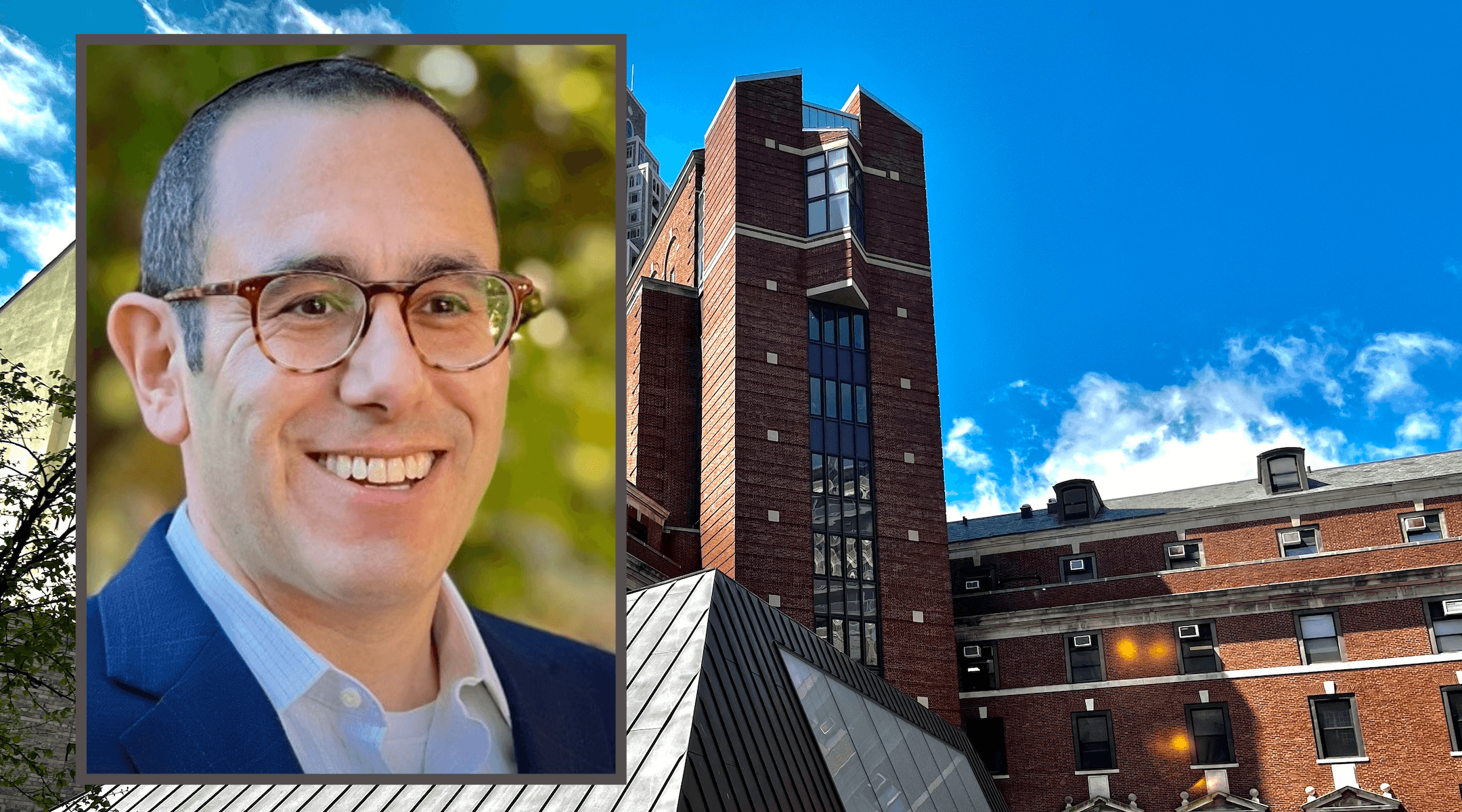
Rabbi Mikę Uram has been tapped to become the ninth chancellor of the Jewish Theological Seminary, seen at rear. Courtesy of JTS; background JTA

By Andrew Silow-Carroll April 30, 2026
(JTA) — The Jewish Theological Seminary has named Rabbi Mike Uram as its next chancellor, elevating a Jewish educator best known for his time as executive director of the University of Pennsylvania Hillel to lead Conservative Judaism’s flagship university and rabbinical school.
Uram, 49, will succeed Shuly Rubin Schwartz, who is stepping down at the end of the 2025-26 academic year and will become chancellor emerita.
Ordained at JTS in 2005, Uram currently serves as the first chief Jewish learning officer at the Jewish Federations of North America. He previously spent more than 16 years at the Penn Hillel, where he rose from campus rabbi to executive director and built a national reputation for his ideas on encouraging young Jews to take part in Jewish life. He left Hillel in 2020 to lead Pardes North America, a branch of the egalitarian yeshiva in Jerusalem whose alumni often go on to enroll in rabbinical schools.
In a statement to the JTS community, Alan Levine, who chairs its board of trustees, described Uram as “the right person to help JTS meet this important moment.”
“He brings to our institution a rabbinic voice, a connection to a new generation of current and emerging Jewish leaders, and deep experience serving the broader Jewish community that we need to engage as part of the vital center,” wrote Levine.
His selection marks a notable departure for JTS, which historically has been led by scholars or academics. Uram, who does not have a PhD, did not grow up in the Conservative movement and has not served in a long-term congregational pulpit, called it a “bold move to hire someone who is outside of the molds.”
But in an interview with the Jewish Telegraphic Agency this week, Uram described his novel background as his strength. He pointed to his experiences in higher education, fundraising at both Hillel and JFNA, and in settings where he gained an understanding of “the dynamics of the larger Jewish ecosystem outside of Jewish denominations.”
He also spoke of his signature initiative at Penn, the “Jewish Renaissance Project,” which aimed to reach students who might not otherwise walk into a Hillel building.
“In the process of building that, we more than tripled Penn Hillel’s budget through new fundraising, and we more than doubled the number of students that we were engaging each year,” said Uram. Uram drew on his experience at Penn in his 2016 book, “Next Generation Judaism: How College Students and Hillel Can Help Reinvent Jewish Organizations.”
He has similar ambitions for JTS, both in adding new donors and extending JTA’s reach beyond its walls.
“The idea is that we can both continue to do the things that have made JTS the leading Jewish academic institution for the past 140 years, and open up the power of JTS’s approach to study and religion and community and values to a much larger audience across North America,” said Uram.
At a farewell event Monday night honoring Schwartz, speakers praised her efforts to improve the “pipeline” for incoming clergy, whose ranks had dipped in recent years. The results have been promising: 2025 has seen 23 entering rabbinical and cantorial students, compared to 16 in 2024.
Uram praised those efforts, while emphasizing that JTS is more than a rabbinical and cantorial school.
“People do think of JTS as just a seminary, but it has been built into something much more than that for a long time,” he said, pointing to its undergraduate programs and graduate schools in Jewish education, thought, rabbinic literature and philosophy. Under Schwartz, JTS launched new academic programs, including degrees in creative writing, spiritual care and executive leadership, and expanded online learning.
He described the institution as “a deep R&D department for advancing Jewish knowledge and accelerating that knowledge out into the world.”
That expansive vision is meant to reinvigorate a centrist movement whose membership has flattened while Orthodoxy and Reform, denominations to its right and left, have been growing. A number of prominent JTS rabbinic alumni have also chosen to establish synagogues and educational institutions that do not fly the Conservative banner.
Partially in response to this contraction, the seminary sold roughly $96 million in Manhattan real estate in 2016 to help fund a major campus redevelopment, a project that ultimately replaced its historic library building with a smaller facility and shifted large portions of its famed Judaica collection to off-site storage. In 2021, JTS quietly deaccessioned and sold rare manuscripts and books from its library.
Uram is confident that despite structural pressures facing JTS and the Conservative movement, the institution can preserve its scholarly stature and moral authority while expanding its audience, rebuilding leadership pipelines and persuading a new generation that a legacy institution can still serve as a central address for Jewish learning and life.
For years, he said, the movement has been “stuck in trying to figure out how much it wants to hold onto and how it wants to change.” Now, he argued, the question the movement should be asking is “not about how do we restore the good old days, but what is the Jewish future that we want to build?”
He sees Conservative Judaism’s centrism as a counterweight, even an antidote, to a broader social and political trend toward polarization.
“It’s not surprising that it has lost market share, because we’ve been living in a time where the middle has dropped out,” said Uram, who grew up attending a Reform synagogue in suburban Cleveland.
“We’re living in this moment of incredible political polarization. People are moving more into these echo chambers,” he added. What is needed, he said, is what he calls “the muscular middle” — a space that “has to reject simplicity in favor of complexity.”
He also believes JTS can respond to a Jewish community deeply affected by the Oct. 7, 2023, attack on Israel and its aftermath, which, he said, “forced many Jewish folks to reexamine their assumptions about their own Jewish identities.”
In that environment, he said, “there’s a huge hunger to deepen a relationship with Judaism” and “to vanquish imposter syndrome and Jewish insecurity.”
He argued that JTS is uniquely positioned to respond by offering “deep and authentic” Jewish learning that remains broadly accessible.
Although his tenure at Penn Hillel predated the post-Oct. 7 turmoil on college campuses, he earned praise — and a “Forward 50” designation from the Jewish newspaper — for encouraging quiet, student-led responses to the growing campus movement to boycott Israel. His approach stood in contrast to the more aggressive legal challenges and “name and shame” tactics deployed by outside campus groups
As chancellor, Uram said, he will make clear that engagement with Israel will remain central to JTS’s mission and its training of clergy. Asked if he would draw any red lines for current or prospective students, Uram said that a Jewish education — for the rabbinate, academia or the Jewish classroom — would be incomplete without understanding what has become the world’s largest Jewish community and the first expression of Jewish self-determination in the Land of Israel in millennia.
“Any student who’s coming to JTS has the opportunity and really the obligation to engage deeply in the broadest set of expressions of all things Jewish,” he said. “I can’t imagine a scenario where a JTS education would not include serious engagement with all things related to Israel.”
Asked what message his hiring sends to the broader Jewish world, Uram referred to his track record.
“I think the statement that JTS is making is that it is in an incredibly strong position, and that it’s the right time to hire someone whose background is as an innovator who was a creative and successful fundraiser,” he said, “and someone who has real experience leading a Jewish nonprofit in building a productive culture and navigating political difficulties.”
This article originally appeared on JTA.org.
I’m personally matching all gifts to the Forward, up to $36,000. Can I match your gift now?

Hello, fellow Forward reader! I’m Joel Brown, a Forward reader and supporter for more than 15 years, and currently the chair of the board of directors.
I’m an avid Forward reader because it ticks so many of my essential boxes: excellent journalism, Jewish focus and diverse viewpoints. In today’s political climate, what I most appreciate is the Forward’s independence — made possible by the generosity of its membership.
The Forward is committed to bringing you unbiased, nuanced Jewish news. From my position as board chair, I see an exciting future as we expand our position as the definitive independent voice of contemporary American Judaism.
— Joel Brown, Forward board chair
Support our mission to tell the Jewish story fully and fairly.